Archive | July, 2013

Our Chains Are Forged By Usury

31 Jul

Cross-posted from Forbidden News, this article by Anthony Migchels, inventor of the Netherlands’ “Gelre” alternate currency, and author of the Real Currencies blog:
usury

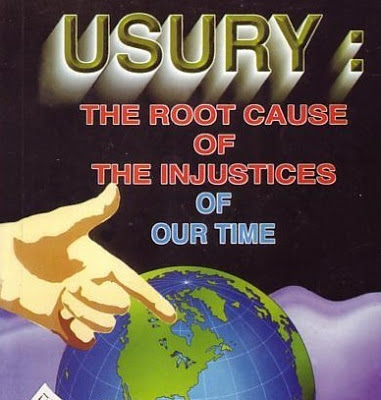
Usury is the original sin and the root cause of all our economic and political problems.

The truth is we have everything we need to create an interest-free money supply. An usury-free economy ends poverty and saves our souls in the process.

The love of money is the root of all evils. Usury is the weaponization of money love. It feeds the avarice of the usurer. It forces ever more debtors into ever more immoral behavior. It replaces love with commerce. It corrupts commerce, which becomes ever more exploitative. It rips apart the fabric of society and makes a mockery of any kind of social contract.

Billions of people live in abject poverty all over the world because of it. Entire communities, nations are gutted to pay the interest to the opulent. Nobody counts the billions dying prematurely from its effects.

Poor countries pay ten times more interest on their foreign debts than they receive development aid.

Even when not in debt, forty percent of our income is lost to interest passed on in prices by producers. The many pay anywhere between five and ten trillion per year to the wealthy. All other rents ultimately are based on cost for capital and would hardly exist without usury.

It is the ultimate centralizer of power and it is global. It has been growing at a compound interest rate for centuries, and now this incredible cancer is ready to devour the host body.

The European nations put up $4.5 trillion in handouts, easy credit and guarantees to ‘save’ their banks and the euro. The Fed provided an unimaginable $16 trillion dollars in easy credit to its banking buddies. Much of it was never repaid. This is ‘necessary’ because without banks we would not have money. So the West put up $20 trillion to have some bits and bytes and paper and coins circulate to exchange goods and services.

Surely the end of our civilization is near when we allow such rapacious plunder while there is no money to save the poor from starvation and the Earth from pollution.
evil_bankers_usury

SENSELESS

We think: “without interest there will be no credit! I would not lend if I didn’t get anything back.”

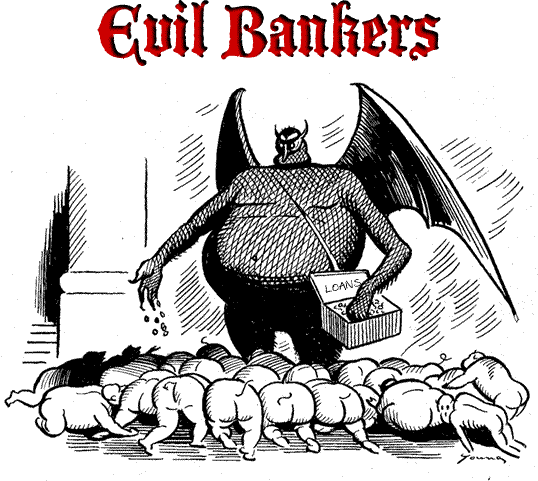
But the Money Power doesn’t lend anything!

Money is just bookkeeping and credit is an automatic result of double entry bookkeeping, which by its very nature knows debit and credit.

The problem is not the creation of money! Quite the opposite: it’s marvelous that we never need to have a shortage of money.

The problem is when the bookkeeper starts raping the debitor with interest for no other reason than the associated minus. And takes all this interest himself. Just for the service of bookkeeping!

We pay $300k in interest in thirty years for our $200k mortgage which was created by entering some numbers in a computer bookkeeping application!

GOLD SOLVES NOTHING

We don’t want to pay $300k interest in coin! We want bookkeeping at cost-price! Interest-free!

Even in ancient times Gold and Silver were circulated by private parties. This is touted as a wonderful free market operation. But who circulated the specie? Those owning the mines, of course!

They circulated the metal by lending it out at interest and manipulated the volume from day one.

Today, nobody knows how much Gold there is. All the Gold mines are owned and controlled by the Money Power. Those owning the mines are the Money Power, that’s how it all started. Vast amounts of Gold are in their vaults, ready to be unleashed onto the market through usurious lending, aiming to create asset bubbles, only to stop lending a little later to create a deflationary crash when people pay off their loans.

It is exactly the same way they create the boom-bust cycle with paper based money.

Just look at what they are doing to Gold today. They have been doing this forever.

The Golden Calf is the archetypal symbol of avarice; the Money Power is unthinkable without it.

WE WANT INTEREST-FREE MONEY
temple1

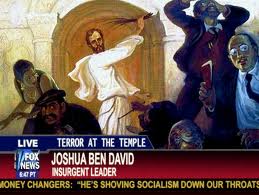
Jesus admonished us to lend freely, expecting nothing in return. The Vedas abhor usury. Moses forbade it. Half of the Q’uran is Allah threatening severe punishment for those taking Usury.

Money is bookkeeping. We don’t need interest for savers. The bank doesn’t need savers. Debit and Credit are the two sides of the coin in bookkeeping. They are automatic.

Yes, the volume must be managed, but that is unavoidable. No monetary system can exist without managing volume. The problem is not management; it is allowing vultures to do it.

The reason we have a boom-bust cycle is because we allowed private parties, banks, to manage the volume in their own interest. They set up Central Banks to create the illusion of ‘officialdom’.

Saying ‘the market must do it’ is saying the Plutocracy has been doing a good job over the last 5000 years.

We want interest-free mortgages, no income tax, no poverty. We want abundance, good will, a cultural rebirth, fairness and an end to Plutocracy.

Kill Usury!

 

Ho Lee Fuk – TV News Anchor Seriously Beclowned

30 Jul

I mean, really, dear reader.

Do you trust anything the mainstream media tells you?

Really?

Then perhaps you are almost as much of a “useful idiot” as they are:

Er …

Turn off your TV:

NEVER watch television:

Spain Introduces Sunlight Tax

28 Jul

5pxjxy34-1345099630

Are you one of those millions of “useful idiots” who believe that our elites really, truly want to reduce CO2 emissions, to “save the planet” from “man-made global warming”?

Ask yourself WHY then, why they would try to stop you from privately harnessing the energy of the sun for yourself and your family — CO2 emissions-free — by introducing a sunlight tax, designed to “encourage” (ie, force) you to use the state-“sponsored” — make that, privatised, international banker-financed — energy providers instead.

From Mike Shedlock’s “Mish’s Global Economics”:

Spain Levies Consumption Tax On Sunlight

Proving that idiocy truly has no bounds, Spain issued a “royal decree” taxing sunlight gatherers. The state threatens fines as much as 30 million euros for those who illegally gather sunlight without paying a tax.

The tax is just enough to make sure that homeowners cannot gather and store solar energy cheaper than state-sponsored providers.

Via Mish-modified Google Translate from Energias Renovables, please consider Photovoltaic Sector, Stunned

The Secretary of State for Energy, Alberto Nadal, signed a draft royal decree in which consumption taxes are levied on those who want to start solar power systems on their rooftops. The tax, labeled a “backup toll” is high enough to ensure that it will be cheaper to keep buying energy from current providers.

Spain Privatizes the Sun

Via Google translate from El Pais, please consider Spain Privatizes The Sun

If you get caught collecting photons of sunlight for your own use, you can be fined as much as 30 million euros.

If you were thinking the best energy option was to buy some solar panels that were down 80% in price, you can forget about it.

“Of all the possible scenarios, this is the worst,” said José Donoso, president of the Spanish Photovoltaic Union (UNEF), which represents 85% of the sector’s activity.

Before the decree it took 12 years to recover the investment in a residential installation of 2.4 kilowatts of power. Following the decree, it will take an additional 23 years according to estimates by UNEF.

Petition of the Candle Makers Revisited

And so the “Petition of the Candle Makers” comes to pass.

I have written about the “petition” on many occasions, but here is the latest reference: Extremely Difficult to Keep Up With Economic Stupidity

Reflections on “Unfair Competition”

Corporations always consider it “unfair” when any other company can do things faster, smarter, or cheaper than they can. The buggy whip industry once protested cars.

Today, land-line telecom companies have to compete with wireless and they don’t like it. Now, we see protests about VOIP (voice over internet protocol).

Technology marches on. But France does not like it. The French solution is to tax Skype because it has an “unfair advantage“.

This is an age-old unwinnable argument.

Petition of the Candle Makers

The ultimate irony is France’s preposterous “unfair advantage” argument was lampooned by French economist Frederic Bastiat back in 1845 when he penned ‘Petition of the Candle Makers‘.

In his article, candle makers were incensed that the light of the sun could be had for free. The sun’s unfair trade advantage was to the “detriment of fair industries” who could not compete against the sun’s price.

Something had to be done to “shut off as much as possible, all access to natural light, and thereby create a need for artificial light” so that “industry in France will encouraged”.

The moral to this story is “Don’t propose something purposefully stupid hoping to make a point. Some idiot might actually think it’s a good idea and do it”.

Mike “Mish” Shedlock


Mike Shedlock and others are wrong to mock this as simple greed and idiocy.

Because it is symptomatic of something far more evil, planned, and pervasive.

Every mainstream “issue” — like “man-made global warming” — is really all about something other than what you see, at “face value”.

It is really all about Money. And far more importantly, Control.

More and more of both, for the international banker class.

And less and less for you.

Know Your Real Enemy.


Climate Deception Exposed: The North Pole Ice Melt Video Scare

28 Jul

original

A so-called time-lapse video of still photos, first published by The Atlantic, then feverishly republished by the Huffington Post, has been making waves around the world.

With the gullible, and the intellectually lax — I can be no more polite than that.

It purports to prove that man-made global warming is real, and getting worse, because “North Pole Melting Leaves Small Lake At The Top Of The World.”

It is a blatant deception.

By the (international banker-owned) media.

How so?

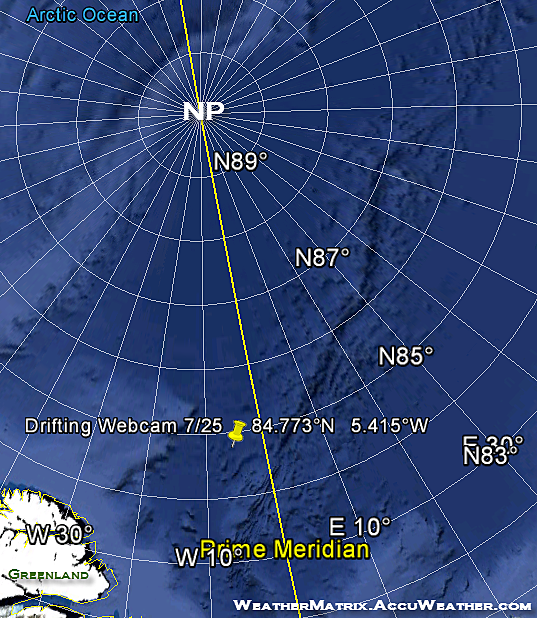
The webcams from which the images were taken are actually located some 350 miles south of the north pole. As exposed by AccuWeather.com:

Did the media just prove North Pole is NOT melting?

UPDATE: I received a reply via email from Roger Anderson, who is one of the webcam scientists at the University of Washington. I had asked him if the media was using the webcams that were NOT at the North Pole, but rather drifting southward. He replied: “Yes, they are. The approximate position of the webcams today (obtained from PAWS Buoy 819920) is 07/25/1500Z 84.773°N 5.415°W.” This is even further south than I had placed the buoy, because the data I had was one week old. This puts the webcam at approximately 350 miles south of the North Pole, closer to Greenland than Santa Claus! So no worries, folks, the North Pole is not melting.

537x618_07260944_buoyfiknal

UPDATE: I just found another Atlantic article that quotes one of the webcam scientists, who doesn’t address the location issue but says this is “not the first time scientists have observed a melt pond at the North Pole, nor is it the largest.”

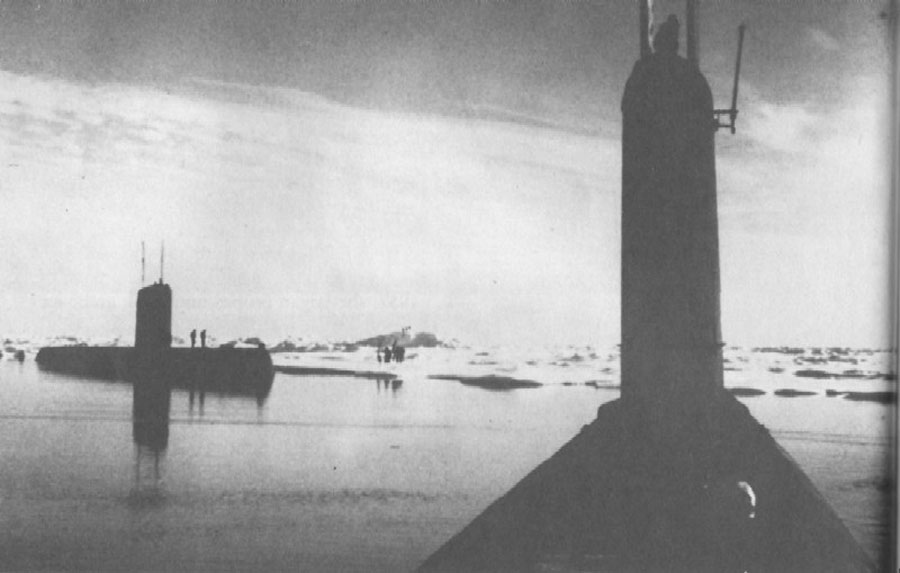
Then there’s the inconvenient truth that the ice sheet in the Arctic is not solid, it is packed ice floes, and that “lakes” and at times, open ocean, have often appeared at the actual North Pole. Indeed, they have been one of the hazards of over-the-ice travel to the North Pole from the beginning of European and American polar exploration. There is lots of photographic proof of this, as far back as the 1960’s (from navsource):

"Seadragon (SSN-584), foreground, and her sister Skate (SSN-578) during a rendezvous at the North Pole in August 1962. Note the men on the ice beyond the submarines"

“Seadragon (SSN-584), foreground, and her sister Skate (SSN-578) during a rendezvous at the North Pole in August 1962. Note the men on the ice beyond the submarines”

Of course, you can be certain that all those Chicken Littles shrieking and panicking and sharing that oh so scary video, have not once paused to question whether it is truth or fiction.

These people vote.

These people are the international usurers’ best friends.

“Useful idiots”, I believe is the phrase they use.

If You Don’t Support An ETS, You Are “Ungodly”: Rudd

28 Jul

Ring of Solomon 01

Two standout observations, for mine, regarding today’s Kevin Rudd interview on Channel Ten’s ‘The Bolt Report’.

First, Rudd’s defence of his failed border protection policy introduced in 2007 was to, in essence, blame the Australian people. How so? By pointing out that we are a “democracy”, and arguing that he was following the “democratic mandate” given by the people at the 2007 election.

Apparently, his designing and spruiking of that policy as a reason to vote for him, before and after the 2007 election, is irrelevant. If enough people were stupid enough to vote for the ALP based on that policy, then its failure is the peoples’ fault.

Second, in defending his planned move to an ETS ahead of schedule, Rudd argued that the reason an ETS failed to be legislated much earlier (in 2009), was due to “an ungodly cabal” of conservatives and the Greens.

Apparently, if you do not support CO2 emissions trading, you are “ungodly”.

Makes one wonder which “god” Rudd serves.

And reminds one of Goldman Sachs CEO Lloyd Blankfein’s claim, that bankers are “doing god’s work“.

Videos of the interview will be available here.

See also:

Scrap The ETS: Growing Global Movement Calls On EU To Abolish “Major Obstacle” To Emissions Reduction

EU ETS Myths Busted As Carbon Price Collapses; “Should Not Be Replicated”

TIME: Carbon Markets May Be Finished

Infographic: Visualising The Size Of Australia’s Carbon Derivatives Time Bomb

The Financialisation Of Nature

UPDATE:

From the transcript –

ANDREW BOLT: They’re snowing you, Prime Minister. To finish off, in 2007, Labor under you promised to turn back the boats. It promised to stop reckless spending. In 2010 Julia Gillard promised no carbon tax, and a budget surplus. This year all of those promises and a lot more were broken. What are you going to do to make people trust your promises now?

KEVIN RUDD: The first thing I would say is that climate change, building on where we’ve just been in this discussion, is real. It requires action, putting a price on carbon. What I put forward was a floating price way back when – rejected by an ungodly cabal of the Liberals and the Greens. And subsequently, Julia Gillard at the beginning of the last parliamentary term – or this parliamentary term.

The Rich “And Everyone Else” – Citigroup Global Strategist

27 Jul

“The earth is being held up by the muscular arms of its entrepreneur-plutocrats, like it, or not.”

– Citigroup ‘Plutonomy’ memos, 2005

“A plutonomy is a form of capitalism that is designed to make the rich who control a nation’s government and its economy—aka, the plutocrats—even richer.”

– Rational Wiki

Here is the result of the creeping cancer of usury — the root of capital-ism — and the usurer class.

As told by one of their own — a “global strategist”, for Citigroup.

From the Wall Street Journal, 2007 (my emphasis added):

It’s well known that the rich have an outsized influence on the economy.

The nation’s top 1% of households own more than half the nation’s stocks, according to the Federal Reserve. They also control more than $16 trillion in wealth — more than the bottom 90%.

Yet a new body of research from Citigroup suggests that the rich have other, more-surprising impacts on the economy.

Ajay Kapur, global strategist at Citigroup, and his research team came up with the term “Plutonomy” in 2005 to describe a country that is defined by massive income and wealth inequality. According to their definition, the U.S. is a Plutonomy, along with the U.K., Canada and Australia.

In a series of research notes over the past year, Kapur and his team explained that Plutonomies have three basic characteristics.

1. They are all created by “disruptive technology-driven productivity gains, creative financial innovation, capitalist friendly cooperative governments, immigrants…the rule of law and patenting inventions. Often these wealth waves involve great complexity exploited best by the rich and educated of the time.”

2. There is no “average” consumer in Plutonomies. There is only the rich “and everyone else.” The rich account for a disproportionate chunk of the economy, while the non-rich account for “surprisingly small bites of the national pie.” Kapur estimates that in 2005, the richest 20% may have been responsible for 60% of total spending.

3. Plutonomies are likely to grow in the future, fed by capitalist-friendly governments, more technology-driven productivity and globalization.

Of course, Kapur says there are risks to the Plutonomy, including war, inflation, financial crises, the end of the technological revolution and populist political pressure. Yet he maintains that the “the rich are likely to keep getting even richer, and enjoy an even greater share of the wealth pie over the coming years.”

All of which means that, like it or not, inequality isn’t going away and may become even more pronounced in the coming years.

Little wonder then, that politicians who support “protectionism” of national sovereignty — Barnaby Joyce and Bob Katter spring to mind — are mocked, smeared, and pilloried in the media as “populists”.

That “immigration” is such a vexed issue — with the general public concerned about it, and politicians (despite their rhetoric) enabling it.

That “financial innovation” presses relentlessly onwards, aided and abetted by both “sides” of politics — think covered bonds (to prop up the banks’ debt-financed housing Ponzi scheme), “emissions” trading (a gigantic derivatives time bomb), and most recently, the Rudd government’s sole idea for “managing the economic transition”; to turn Australia into a “financial services centre” for the region:

Encouraging competition and efficiency would improve the range and choice of financial products available to consumers and promote increased exports of financial services.

…Labor knows that increased trade in financial services will increase Australia’s growth prospects and standard of living.

We know positioning Australia as a financial services centre in the region means that we would be able to offer increased job opportunities for a range of skilled workers in the financial sector.

For those with eyes to see, it is perfectly clear that both “sides” of Australian politics — and the Greens too — are simply puppets of the Plutonomy.

Citizens who vote for any of them are — whether they realise it or not — actually voting for their own continued enslavement, and, gradual destruction.

The following video featuring white collar criminologist William Black, is a must-watch:


Usury is the root of the plutocrats’ power.

It is their most powerful weapon.

Like cancer, it is a silent, invasive killer. One that consumes the living, healthy cells of its host.

To feed its own relentless “growth”.

Anyone talking “solutions” who is not talking about eliminating usury, is not worth listening to.

“There are a thousand hacking at the branches of evil to one striking at the root.”

– Henry David Thoreau


Brighter Ideas From Wikileaks Party Than All The Others Combined

26 Jul

With innovative thinking like this, they might get my Senate vote yet.

I wonder if Kevin Rudd has the first clue about the observation made by Assange concerning his PNG “solution”, right at the end.

Julian Assange speaks at Splendour In The Grass from WikiLeaksParty on Vimeo.

UPDATE: The Wikileaks Party website and Platform here. The policy of “standing up for national sovereignty” draws my eye, and applause.

IMF Says Rudd’s Depositor Guarantee Scheme “Increases Moral Hazard Greatly”

25 Jul

It’s yet another Rudd Labor disaster, just waiting to happen.

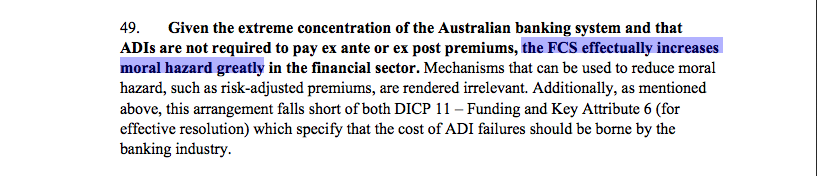
According to the IMF’s November 2012 technical note, Australia: Financial Safety Net and Crisis Management Framework, page 26, not only is there an “extreme concentration” in our banking system; the Financial Claims Scheme (FCS) introduced by the Rudd Government in 2008 “increases moral hazard greatly” –

Australia: Financial Safety Net and Crisis Management Framework. Source: IMF (click to enlarge)

Australia: Financial Safety Net and Crisis Management Framework. Source: IMF (click to enlarge)

Why so?

The IMF says that, unlike “most” similar schemes elsewhere, the Rudd scheme does not require the banks to make any contributions towards pre-funding of the guarantee. The responsibility for funding it, falls on the government. Meaning, the taxpayer.

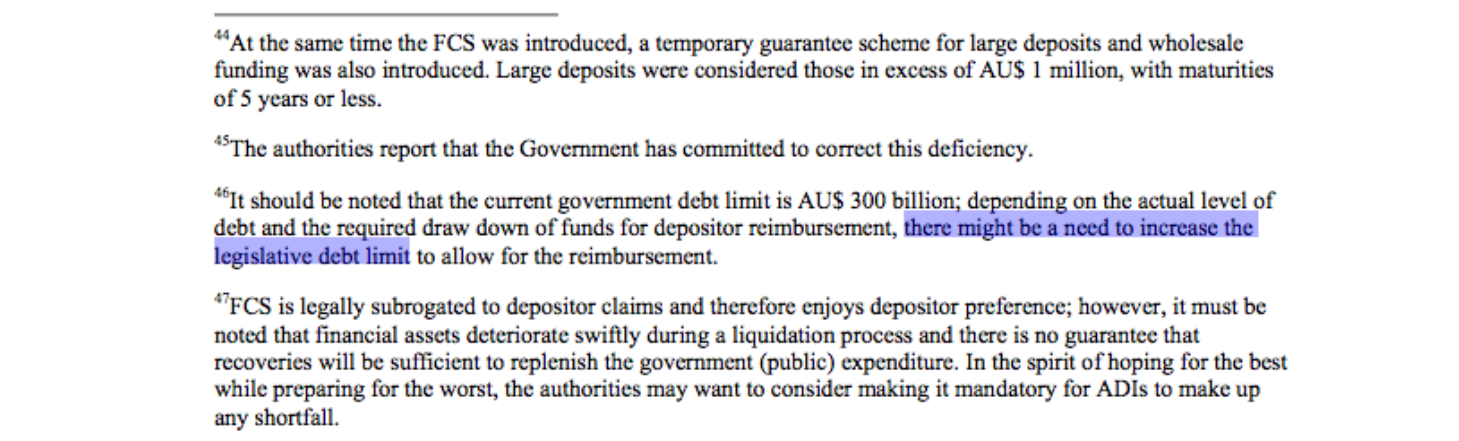
Indeed, the IMF points out that the government may need to increase the public debt limit above the present $300 billion ceiling, if payouts under the scheme became necessary –

Click to enlarge

Click to enlarge

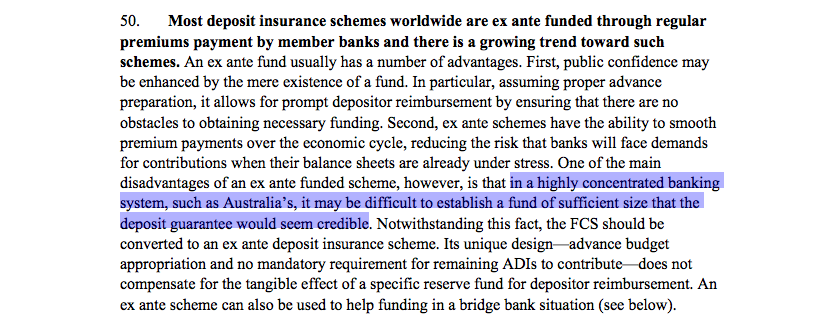
The IMF’s suggested solution to this “moral hazard” problem, is to make the banks pay “premiums” towards a “reserve fund” that could be used to support payouts under a depositor guarantee. However, the IMF also notes that even if a requirement for premium contributions was established, Australia’s banking system is so highly concentrated that “it may be difficult to establish a fund of sufficient size that the deposit guarantee would seem credible”

Click to enlarge

Click to enlarge

When you pause to carefully think this through, merely forcing the banks to pay a premium contribution towards a depositor claims reserve fund is really a rather ridiculous non-solution to the highlighted problem of moral hazard. It is analogous to charging an insurance premium for a policy that promises to pay for the ticket if the banker gets caught speeding –

121807_2025_MoralHazard2

We have recently seen the evidence in the Portfolio Budget Statements (page 134) for Budget 2013-14 that the government is now well-advanced in preparations for a Cyprus-style “bail-in” of our banks.

We have also seen the recent warning by Moodys ratings agency that our banking system has the world’s highest exposure to mortgages, and so is vulnerable to collapse if house prices fall.

Combine this with the IMF’s warning about Rudd Labor’s rushed and bungled depositor guarantee scheme that “increases moral hazard greatly”, and it is increasingly clear that I will soon have to redraft the debt trajectory chart on the masthead of this blog.

It only goes up to $300 billion.

See also:

The Bank Deposits Guarantee Is No Guarantee At All

Full Reserve Banking Advocates Are Myopic: Here’s Why

23 Jul

myopic-lasik

From central bank governors, to the IMF, to brilliant contrarian economists, to well-intentioned activist groups, there is a growing chorus of voices calling for an end to fractional reserve banking … or, more correctly, fractional reserve lending.

These voices are of those suffering from myopia.

Their complaint is this; that the root cause of the world’s ongoing economic ills is that, due to fractional reserve lending, private banks have been permitted to create too much “money” (debt) out of nothing, and lend it for profit.

Alas, they are only seeing what is immediately in front of their eyes.

The creation of “money” out of nothing, is only a lever.

Usury (ie, net interest income), is what is being lever-aged.

Consider the words of the National Australia Bank:

How Banks Work

…Their profit is the difference between what they pay in interest on your deposits and what you pay them in interest for the loan they made you.

Creating money — debt — out of nothing, does not make profits for bankers.

Charging interest on money (debt) created out of nothing, is what makes profits for bankers.

For those with full vision, the Big Picture is clear.

Every “solution” to the economic crisis that does not focus on the real problem — usury — is a short-sighted, and inevitably short-lived, non-solution.

4,500 years of recorded economic history prove it so.

See An Historical Warning For Proponents Of A Modern Debt Jubilee

New York Times: Keen Right, Bernanke Wrong

22 Jul
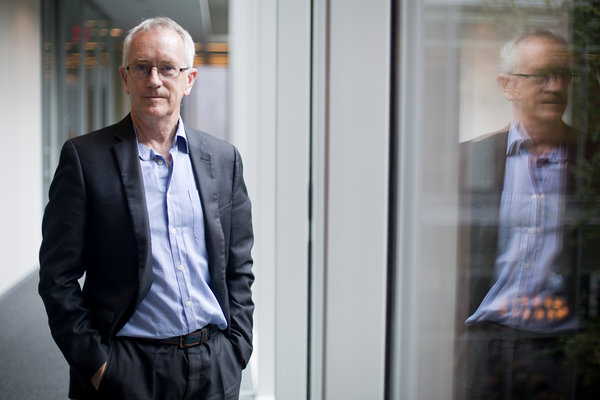
Steve Keen, an Australian economist, used the ideas of another economist, Hyman Minsky, to  set forth the possibility of a global debt crisis that now seems prescient. In a 2000 book,  Mr. Bernanke briefly mentioned, and dismissed, Mr. Minsky. (Source: Demetrius Freeman/New York Times)

Steve Keen, an Australian economist, used the ideas of another economist, Hyman Minsky, to set forth the possibility of a global debt crisis that now seems prescient. In a 2000 book, Mr. Bernanke briefly mentioned, and dismissed, Mr. Minsky. (Source: Demetrius Freeman/New York Times)

Oh dear.

What does it tell you — particularly about the gross misallocation (and mis-remuneration) of human intellectual resources — when the New York Times declares the most powerful central banker on the planet, US Federal Reserve chairman Ben Bernanke, to be fundamentally wrong, and a humble Aussie economist, (now unemployed) Associate Professor Steve Keen, to be fundamentally right:

For a time, the period before the collapse was known as the “Great Moderation,” a term that Mr. Bernanke helped to publicize in a 2004 speech. Low levels of inflation, long periods of economic growth and low levels of employment volatility were viewed as unquestioned proof of success.

And what brought on that success? In 2004, Mr. Bernanke, then a Fed governor, conceded good luck might have helped, but his view was that “improvements in monetary policy, though certainly not the only factor, have probably been an important source of the Great Moderation.”

In 2005, three Fed economists, Karen E. Dynan, Douglas W. Elmendorf and Daniel E. Sichel, proposed an additional explanation for the Great Moderation: the success of financial innovation.

“Improved assessment and pricing of risk, expanded lending to households without strong collateral, more widespread securitization of loans, and the development of markets for riskier corporate debt have enhanced the ability of households and businesses to borrow funds,” they wrote. “Greater use of credit could foster a reduction in economic volatility by lessening the sensitivity of household and business spending to downturns in income and cash flow.”

At least Mr. Bernanke’s hubris was not as great as that of Robert E. Lucas Jr., the Nobel Prize-winning University of Chicago economist. In 2003, he began his presidential address to the American Economic Association by proclaiming that macroeconomics “has succeeded: Its central problem of depression prevention has been solved.”

In his speech last week, Mr. Bernanke cited several assessments of the Great Moderation, including the one by the Fed economists. None questioned that it was wonderful.

The Fed chairman conceded that “one cannot look back at the Great Moderation today without asking whether the sustained economic stability of the period somehow promoted the excessive risk-taking that followed. The idea that this long period of calm lulled investors, financial firms and financial regulators into paying insufficient attention to building risks must have some truth in it.”

One economist who would have expected that development was Hyman Minsky. In 1995, the year before Minsky died, Steve Keen, an Australian economist, used his ideas to set forth a possibility that now seems prescient. It was published in The Journal of Post Keynesian Economics.

He suggested that lending standards would be gradually reduced, and asset prices would rise, as confidence grew that “the future is assured, and therefore that most investments will succeed.” Eventually, the income-earning ability of an asset would seem less important than the expected capital gains. Buyers would pay high prices and finance their purchases with ever-rising amounts of debt.

When something went wrong, an immediate need for liquidity would cause financiers to try to sell assets immediately. “The asset market becomes flooded,” Mr. Keen wrote, “and the euphoria becomes a panic, the boom becomes a slump.” Minsky argued that could end without disaster, if inflation bailed everyone out. But if it happened in a period of low inflation, it could feed upon itself and lead to depression.

“The chaotic dynamics explored in this paper,” Mr. Keen concluded, “should warn us against accepting a period of relative tranquillity in a capitalist economy as anything other than a lull before the storm.”

When I talked to Mr. Keen this week, he called my attention to the fact that Mr. Bernanke, in his 2000 book “Essays on the Great Depression,” briefly mentioned, and dismissed, both Minsky and Charles Kindleberger, author of the classic “Manias, Panics and Crashes.”

They had, Mr. Bernanke wrote, “argued for the inherent instability of the financial system but in doing so have had to depart from the assumption of rational economic behavior.” In a footnote, he added, “I do not deny the possible importance of irrationality in economic life; however it seems that the best research strategy is to push the rationality postulate as far as it will go.”

It seems to me that he had both Minsky and Kindleberger wrong. Their insight was that behavior that seems perfectly rational at the time can turn out to be destructive.

Design a site like this with WordPress.com
Get started