Tag Archives: wayne swan

Wayne: OOPS! I Did It Again

6 Aug

You see my problem is this:
I’m dreaming away;
Wishing that heroes, they truly exist.
I cry watching the days.
Can’t you see I’m a fool
In so many ways?
But to lose all my senses…
That is just so typically me.
Baby, oh.

Hands up all those who think yesterday’s bloodbath in global sharemarkets should inspire us with confidence that all is well here in the land of Oz?

Let’s see now … that’ll be Wayne … and his friend Glenn … oh yes, and their new mate Martin … noone else?

Interesting, is it not, how all the same clowns persist in repeating their same tired old lines.

Overwhelming weight of evidence to the contrary be damned.

Here’s our Treasurer Wayne Swan as quoted by AAP (via the Australian):

The Australian share market slumped around 4 per cent this morning following a similar drop on Wall Street over rising fears of another economic downturn and worries Europe’s debt problems will widen.

“Australians should never forget that our economic credentials are among the strongest in the developed world,” the treasurer said.

“Australia has a proven track record of dealing with global economic uncertainty.

Indeed we do.

But “a proven track record of dealing with global economic uncertainty”, and “a proven track record of dealing wisely with global economic uncertainty”, are two very different animals.

What is your track record, Wayne?

“The fact is the share market in Australia is not back to levels prior to the global financial crisis and now we’re being hit by another bout of uncertainty.”

Hold the phone!

I thought you’ve been tirelessly telling us just how well you brought Australia through the GFC?  Now you’re telling us the share market “is not back to levels prior to the GFC”? And it’s getting its a*** kicked again?

But but but … you had me believing that you were our Saviour, Wayne!

Please… say it ‘aint so!?

I think I did it again. I made you believe
We’re more than just friends.
Oh, baby;
It might seem like a crush,
But it doesn’t mean
That I’m serious.
‘Cause to lose all my senses…
That is just so typically me.
Oh, baby; baby.

I’m devastated!

Oh Wayne, I feel so used!!

What … what was that you said again?

Mr Swan insists Australia is in the right part of the world at the right time, as the Asia-Pacific economy remained strong.

Really?

Funny. That’s not what the latest RBA Chart Pack graphs suggest.

Here’s China and India:
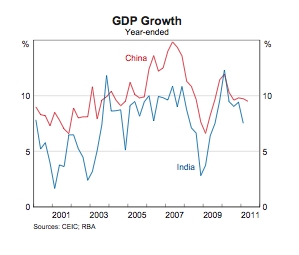
Looks to me like Chindia’s GDP growth has been on a downward slide since late 2009 / early 2010, Wayne.  Ever since their GFC Mk1 “stimulus” money began to dry up.  Seems they didn’t get any sustainable bang-for-their-stimulus-bucks either. Both of their economies are now running at lower rates of growth than 6 years ago Wayne … that’s 2005.

Oh look … here’s our second biggest trading partner, Japan:
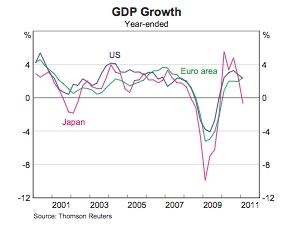
Oops.

Looks like Japan’s GFC “stimulus” can-kicking exercise has stopped rolling up the road too, Wayne. They’re back to 2001-02 levels of growth.

And our GDP growth chart looks even worse:
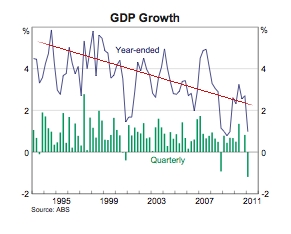
Ummmm … Wayne, ol’ son.

That approximate trendline I’ve added to the RBA’s GDP growth chart for the land of Oz looks suspiciously like a long term downward trend to me. And looking pretty ugly at the pointy end.

What was it your mate Glenn was saying just yesterday, about his RBA’s forecast tea-leaf prognostication for GDP growth?

The Reserve Bank has slashed its growth forecasts for the Australian economy while predicting inflation would remain high for longer than expected.

The August statement of monetary policy released today shows the central bank believes the economy will grow by just 2 per cent in 2011, on a yearly average, compared to its earlier call of 3.25 per cent.

The reduced forecasts are greater than economists had expected. It predicts this financial year growth will be 4 per cent down from 4. 5 per cent.

Ummmm.

Not bad.  If your revised prognostication turns out to be right this time – questionable, since you only made the first one a couple of months ago – then you’ll only have screwed up your first guesstimate by a measly 38.5%.

By the way.

A little tip Glenn.

Your own Chart Pack says our GDP is already sitting well below 2%. About half that, actually.

Expecting a surging “recovery” out of the blue red yonder, are we?

Got any other sage comments?

In the statement, the RBA said economic growth would be lower because of a range of domestic and overseas factors.

“Growth over 2011 has been revised downwards due to a slower than expected recovery in coal production and to a lesser extent a downward revision to consumer spending as domestic and international concerns have weighed on sentiment,” the RBA said.

Ruh roh!

The Greens want to shut down the coal industry. Preferably within 10 years, they say.

And you’re saying, Glenn, that the main reason why your original economic growth forecast has been revised within a couple of months by a whopping 38.5%, is due to a “slower than expected recovery in coal production”?!?

Anything else to add Glenn?

“The medium-term outlook continues to be characterised by the significant pipeline of resource sector investment with a number of large projects already underway and by strong growth in resource exports.”

Oh yes. That tired old line.

Sorry Glenn.

Macquarie Research tore that particular ass-umption underpinning all of your “forecasts” into lots of little shreds some time ago.

Back over to you Wayne:

[Swan] said Australia’s fundamentals – low unemployment, robust financial institutions and low public debt – would help protect the economy.

“Robust financial institutions”?!?!

Surely you jest.

“Low public debt”?!?!

Ahhhh … Wayne.

Something isn’t “low”, just because it may be less than others that are huge.

Your total tax revenues are only around $300 billion.

You’ve got us in debt to the tune of nearly $200 billion.

And don’t give me any of that “Net” debt crap.

“Net” debt might sound better (for you) when you’re spruiking, because it’s a lower number than the Gross figure that you really owe.

But presuming others will pay you back what they owe you, is counting your chickens before they’ve hatched.

We owe $200 billion in public debt.  End of story. Versus … at best … $300 billion in taxes this year.

By your own “estimates”, we’re paying $11+ billion per annum in Interest-only.

And you’ve got to run the country with the rest.

And another thing Wayne.

You’re always banging on trying to make out that our “public debt” is “low” compared to basket case “developed” economies abroad.

You remember.  Europe, the UK, the USA. Those “developed” economies.  Hardly a big claim to fame to say our public debt is lower than these paragons of fiscal prudence (/sarc).

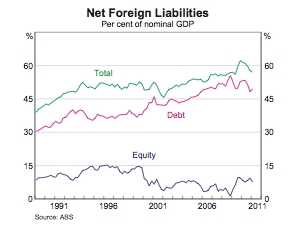
But what about our Net Foreign Liabilities, Wayne?
Ummmm.

Wayne.

Net Foreign Liabilities at nearly 60% of GDP?

I had a little look in the RBA’s data, Wayne.  Takes about 20 seconds.

Our Net Foreign Liabilities of nearly 60% of GDP?

In real numbers (not this “% of GDP” nonsense) … that’s $780.57 Billion at March 2011 (RBA Statistics, H5.xls).

Oops!

Wayne … you’ve done it again.

You’ve confirmed your official title, and your legacy for the history books.

World’s Stupidest Treasurer.

Barnaby: Good On You Wayne, You Are A Genius

5 Aug

Media Release – Senator Barnaby Joyce, 5 August 2011:

Mr Swan is a precise reflection on the Labor Party’s total and utter financial incompetence. Mr Swan has carriage over, and a fascination for, a Climate Change modelling section in Treasury. The reality of course is that it has not a prayer of affecting the climate, but until the wave hit he denied the bleeding obvious about Catastrophic Debt Change.

But the Treasurer has done nothing to prepare Australia for the financial fallout on global sovereign debt, which some of us have been screaming about now for years. Yes, I was talking about this even before my brief tenure in Shadow Finance.

Instead, Swan and Labor have overseen the third largest proportional increase in public sector debt in the world. Ken Rogoff from Harvard will confirm this.[1]  Iceland, Ireland then us; good on you Wayne you are a genius.

Iron ore, coal and wheat saved us from the first GFC not $900 cheques, ceiling insulation and school halls. Heavy floods in Queensland also brought a severe decline in GDP for Australia recently just to remind us of what happens when coal can not get to port.

We have not heard boo on how this nation invests in where we make our money. It was pathetic that even as recent as yesterday they were talking about borrowing another $100 billion to build a not as fast as a plane passenger train.

Now Wayne what will that help us export to pay for your debt?

[1] Reinhart, C. and Rogoff, K. 2011, ‘A Decade of Debt’, Centre for Economic Policy Research Discussion Paper, p. 12, http://www.voxeu.org/sites/default/files/file/DP8310.pdf

Remember When …

28 Jul

From the Australian, 27 July 2011:

Fitch Ratings today revised to negative the outlook for Queensland and warned a potential downgrade was likely if it didn’t limit the growth of its debt.

Remember when Senator Barnaby Joyce dared to suggest that not only was there a “distant but real” risk that the US could default on its debts, but that some Australian states were over-indebted too?

From the Sydney Morning Herald, 11 December 2009:

The Opposition finance spokesman, Barnaby Joyce, believes the United States government could default on its debt, triggering an ”economic Armageddon” which will make the recent global financial crisis pale into insignificance.

Senator Joyce told the Herald yesterday he did not mean to alarm the public but there needed to be a debate about Australia’s ”contingency plan” for a sovereign debt default by the US or even by a local state government.

Senator Joyce said the chances of a US debt default were distant but real and politicians were not doing the electorate a favour by refusing to acknowledge the risk.

He said the Federal Government’s debt would push up interest rates and predicted that some state Labor governments would not be able to repay their borrowings.

”The Federal Government has $115.7 billion in debt, Australian government securities, notes and bonds on issue, and the states have another $170 billion in debt.

”We have to ask whether the states have the capacity to repay that. I would say in some instances they do not, particularly Queensland.”

Remember when, a couple of months prior to those statements, Barnaby raised his concerns in Senate Estimates hearings with former Treasury secretary Ken Henry?

From The Age, 23 October 2009:

The Nationals Senate leader Barnaby Joyce is openly canvassing an economic upheaval that would dwarf the current global financial crisis, triggered by the US defaulting on its sovereign debt within the next few years.

In unusually pessimistic comments for a senior political figure, Senator Joyce said the US Government was running such large deficits and building up so much debt that it was in a similar position to Iceland or Germany before World War II.

In a Senate estimates hearing on Wednesday night, he asked Treasury secretary Ken Henry what would be the implications of an American debt default for the Australian economy.

Dr Henry warned that canvassing extreme scenarios could alarm the community.

”I don’t mind discussing hypotheticals in general … [but] one has to be careful not to discuss publicly hypotheticals that are that extreme,” Dr Henry said.

”I don’t, myself, consider that outcome to be a high probability outcome, certainly not one that I would want to say much about in a public forum.”

But Senator Joyce insisted yesterday that the dangers to the global economy from the run-up in US private and public sector debt were real and should be debated.

”It is the elephant in the room,” Senator Joyce said. ”This is a huge risk that Australia faces. What is the game plan, what happens if it comes unstuck?

Remember when former PM KRudd joined Ken Henry, Wayne Swan, and then Finance spokesman Chris Bowen, in ridiculing Barnaby day in day out for his concerns about debt, until he lost his job as Opposition Finance spokesman?

From The Age, 11 December 2009:

Joyce blasted for ‘extremist’ views on debt

Senior government figures have taken aim at Barnaby Joyce’s dire warning about a global financial meltdown if the United States government defaults on its debt. Mr Joyce also came under fire for comments about the financial health of Australian states.

”That’s shooting from the lip, making it up on the run,” Prime Minister Kevin Rudd said of the new opposition finance spokesman’s comments.

Senator Joyce is concerned that demand for Australia’s resources would ”go through the floor” if the US was not able to pay off its burgeoning foreign debt.

Senator Joyce told Fairfax Media he did not mean to alarm the public but there needed to be a debate about Australia’s ”contingency plan” for a sovereign debt default by the US or even by a local state government.

”How would Australia go forward in a position where the dynamics of the global economy are all changed,” he said on ABC Radio today.

Mr Rudd dismissed the senator’s comments, describing them as ”not responsible economic policy”.

Assistant Treasurer Chris Bowen went further saying Senator Joyce’s comments were extremist.

”His comments on the United States need to be taken with a grain of salt,” he said, adding the vast majority of economists believed US debt levels were manageable.

He accused Senator Joyce of engaging in a series of thought bubbles that were unbecoming of a senior economics spokesman from either government or opposition.

”Senator Joyce adopts very extreme positions, he is an extremist.”

States ‘rock solid’

Separately, Mr Rudd criticised comments made by Senator Joyce that some Australian state governments might not be able to repay billions of dollars in debt.

The states were carrying $170 billion in debt and rising interest rates were affecting their capacity to make repayments, Mr Joyce said.

”I would say in some instances they do not, particularly Queensland,” he told Fairfax Media.

The Prime Minister said such ”erratic and ill-considered” comments should not be made by a senior opposition spokesman.

Mr Rudd described as the ”most serious charge” the coalition’s view that state governments could default on their debt.

”It’s got to produce evidence of that,” he told Fairfax Radio Network today, adding Opposition Leader Tony Abbott and his treasury spokesman Joe Hockey needed to confirm or repudiate Senator Joyce’s claim.

Mr Rudd said any message to international financial markets about the ability of state governments to repay debt needed to take into account the national interest.

State and territory governments had some of the strongest credit ratings in the world and Australia had a ”rock-solid and robust” reputation for public finance.

”There are basic interests for Australia at stake here and responsible, calm, considered policy suggests that the sort of remark … should simply not be made,” Mr Rudd said.

”This is gross economic irresponsibility, policy on the run and shooting from the lip.”

Remember when the media pack joined the Rudd Labor government in rounding on Barnaby too?

From Economics Writer Jessica Irvine, for the Sydney Morning Herald, 11 December 2009:

Barnaby, mate, you gotta stop being a boofhead about the economy

Hark!

What’s that sound?

No, it is not the sound of abject apologies from the Labor party, the Treasury department, the RBA, and the Australian media.

Nor is it the sound of public applause for Australia’s solitary modern-day economic prophet.

No.

It is the sound of deafening silence.

Well … except for this, from the impressive John Roskam at the IPA, 25 March 2011:

We’re in debt to Barnaby

Wayne Swan and Ken Henry owe Barnaby Joyce an apology. A year ago Joyce, then the Coalition’s finance spokesman, warned of “economic Armageddon” if the United States government defaulted on its debt. He said the threat was “distant but real” and politicians should at least acknowledge the possibility of default, however remote it might be.

Treasurer Wayne Swan accused Joyce of coming from the “reactionary fringe of our economic debate”. Ken Henry, then the secretary of the Treasury Department, claimed that Joyce shouldn’t be talking about such things because it would frighten people.

So on that basis Austan Goolsbee must be from the reactionary fringe too. The trouble for Swan is that Goolsbee is a professor of economics at the University of Chicago, the chairman of US President Barack Obama’s council of economic advisers and a member of the US cabinet. Presumably for Swan and Henry it’s OK when Goolsbee speculates on the US going broke, but it’s not OK when Barnaby Joyce does.

In January Goolsbee contemplated the result of the US House of Representatives, controlled by the Republican party, not allowing the US government to increase its debt. “If we hit the debt ceiling, that’s essentially defaulting on our obligations, which is totally unprecedented in American history,” he said.

The context in which Joyce and Goolsbee spoke was different. Joyce was talking generally about the sustainability of US government debt, while Goolsbee was contemplating the unlikely event of the Obama administration being unable to raise its debt ceiling. But in essence Joyce and Goolsbee were talking about the same thing – namely the US government running out of money.

In the US Goolsbee’s remark was taken as a simple statement of fact. In Australia Joyce’s remark provoked outrage from Labor politicians and economics commentators. It was one of the reasons Opposition Leader Tony Abbott subsequently removed Joyce from the fmance portfolio.

The treatment of Joyce reveals just how ignorant Australians are about the financial situation of the United States government.

It’s understandable that Swan and Henry, who presided over the biggest growth in Australian government debt since Gough Whitlam, didn’t like Joyce talking about the consequences of government debt. But it’s Australia’s policymakers – who refuse to face the facts of the long-term consequences of America’s financial situation – who are the ones being irresponsible.

Barnaby Joyce is the only politician in this nation

who was right.

Barnaby mockers? Be damned.

The whole damned lot of you.

Fruitlooping Swan: Every Word A Lie

27 Jul

Recently I commented to a Twitter follower that, after my 3-weeks-of-work-in-1 spent on researching the government’s National Greenhouse and Energy Reporting department’s entire Register of “polluters” (results here), I now consider every single word that this government utters to be a lie.  By default.

And here comes Wayne Swan talking lying about the economy, confirming that I was right.

From the Australian (emphasis added):

Treasurer Wayne Swan has played down an inflation surge as he defended the government’s productivity agenda, saying its benefits would not be realised overnight.

Mr Swan said a summer of natural disasters and higher fruit prices were responsible for a stronger than expected increase in Australia’s consumer price index, which he accepted was making life harder for struggling families.

“These events are one-off events and they have a one-off impact on the CPI,” he said.

The Treasurer said a 27 per cent increase in fruit prices had contributed 0.4 per cent to the total 0.9 per cent inflation rate.

Bullshit.

Not “fruit” prices.

“Food” prices.

From the Australian Bureau of Statistics, whence cometh said CPI figures fraudulently misquoth by the completely despicable truth-avoidance expert, Treasurer Swan (emphasis added):

JUNE KEY FIGURES

Mar Qtr 2011 to Jun Qtr 2011
Jun Qtr 2010 to Jun Qtr 2011
Weighted average of eight capital cities
% change
% change

Food
1.4
6.1
Alcohol and tobacco
0.7
5.6
Clothing and footwear
2.5
1.1
Housing
0.4
4.6
Household contents and services
1.5
0.1
Health
2.0
4.0
Transportation
1.2
3.5
Communication
0.4
0.4
Recreation
-0.6
-0.3
Education
0.0
5.9
Financial and insurance services
1.6
4.2
All groups
0.9
3.6
All groups excluding Housing and Financial and insurance services
1.0
3.2

Contribution to quarterly change – June Quarter 2011

OVERVIEW OF CPI MOVEMENTS

* The most significant price rises this quarter were for fruit (+26.9%), automotive fuel (+4.0%), hospital and medical services (+3.4%), furniture (+6.0%), deposit and loan facilities (+2.1%) and rents (+1.1%).

FOOD prices increased by 1.4% in the quarter (table, in red).

FOOD price increases contributed almost half (0.4%) of the 0.9% increase in the CPI.

“Fruit” alone did NOT contribute 0.4% of the 0.9% increase in the CPI.

Not unless the entire nation bought fruit and only fruit to eat during the March to June quarter.

Wayne Swan lied.

Again.

Still Pointing To The IMF’s Opinion Now, Wayne?

24 Jul

Remember when Treasurer Swan repeatedly pointed to cherry-picked comments by the IMF, as though they should somehow be construed as proof of Labor’s economic management throught the GFC?

In light of his government’s/the Treasury’s “truly extraordinary” assumptions underlying the “stratospheric” growth forecasts in the May budget, any bets that Wayne won’t be pointing out what the IMF is saying now, about China’s darkening economic prospects?

From Dow Jones Newswires via the Australian (emphasis added):

China’s manufacturing sector shrinks, HSBC’s preliminary PMI survey signals

HSBC’S preliminary survey of China’s factories indicated manufacturing activity in the world’s second-biggest economy in July declined from last month, the first such contraction in a year.

The survey comes at a time when various economic indicators in China are pointing in different directions, leaving market participants unsure if they should be more concerned about slowing growth or high inflation.

The International Monetary Fund released its annual review of China today, warning that inflation, real-estate bubbles and weak monetary controls pose “significant risks to financial and macroeconomic stability” in the world’s second-biggest economy.

“Significant risks” to the financial and economic stability of the nation whose massive, regional “shadow-banking” credit-fuelled “stimulus” in the GFC was almost solely responsible for our not following after the USA, UK, and Europe.

I think that I can safely guarantee that you won’t be hearing Wayne trumpet that comment from the IMF.

Here Comes Swan’s Black Swans – Chinese Bad Debt “Bigger Than Stated”

8 Jul

Remember our Wayne’s tireless refrain on the economy?

That investment (mostly from China) in our resources sector will ensure a budget back in surplus (for one year), and “lasting prosperity” via an endless “boom”?

Remember how he remains ignorant of all the many warnings about China?

(And, about our second largest trading partner, Japan?)

Including this one, just before the May budget:

“The market is telling you that something is not quite right,” Faber, the publisher of the Gloom, Boom & Doom report, said in a Bloomberg Television interview in Hong Kong today. “The Chinese economy is going to slow down regardless. It is more likely that we will even have a crash sometime in the next nine to 12 months.

Faber joins hedge fund manager Jim Chanos and Harvard University’s Kenneth Rogoff in warning of a crash in China.

China is “on a treadmill to hell” because it’s hooked on property development for driving growth, Chanos said in an interview last month. As much as 60 percent of the country’s gross domestic product relies on construction, he said. Rogoff said in February a debt-fueled bubble in China may trigger a regional recession within a decade.

Remember the devastating critique of the May budget by Macquarie Research? The one that said Wayne’s (ie, Treasury’s) forecasts for business investment – the key assumption underpinning all the budget projections – are “truly extraordinary”?

Upbeat growth forecasts from the Treasury and the Reserve Bank of Australia (RBA) are based on very optimistic forecasts for private sector business investment.

The RBA and Treasury forecasts for business investment over the next couple of years are truly extraordinary.

In our opinion, achieving such stratospheric growth would be extremely difficult.

By putting all their eggs in the mining investment basket, policymakers appear to have no Plan B for what will support the economy if investment disappoints. And this note provides three clear reasons why one should be cautious about counting those mining investment chickens before they are hatched.

Well, on July 4 the international ratings agency Moody’s – the same one that has downgraded our banks and effectively declared them “Too Big To Fail – dropped another bomb on Wayne’s parade.

It says that 10% or more of Chinese GDP is bad debt, and claims that the “China debt problem (is) bigger than stated”.

From Moody’s Investors Service, via ZeroHedge (emphasis added):

Moody’s Investors Service says that the potential scale of the problem loans at Chinese banks may be closer to its stress case than its base case, according to an assessment that the rating agency conducted following the release of new data by China’s National Audit Office (NAO).

Since these loans to local governments are not covered by the NAO report, this means they are not considered by the audit agency as real claims on local governments. This indicates that these loans are most likely poorly documented and may pose the greatest risk of delinquency,” the analyst adds.

Moody’s report estimates that the Chinese banking system’s economic non-performing loans could reach between 8% and 12% of total loans, compared to 5% to 8% in the rating agency’s base case, and 10% to 18% in its stress case.

But it’s not just Moody’s now warning about China’s banking system.

From MarketWatch (emphasis added):

China’s debt woes point to bank bailout

China’s banking system will require an eventual bailout by the central government, according to some analysts, who said figures released last week on the size of local-government borrowings point to the need for a rescue.

Credit Suisse economist Dong Tao said the numbers backed up concerns he’s been voicing for the past two years on China’s toxic loan problem.

“Ultimately, we believe that the central government will need to separate the local government’s bank debt from banks’ balance sheets and recapitalize the banks,” Tao said in a note following the release of data on China’s local-debt obligations by the National Audit Office.

Reuters reported last month that Beijing is considering a bailout that could see the central government accept to 2 trillion to 3 trillion yuan of local governments’ outstanding debt in an effort to ensure against a mass default, which could bring down the economy. See report on China’s initial bailout plans.

Stress is building within the system, Tao said, as local governments face a growing pile of debts coming due at a time of declining land sales, normally a key revenue stream for the provincial authorities.

Meanwhile, local governments are also having trouble finding new sources of lending as state-controlled banks grow increasingly wary of their deteriorating ability to service existing debt.

Standard Chartered said last week there were early signs of major financial distress building at the local government level.

Anecdotes of local-government investment vehicles in Shanghai and in Yunnan province struggling to meet loan payments “signal the beginning of the wave of difficulties,” Standard Chartered’s China economist Stephen Green said in a note Thursday.

And Bloomberg reports that both Fitch Ratings and Standard & Poors have also flagged serious concerns:

Fitch Ratings lowered its outlook on China’s AA- long-term, local-currency rating to negative from stable on April 12 because of the risk the government would have to bail out banks. As much as 30 percent of loans to local government entities may go bad, accounting for the biggest source of banks’ non- performing assets, Standard & Poor’s said that month.

Now, are you one of those who doubts that China’s “boom” is/was driven by massive borrowing by local (regional) Chinese banks to finance over-investment in “infrastructure” – the mother of all real estate bubbles world wide?

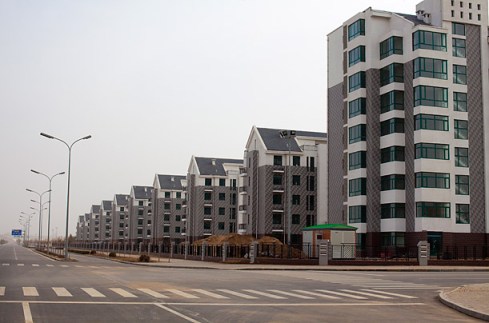
Then take a look at these pictures from Time magazine, showing just how massive speculative over-investment in property construction has left China with literal ‘ghost cities’:

Click to visit the complete Time photo series

If like many readers you have skimmed over this article and not bothered to click on … and carefully read … all of the links embedded in this article, then you are doing yourself and your loved ones a disservice.

Because you are about to leave this site … ignorant.

With only part of the story.

Do not be a Goose.

Like Swan.

Educate yourself.

Lots of labour has gone into collating all these news articles from around the world.

Over many, many months.

Do yourself a favour, and become better educated about reality than the buffoon who lives in Wayne’s World.

So that you too can see with crystal clarity the gaggle of Black Swans that are soon to blot out our Aussie sun.

Then you too can help to warn others.

Because rest assured – just as with the GFC – you will get no forewarnings from our “expert” economists when the SHTF.

Or from our “authorities”.

Or from their sycophants in the mainstream “business” media.

Your superannuation depends on your being properly informed.

Because both “sides” of politics are planning to steal itwhen the SHTF

Hockey Pucked: Our Next Treasurer As Clueless As Goose?

7 Jul

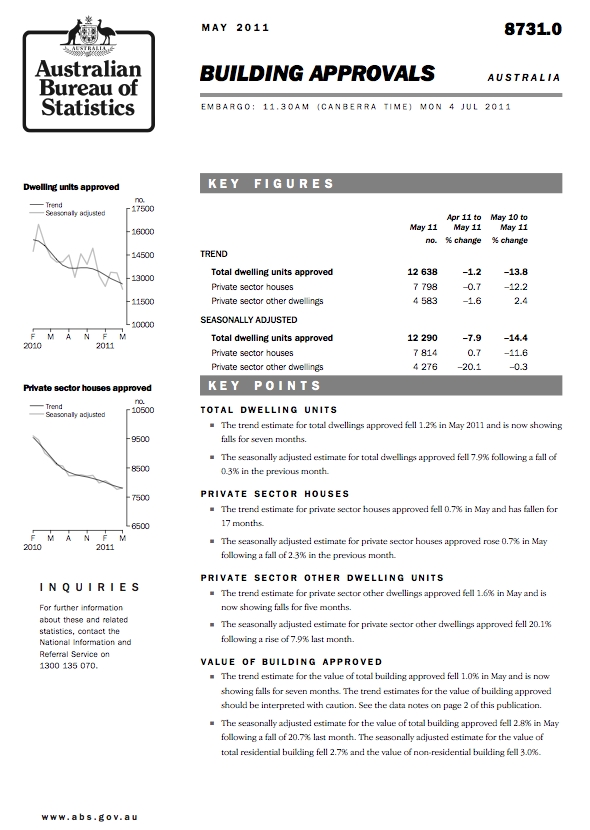
Click to enlarge

The latest building approvals data came out a few days ago.

Down again.

From AAP via the SMH:

Australian residential building approvals fell 7.9 per cent to 12,290 units in May, seasonally adjusted.

This compares to a downwardly revised 13,342 units in April.

In the year to May, building approvals were down 14.4 per cent, the Australian Bureau of Statistics (ABS) said on Monday.

Economists’ forecasts had centred on a 0.5 per cent fall in approvals in May.

So.

The economists’ “forecasts” were not worth the binary code they are “printed” with.

As usual.

And they were wrong … on the “too confident” side.

Interesting.

Could it be that these unnamed “economists”, whose forecast for a tiny fall was (yet again) so far off beam … are connected to the banking industry … which lives and breathes off its lending hundreds of billions into our now-bursting, debt-driven, housing bubble Ponzi scheme?

And could it be that our next Treasurer – the Liberal Party’s Joe Hockey – is just as clueless as the dribbling imbecile currently in the job?

It appears so … if his comment on Twitter in response to the building approvals data release is anything to go by (emphasis added):

@JoeHockey Joe Hockey

Building approvals down for 7th month in a row. NSW and Vict. hardest hit.I can’t believe house prices won’t rise soon on back of shortages.

4 Jul via web Unfavorite Retweet Reply

Joe has drunk the Kool-aid (as they say in North America). He’s drunk the sweet sugary orange Cottee’s cordial, in other words.

He’s bought into the great “housing shortage” myth.

You know. The one that every other country with a housing bubble fervently believed in too.

The myth that has been comprehensively debunked here in Australia, by Money Morning amongst others.

One can only wonder what Joe would make of the following advertisement, that was brought to my attention by Twitter user @iClevercat.

The advertisement was in a magazine insert included with the weekend edition of a major West Australian newspaper. Placed by a major home builder, in our only economic “boom” state.

You know. The state where all the mining “boom” money is supposed to be.  Where you’d imagine that demand for new McMansions should be really strong.  And where builders certainly should not need to start offering incentives like this, just to get people to sign up to buy a house –

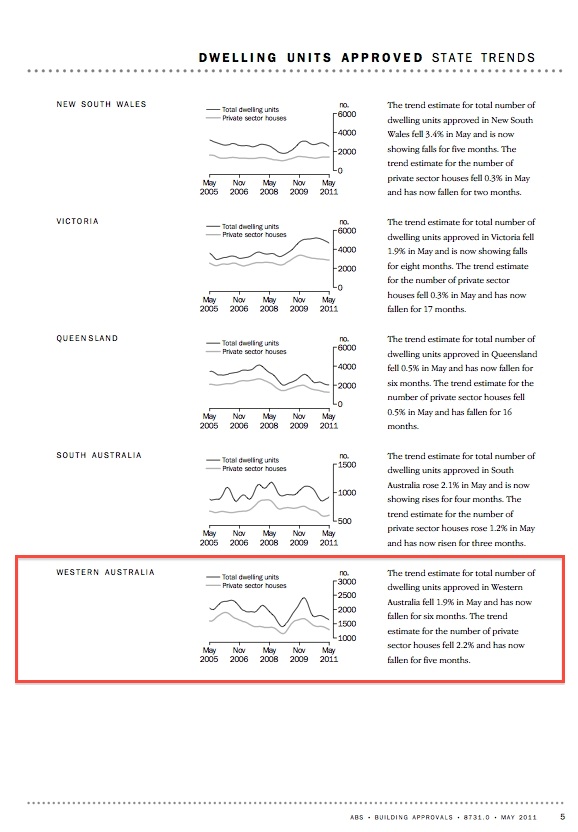
Now, what’s the ABS data say about the trend for building approvals (ie, demand for new houses) in our last remaining economic nirvana, Western Australia?

Click to enlarge

So.

The “trend estimate for total number of dwelling units approved in Western Australia fell by 1.9% in May and has now fallen for six months.”

And major builders in that same “boom” state are offering a $14,500 RRP “free” car, as an incentive to encourage people to sign up for a new house.

What say you, Mr Hockey?

Or must we conclude that our economic fate is to be handed over from the Goose to another babbling buffoon who’s dense as puck.

Global Economy Headed For “Slow-Motion Train Wreck”

6 Jul

The RBA’s soon to be dumped Board member Warwick McKibbin warns – unofficially – that Greece will be just the first carriage to careen off the rails, in what will be a global train wreck.

From Bloomberg, 30 June 2011 (emphasis added):

The fiscal outlook “is what I call the slow motion train wreck — the first carriage to break is going to be the Greek economy, but we have a series of economies facing very serious fiscal adjustment,” said McKibbin, a professor at Australian National University whose board term ends July 30, in a speech in Melbourne today. He said his comments reflected his personal views, not those of the Reserve Bank of Australia.

“There’s almost guaranteed collapse or crisis in the euro zone and there’s serious global inflation problems and a policy response looming,” said McKibbin, who is also a senior fellow at the Brookings Institution in Washington. “All of these have implications for relative commodity prices.”

In contrast, Treasurer Wayne Swan in a speech at the same Melbourne conference today said: “Some have a dire view of what’s happening in Europe. I don’t share those views.”

Hmmm.

Just as he did not share Senator Joyce’s views in 2009, that the US economy was on a debt trajectory that made the risk of default a real possibility. One that Australia should have “a contingency plan” for, just in case.

A warning that is now coming to pass.

Barnaby was right.

And Swan, and every economist in the country (except Dr Steve Keen) … was wrong.

Bookmark this page.

So that you can refer back to Swan’s latest oh-so-confident and authoritative pronouncement that all’s well.

I know that I for one am fully seized with absolute confidence in the word of our career political hack cum “Treasurer”. An arts student, with zero business or financial credentials or experience whatsoever.

Here’s how McKibbin’s comments were reported locally, compared with the USA’s Bloomberg.

From the SMH, 1 July 2011:

The global economy is facing ”a slow-motion train wreck” with Greece only the first nation to be hit, Reserve Bank director Warwick McKibbin has told a Melbourne conference.

Referring to the most recent global economic crisis as a mere ”blip”, he said the coming crisis could undo the mining boom and bring on inflation of the kind not seen since the 1970s.

Professor McKibbin told the Melbourne Institute conference dozens of European countries now had gross government debts on track to exceed 60 per cent of GDP. ”Japan is forecast to be 200 per cent of GDP, the US is forecast to be over 100 per cent of GDP,” he said.

”At zero interest rates that can be sustained, but at 5 per cent interest rates countries have to put aside 5 per cent of their GDP every year just to service the debt. That is not sustainable.

”Already consumers aren’t spending and investors aren’t spending because of the tax increases that are in prospect.

”Greece, Portugal and Ireland don’t just need to have their debts written off, they need to have a 30 per cent to 40 per cent depreciation of their real exchange rate,” he told the conference.

”There are two ways to do that, either pull out of the euro and depreciate by 40 per cent, or have deflation of 40 per cent over the next 12 months.

”I do not believe any society can survive having a 40 per cent deflation that’s been imposed by the International Monetary Fund and the European Central Bank.”

As the US created more dollars to inflate away its debt repayment obligations, countries that are linked to the dollar, including China, India and parts of Latin America, would suffer 1970s-style inflation.

”In India inflation is 9 per cent, in China it is 6 per cent. That inflation is pushing up resource prices for now, but it will have to be brought under control with much higher interest rates,” he said.

Joking that he could not talk about Australian interest rates, which were in any event ”always appropriate”, the Reserve Bank board member warned that the inflation would spread worldwide.

Soon-to-be-former Board member McKibbin has form.

For criticising the Labor Government over its “stimulus” measures in response to the GFC, amongst other things.

Little wonder they will not renew his term.

Can’t have anyone in a position of “authority” telling something even vaguely resembling the truth, now can we.

Swan: We Created Every Single New Job In The Entire Nation Since We Came To Office … And 10,000 More, That Don’t Even Exist

22 Jun

Goose talking "jobs jobs jobs"

Do you remember Wayne’s pre-budget mantra?

That big red herring about jobs – the one that the entire Australian media corps swallowed hook, line, and sinker?

We created 750,000 jobs since we came to office when other nations shed millions of jobs…

Back in early May, we first debunked Wayne’s Big Lie ( “Behold, Wayne’s Große Lüge” ), simply by comparing his own Final Budget Outcome 2009-10 to the Final Budget Outcome for 2007-08, the year that Labor came to office.

Of course, that simple comparison using government budget documents did not take into account a number of factors. Including what may have happened in the employment trends between the end of financial year 2010, and Wayne’s grand claim in May 2011.

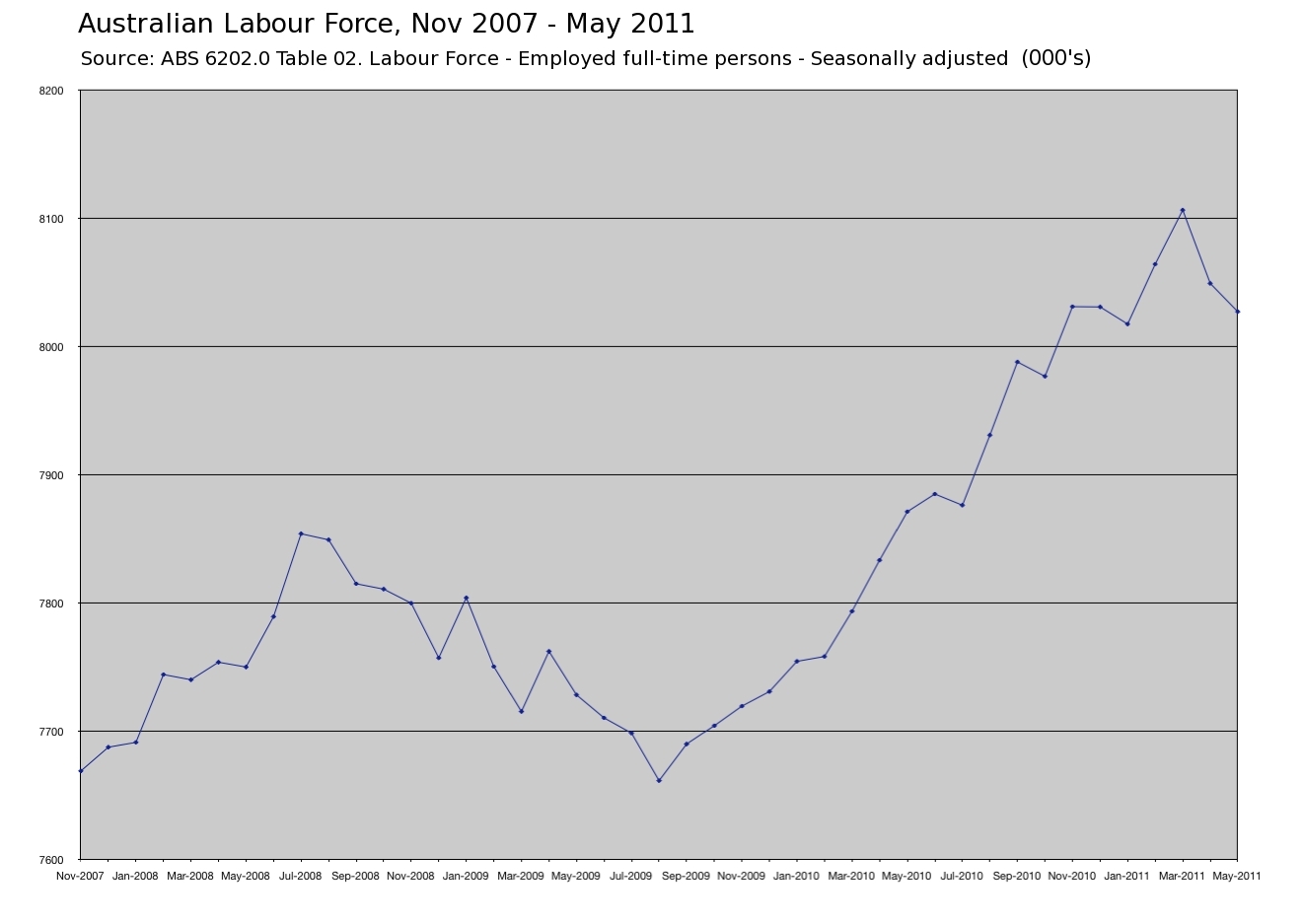
So now, dear reader, we present for your enjoyment the definitive proof. The Australian Bureau of Statistics (ABS) Labour Force data from November 2007 (the month that Rudd won the election) through to May 2011 (the month in which Wayne was frantically waving his “jobs jobs jobs” red herring, to distract from his upcoming record-high budget deficit announcement).

First, here is a chart for Full-time employed persons:

Click to enlarge

That’s a grand total of (8.0271 million – 7.6689 million) 358,200 more Full-time employed persons now, than in November 2007.

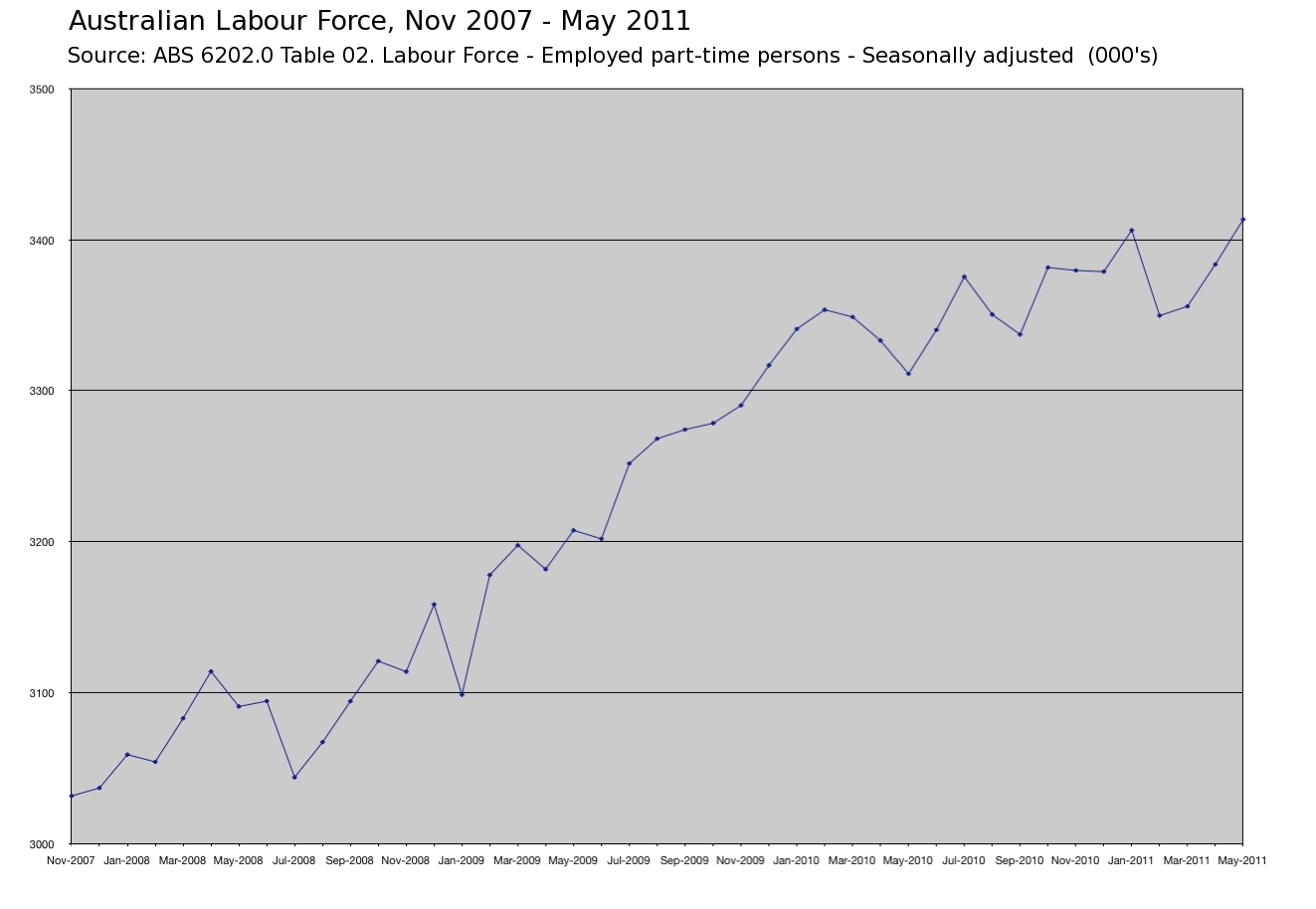
Second, here is a chart for Part-time employed persons:

Click to enlarge

That’s a grand total of (3.4135 million – 3.0317 million) 381,800 more Part-time employed persons now, than in November 2007.

For a grand total of … 740,000 more employed persons than in November 2007.

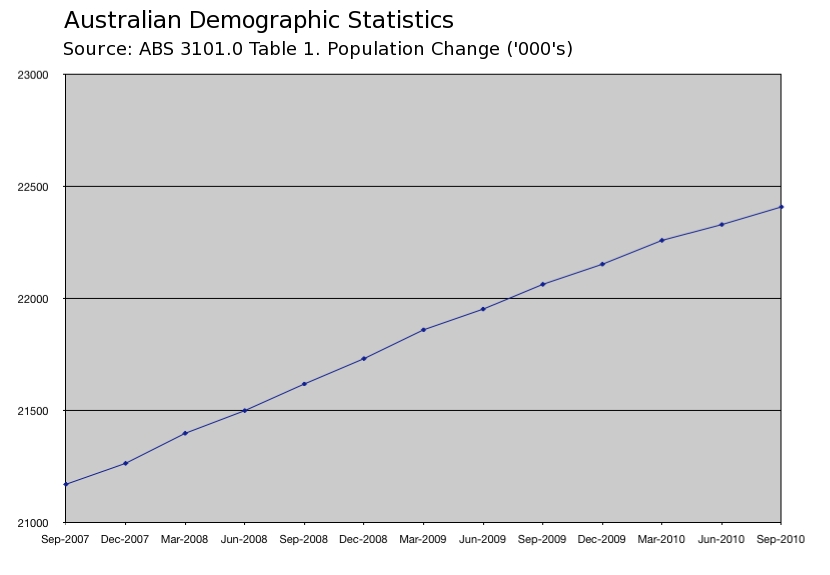
In a nation where the population increased by 1.237 million from September 2007 to September 2010 (the latest data), including a natural increase of 0.5 million (births minus deaths):

Click to enlarge

Now, what was that you said, Wayne?

We created 750,000 jobs since we came to office when other nations shed millions of jobs…

Let’s take a moment to enter an imaginary parallel universe.  A fantasy world where the Australian private sector – that’s every non-government business in the nation – did not create a single new job – full or part-time – in the past 3.5 years. 

Not one.

According to the official ABS data, even if the entire private sector did not create a single new job, and instead, we swallow the patently absurd notion that Labor alone was responsible for creating every single new full-time and part-time job in the entire country over the past 3.5 years, Wayne’s claim would still fall short long.  By 10,000 jobs.

Now, perhaps you are one of the eagle-eyed readers who has spotted the big 80,000 fall in full-time employed persons in April-May.  An ominous collapse, only one-tenth less than the GFC-triggered f/t employed persons plunge in Feb-Mar 2009.

And perhaps you are also quick-witted enough to be thinking, “Hey wait on there mate, Wayne couldn’t have known the May figures in early May, could he?”

And you would be right on both counts.

Doesn’t help our Wayne’s claim though.

Because if you calculate November 2007 through April 2011 instead, you get a grand total of … (380,200 F/t + 352,000 P/t) 732,200 employed persons.

Meaning, his lie was even bigger than you thought.

Be-holed, Wayne’s Große Lüge.

If you are going to lie, make it a Big Lie.

And repeat it often.

If you haven’t dug your fork in to check if this goose is fully cooked yet, then you might also enjoy our debunking of Wayne’s “But wait … there’s more!” free steak knives claim.

That the government “will create half a million more” jobs in the next two years.

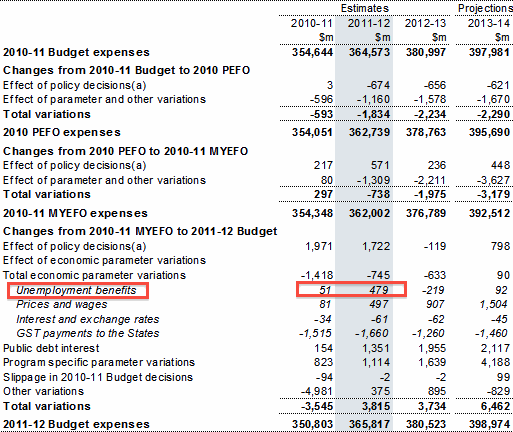
A ridiculous lie that is clearly betrayed by the evidence buried in the fine print of his own May Budget documents –

Economic parameter variations are forecast to reduce expenses in 2011‑12 and over the forward estimates … Partly offsetting these reductions … an upwards revision in the estimated number of unemployment benefit recipients is expected to increase expenses in 2011‑12 compared to MYEFO, although this is partly unwound by a reduction in the forecast of the number of unemployment benefit recipients in 2012‑13.

Budget 2011-12 | Budget Paper No. 1, Statement 6, Table 2

Dig your fork in here – “Half A Million Jobs” – Wayne’s Big Lie (Reprise)

Today's Special - Roast Goose

Swan: Not Drowning, Waving

19 Jun

No, no … everything’s fine!  Really it is!  Just peachy!!

From AAP via Yahoo!7 News:

Economy strong despite global woes: Swan

Treasurer Wayne Swan says Australia’s economic prospects remain strong despite uncertainty about the recovery in the global economy.

Mr Swan said proximity to Asia would continue to fuel the national economy.

“Australia remains well positioned to benefit from robust growth in our region,” Mr Swan said in a statement on Saturday.

“Strong demand for our commodities is underpinning an unprecedented pipeline of business investment, with ABARES estimating a pipeline of $430 billion in resources alone.”

Australia’s economic prospects “remain strong”, ‘eh?

We are “well-positioned to benefit from robust growth in our region”, ‘eh?

An “unprecedented pipeline of business investment”, ‘eh?

Macquarie Bank begs to differ.

As does Michael Byrne, head of Linfox Logistics.

As does Nouriel Roubini, the economist made famous for predicting the GFC.

And many more.

Ever reliable Wayne Swan. Nothing changes.

Same hot air, every time.

Just remember to bookmark this page.

For the day fast approaching, when Wayne’s waving turns to drowning.

Design a site like this with WordPress.com
Get started