Tag Archives: carbon tax

Government’s RIS Admits Carbon Emissions “Audits” A Propaganda Exercise

11 Aug

Have you ever questioned how exactly the government can actually monitor the “emissions” of carbon dioxide of each of the 1,000500“more like in the order of like 400” so-called “biggest polluters”?

Are they really going to have an army of “carbon cops”, as Tony Abbott would have you believe, roaming the country investigating people like a 21st century Green Gestapo?

Even if so, the question still remains – how are they going to measure the “emissions”?

Answer: They are not going to measure them.

They are not even going to audit any but a very few of the very largest “emitters” either.

It is all a hoax.

Just as under the present National Greenhouse and Energy Reporting (NGER) department “system” – one that only came up with 299 companies reporting emissions in their latest Report – the companies “caught” in the system will be asked to “estimate” their own emissions.

Other than that, maintaining public “confidence” in the “credibility” of the scheme scam will be a matter of additional assurance activities undertaken by the regulator”.

Proof?

Let us take a look at the Government’s Clean Energy Future Regulatory Impact Statement.

It is yet another telling indictment of the total fraud that this carbon pricing scheme scam actually is (emphasis added):

7.4    Ensuring compliance with reporting requirements

Under the proposed reporting requirements liable entities will report on their own emissions. As they will also have to acquire (buy) permits to cover these emissions, they will have an incentive to underreport their emissions. There is also the risk that errors would be made in reporting either through negligence or through other ‘good faith’ mistakes. Errors in the reporting of emissions would have a number of negative consequences.

It is to be expected that most (intentional) misreporting would result in an underestimation of emissions and less permits being surrendered to Government. This would have implications for the accuracy of national emissions estimates and would represent an effective loosening of the cap.

Errors in reporting would also have significant implications for the credibility of the scheme. If there was a perception of widespread non-compliance, community support for the scheme would be much harder to maintain (in the absence of community acceptance and support, the long term future of the scheme could be called into question). At an international level, confidence in the legitimacy of the emissions reductions driven by the scheme is a key consideration in whether other countries will be willing to ‘link’ with the Australian scheme. International linking is an important element in reducing the overall costs of the scheme and the ability to establish future links with international schemes is an important consideration in the design of the Australian scheme.15 Finally, business perceptions of compliance by other businesses with the scheme could have implications for their own compliance. That is, if one emitter believes that other emitters are non-compliant with the scheme, this may influence their compliance decisions. In closing, it is important to note that, in considering impacts on the credibility of the scheme, perceptions of non-compliance can be more important than the actual level of non-compliance.16

Translation: It is “more important” for the public to believe that “polluters” are complying, than for them to actually be complying!

Misreporting of emissions would also have a number of implications at a firm or industry level. The emitter that underreported emissions would be placed at a competitive advantage vis a vis other market participants (as they would need to surrender fewer permits). This advantageous position would be a result of non-compliance with the law rather than legitimate business practices and could entail significant costs for competing entities.

For these reasons, assurance arrangements to certify the accuracy of emissions reporting are required. Three options exist:

* ex-post audits undertaken the Government

* ex-ante audits undertaken by third party auditors

* a hybrid option involving third party audits for very large emitters (those emitting over 125 kt CO2-e/year) and Government assurance for liable emitters below this threshold.

Before continuing to examine what the Government thinks about those 3 options, let’s first take a look at footnote 16 annotated in the above paragraphs. It sheds further light on the fact that the reporting/auditing of so-called “polluters”, is really all about perception management.

Propaganda, in other words:

16 While perceptions of non compliance should be linked to actual levels of non-compliance, this need not be the case. Importantly Government actions to ensure compliance can improve perceptions of compliance with the mechanism even in the absence of widespread non-compliance. For instance, even if there were widespread compliance with the carbon pricing mechanism, the absence of an auditing mechanism could lead some stakeholders to question the accuracy of reported emissions. This would have impacts on confidence with the carbon pricing mechanism even in the absence of widespread non-compliance.

The RIS document goes on to waffle on, about the 3 different potential options for “audits” and the estimated costs associated with each.  You can download and read it all for yourself here (pages 58-61). Just for background, following are a few key excerpts regarding costs etc for each option – we wish to move past this to the punchline of the scam:

Under the second and third options it is expected that (at least initially) many audits would be undertaken by large accounting and consulting firms. The extent to which specific training and qualifications will be required before a person can undertake these audits is currently the subject of an auditing regime established under the NGER Act. Over 170 persons are currently registered from a diverse range of organisations.

For those businesses that are required to obtain third party audits, the cost is estimated to be $150 000 per year. It is also likely that companies would incur some costs associated with liaising with the auditors. On average these are estimated to be around $11 500 per business per year. Obviously the overall compliance costs would be largest under option 2 — all business would be required to obtain audits. With around 500 liable entities, this would entail total aggregate compliance costs of around $80 million per year.17 The third option would require less than 200 businesses to seek third party audits. The total compliance costs of this option are estimated to be around $32 million per year. The compliance costs associated with the first option are minimal.

In terms of administrative costs, it is estimated that the cost to Government of the third (hybrid) option would be around $5 to $9 million per year. This represents the costs to Government of undertaking audits of a selection of emissions reports submitted by liable entities both to double check the reports of vary large emitters and assure the accuracy of reports by smaller liable entities. The administrative costs of the first two options have not been separately estimated …

Overall, it is expected that the first option (no third party audits) would be the least costly option while the second option (third party audits for all liable entities) would be the most expensive.

Ok.

Let’s just check that footnote 17:

17 This is likely to be an over estimate of the compliance costs for this option. The per business costs were estimated in the context of assurance for very large emitters (over 125 kt CO2-e/year). The costs of obtaining a third party audit for smaller emitters (the bulk of the 500 liable entities) are likely to be lower than this amount.

Hang on?

Hasn’t the Government been labelling the “polluters” as 1,000500 … more like in the order of like 400 of the BIGGEST?

But in the RIS, the bulk of the ___ liable entities” are here called smaller emitters!?!

There’s an old saying – If you’re going to lie, then you’d better have a perfect memory.

Let’s move on to that punchline, shall we? (emphasis added):

The benefits associated with the third (hybrid) option are lower than under the full third party assurance option as only a subset of emissions reports are assured. However, the benefits are not likely to be significantly lower. The majority of emissions are accounted for by very large emitters (over the 125 kt CO2-e/year threshold). As a result, assuring the accuracy of these emissions will ensure that overall emissions data are largely correct. Moreover, the very large emitters are likely to be the most  ‘visible’ and ensuring the accuracy of these reports should provide confidence in the accuracy of emissions data for the majority of stakeholders. Any concerns with the accuracy of reports by smaller emitters can be alleviated (to a degree) by additional assurance activities undertaken by the regulator.

On balance, it is considered that the hybrid option represents the best balance of risks to scheme credibility and compliance costs for reporting entities and is the preferred option.

Translation: So long as we can assure accuracy of the tiny number of “very large emitters”, who are “the most visible” to the public, then the public will have “con-fidence” in our scheme scam.  And if any concerns are raised about accuracy of (self)reporting by “the bulk of” emitters (who are “smaller”), the regulator can deal with that by “additional assurance activities”.

Otherwise known as “propaganda”.

Or … “cooking the books”.

Something that this Government have a history of being very good at. Just ask former Finance Minister Lindsay Tanner.

Ladies and gentlemen …

IT.

IS.

A.

SCAM.
Small Business “Expected” To “Pass On Majority Of Increased Costs To Customers”, Says Govt

11 Aug

Own a small business?

Employed by a small business?

The government’s Clean Energy Future scheme Regulatory Impact Statement might interest you (relevant section reproduced in full; emphasis added):

Attachment A: Small Business Impact Statement

Small businesses are defined by the Australian Bureau of Statistics as any business with less than 20 employees.

Direct impacts

The Government does not know of* any small businesses who would be directly liable under the carbon price (certainly they would have significant turnover26).

Indirect impacts

The more important impacts on small business will be the indirect impacts associated with increases in the price of inputs. The carbon pricing mechanism will effectively put a price on greenhouse gas emissions (referred to below as carbon emissions). Products that ̳embody‘ carbon emissions (that is, products where emissions were released in their manufacture) will rise in price. The degree of price rise will depend on the price of permits and the amount of carbon released.

The price of permits will depend on the prices set by the Government in the fixed price period, the pollution cap set by Government in the flexible price period, the design of the mechanism and the cost of abatement in the economy. In putting forward preferred positions to Government the mechanism has been designed to minimise the costs associated with meeting any given emissions target. The coverage is recommended to be as broad as possible, subject to measurement and compliance cost constraints. The broad nature of the mechanism should open up more avenues for carbon abatement, thereby ensuring that the lowest cost opportunities are pursued first. Allowing the use of certain international units to meet liabilities under the carbon price mechanism will open up international abatement opportunities which will further reduce the costs associated with placing a price on carbon emissions.

Nevertheless, the price of certain goods and services (those with a significant amount of embodied carbon) will rise. Price rises will be associated with electricity usage, potentially around 10% over the first five years. Most electricity generation in Australia is derived from the combustion of fossil fuels which releases significant amounts of greenhouse gases.

The prices of other goods are also likely to increase. However, it should be noted that many of the most emissions-intensive goods, such as cement, steel and aluminium, are internationally traded and provided significant assistance to offset the impact of carbon pricing.

Overall impacts

Overall the majority of impacts on small business will result from changes in the price of inputs. For some small businesses, which rely on emissions intensive inputs, these may be significant. However, it is expected that small businesses will be able pass on the majority of these increased costs to customers.

Moreover, the impacts on small business will be in proportion to the impacts on other businesses and households**. Price rises faced by small businesses are likely to be in line with price rises felt by other sectors of the economy. Relative to larger businesses that have to participate directly in the scheme, the impacts on small businesses will be significantly lower.

26 At an initial carbon price of $23 per tonne, an emitter on the 25 kt CO2-e/year threshold would have a yearly liability of $600,000. Their turnover would have to be significantly higher than this figure.

* The government “does not know of any” small businesses who would be directly liable? Dear reader, the government does not know anything about any of the so-called “biggest polluters”, much less anything about small business. Proof here.

** Key difference not stated: small business will receive zero “compensation”.

Like, The Incredible Case Of, Like, Julia And The, Like, 400 Shrinking Polluters

10 Aug

h/t reader Bamftiger

First, it was “1,000 of the biggest polluters”.

Then, it was “500 of the biggest polluters”.

Now?

It’s “more in the order of more like 400” of the “biggest polluters”.

Except … even that figure is “somewhat rubbery” (emphasis added):

Prime Minister Julia Gillard originally said the price would be paid by the top 1000 polluters in the country.

But when the $23-a-tonne carbon price was announced in July, that figure was cut in half.

Around 500 of the biggest polluters in Australia will be required to pay for their pollution under the carbon pricing mechanism,” the Government’s policy documents released on July 10 state.

Now the figure has been revised downwards again.

“Under the previous (Kevin Rudd carbon pollution reduction scheme) package the number that we thought was going to be in the system was more in the order of 700,” climate change department secretary Blair Comley said today.

(Now) the number of emitters that we think will be covered is more in the order of more like 400.

Mr Comley was giving evidence in Canberra to a parliamentary inquiry into the proposed carbon tax.

The change of scope was due to the differing treatment of liquid fuels and synthetic gases under Ms Gillard’s carbon price mechanism, he said.

But the 400 figure is somewhat rubbery.

You don’t say?!

barnabyisright.com humbly claims credit as the first (and only) to break the true and complete story of the government’s massive – and perpetual – lying over the real number of so-called “biggest polluters”.

Read the story as broken right here on 25 July. Download and study for yourself the 1.6Mb spreadsheet results of my 3-weeks-work-in-1 research into the government’s “rubbery” (!?!!) National Greenhouse and Energy Reporting department’s official Register of “biggest polluters” –

The 500 “Biggest Polluters” Exposed – Everything The Government Is Not Telling You

“More in the order of more like 400″, they now say?

The government NGER department’s most recent report (April ’11) shows only 299 “polluters” reporting any emissions at all – a story also broken here on 13 July.

And their full Register (775 ABN numbers listed) is chock full of dodgy, unknown/unidentifiable, non-existent, ASIC-unrecognised ABN numbers, liquidated companies, blind trusts, double-triple-quadruple-quintuple-ups, and the “like”.

So Julia … from your own list of “like” 775 company names/numbers, of which only “like” 299 actually reported emissions in your most up-to-date official NGER Report … “like” exactly which “like” 400 “biggest polluters” are you actually going to “tax” in order to legislate the banksters’ carbon derivatives trading platform?

I’ve got the spreadsheet right here – just point out the “like” 400 “biggest polluters” for us.

Flash Crash “Had Something To Do With Some Derivatives” Says Goldman Trader

10 Aug

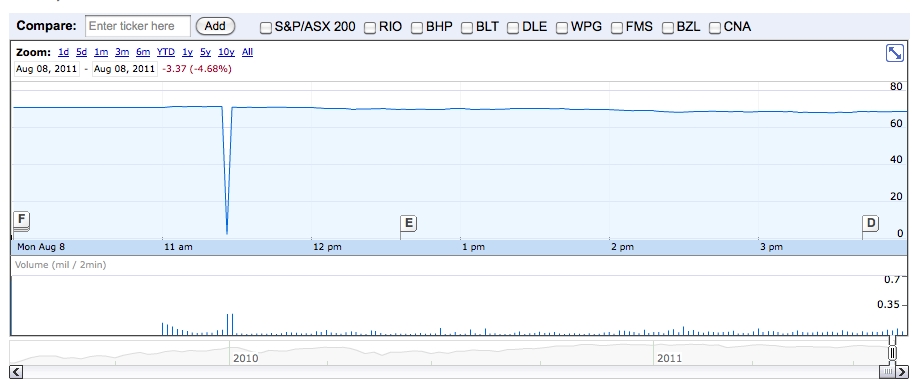
Rio Tinto "flash crash" - 8 August 2011

You probably missed the following little news item, lost in all the screaming red headlines of recent days.

It has important implications for our understanding of what our so-called Clean Energy Future will really look like, under the government’s carbon pricing scheme scam.

Because as we have previously seen from the details buried in the government’s official website, their “carbon pricing mechanism” is nothing whatsoever to do with “saving the planet”.

Instead, it is all about preparing the way for international banking’s latest casino – carbon dioxide futures and derivatives trading.

A mega-casino with trading via the bankers favourite new toy, HFT (High-Frequency Trading) – advanced computerised platforms directly linked into the stock exchanges and able to execute fully-automated trades in under 10 milliseconds.

From Dow Jones Newswires via The Australian (emphasis added):

Rio Tinto trades under investigation after share crash

Some trades in the Australian listing of Rio Tinto are under investigation after the company’s stock lost nearly 98 per cent in four minutes and briefly dropped to its lowest level since the 1970s, the Australian Securities Exchange said today.

A series of trades between 11:24 and 11:26 AEST are being investigated, the ASX said.

Exchange data shows a series of equity options combinations were traded at $1.43 to $1.91 between 11:24 and 11:26 AEST against a typical price of around $71.00 per share.

A total of $489,981 in shares were shown changing hands at the subdued prices, giving an average price of $1.81 per share.

However, a trader at Goldman Sachs said the stock had not actually reached that level.

“It had something to do with some derivatives and I’m sure it will be unwound later in the day,” said the trader, who didn’t want to be named.

… automated trading programs have been known to cause rapid and short-term fluctuations in the prices of securities or so-called “flash crashes”, which have become an increasingly-noticed feature of financial markets.

Hmmmmm.

“It had something to do with some derivatives…”.

Regular readers may recall my analysis of the government’s newly-announced “carbon pricing” scheme on the day after Carbon Sunday – Our Bankers’ Casino Royale – “Carbon Permits” Really Means “A Licence To Print”.

They may also recall my follow up article only a few days later – I Was Right – Our Banks Begin Preparing Carbon Derivatives Market.

To briefly summarise, this is what we found buried in the government’s new website, regarding derivatives:

The “creation of equitable interests”, and “taking security over them”, simply means this.  The carbon permits can be used as the basis for bankers to create other, new financial “securities”.

Carbon derivatives, in other words.

Derivatives (or “securities”) are the toxic, wholly-artificial financial “products” that were at the heart of the GFC.  The same bankster-designed “widgets” that the world’s most famous investor, Warren Buffet, spoke of as “a mega-catastrophic risk”, “financial weapons of mass destruction”, and a “time bomb”.

You can stop reading this piece right now if you like.

Because from that Table 6 alone, you now have conclusive proof that this is nothing whatsoever to do with the climate.

We also identified that setting up the basis for a carbon futures market is part and parcel of the “mechanism”:

Furthermore, the “advance auctions of flexible price permits in the fixed price period” proves beyond all shadow of doubt, that I was right.

That this “carbon pricing mechanism” is the bankers’ CPRS by another name. From Day 1.

Why does it prove it?

The advance auctions of flexible price permits “in the fixed price period” means this.

From Day 1, the government is effectively allowing the setting up of a futures trading market, for Australian CO2 permits.

Futures trading of nothing. Before the nothing is even created.

Now, one could try to argue that the government’s documentation quoted above and in more detail in my analyses, does not actually use the specific word “derivatives”, or “futures”.

And so, one could try to argue that I have no concrete proof.  That I have simply inferred that “creation of equitable interests” and “taking security over them” means “derivatives”, but if the government has not used those exact words, then I might just be making it all up.

Dear reader, if there is any lingering doubt in your mind that the Green-Labor government is setting up a scheme purposefully-designed to serve as the basis for carbon derivatives and futures trading, then doubt no longer.

Here is the government’s Clean Energy Future Regulatory Impact Statement (RIS): 03-Clean-Energy-Future-RIS

And here is a snippet of what it says on page 75 (emphasis added):

10.3 Advance auctioning of future vintages

In consultations undertaken on this issue for previous proposals, most stakeholders supported the auction of future year vintages as future vintages may be an alternative to the spot market and any associated derivative markets for liable entities seeking to manage future emissions obligations.

Advance auctions of future vintages are not required for carbon futures prices to emerge. For example, derivative markets have developed in the European Union Emissions Trading Scheme without advance auctions.

Assessment

The preferred position is that there will be advanced auctions of future vintage permits.

So there you have it.

The government’s scheme is all about putting in place the necessary laws to allow banksters the legal right to create trillions of new carbon “securities” – that is, new carbon derivatives, and futures “products”.

The kind of “products” that lead to “flash crashes” which can wipe out 98% of the sharemarket value of one of the world’s biggest mining companies in less than 4 minutes.

Brilliant, isn’t it?

And do not doubt for a moment, dear reader, just how many carbon dioxide derivatives the bankers can (and will) create.

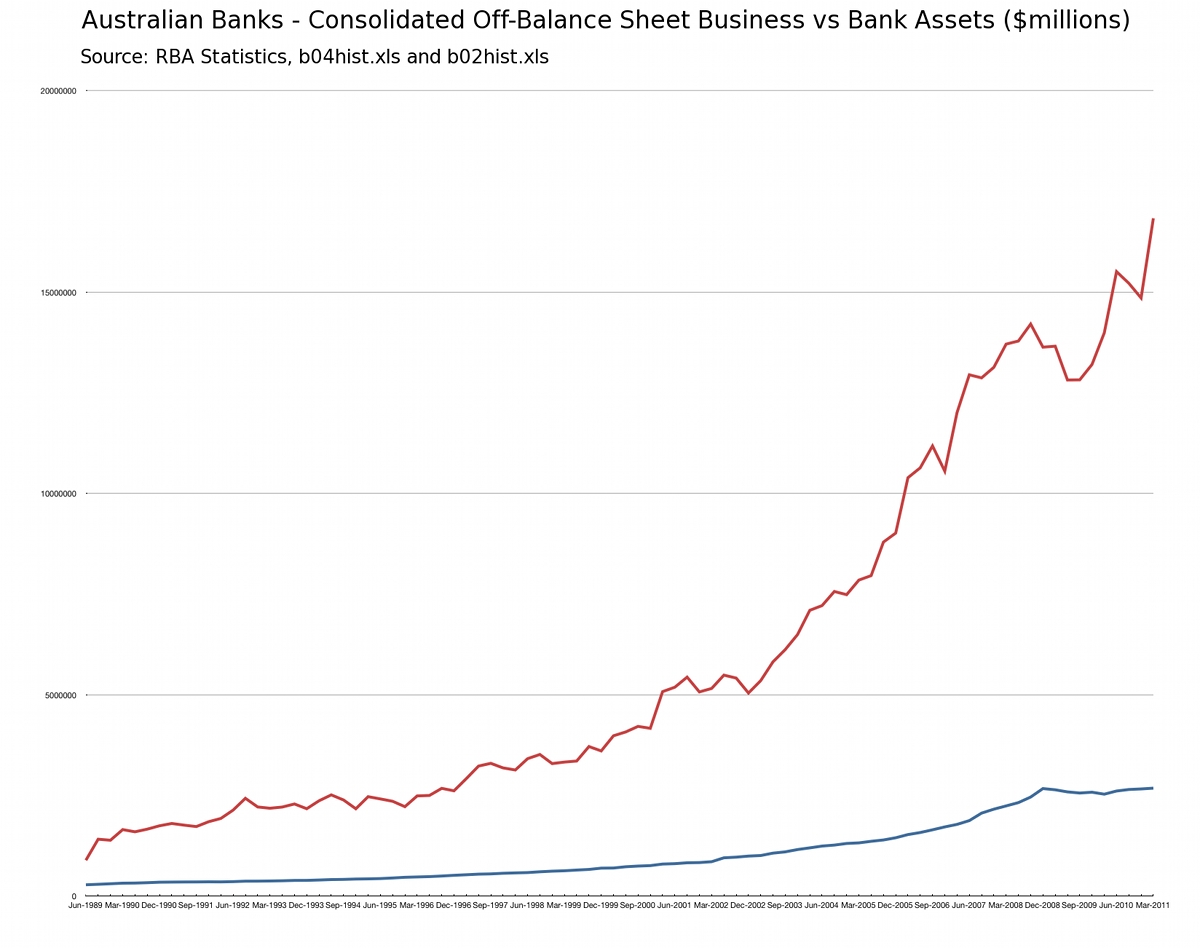
To give you just a tiny hint of the scale, take a look at the following graph of our Aussie banks’ total Off-Balance Sheet derivatives based on Foreign Exchange and Interest Rate bets (euphemistically called “hedges”, of course), current to end March 2011:

Click to enlarge

That’s $16.83 Trillion in Off-Balance Sheet derivatives “Business” (red line), versus only $2.68 Trillion in On-Balance Sheet “Assets” (blue line) – 2/3rds of which “assets” are actually loans.

According to David Bloom, global head of HSBC Foreign Exchange, our banks are racing towards “a bigger Armageddon” in foreign exchange markets … and they are racing towards it sitting atop that monster red line mountain of derivatives bets.

Try to imagine if you will, just how many derivatives that international (and local) bankers will create on top of the underlying “value” of Australia’s $23 starting price carbon “permits”, from the moment that the Brown-Gillard economic planking platform is rammed through Parliament.

And then, think carefully about the words of that Goldman trader just a couple of days ago, when one of the world’s largest miners almost vapourised off the sharemarket in 4 minutes flat.

“It had something to do with some derivatives”.

Barnaby: To Those Who Called Me Fool, Who’s Laughing Now?

8 Aug

Senator Joyce writes for the Australian.

Listen up this time!! –

The joy of vindication on the prospect of a US government default is bittersweet; I was right, Wayne was wrong. To those sucked in by the Treasurer, placing wishful romantic theory above clinical reality, then saying “you wouldn’t cut it with the Bloomsbury group if you talk like that at our soiree”, I suggest this, get real.

Do not confuse tackling a problem with delaying when it comes to debt. If while out on the tiles on a Friday night you discover a septic gash on your leg, and in response down another five jagermeisters, pain gone, problem gone, keep dancing, that is delay. Going to hospital to avoid amputation is dealing with the problem.

Tim Flannery said that the impact of climate change policies won’t be felt for at least a thousand years. The impact of a catastrophic default this time was avoided by a mere 10 hours. When prioritising threats I know which one I would be concentrating on.

Swan has given 25 speeches this year and mentioned climate change 24 times. Debt has only been mentioned 16 times, and eight of these in one speech made last month. A year and a half ago I implored the government to prepare contingency plans for the threat of a US default stating the prospect was “distant but real” but if it eventuated the fallout would be a financial Armageddon making the GFC look like a mere preamble. US President Barack Obama also used the term Armageddon in the past month, so if I’m mad, so is he.

When asked on ABC radio whether the government had prepared for a potential US default, our Treasurer could point to no specific actions taken. But we do have parts of Treasury modelling climate change. The Treasurer believes I have been captured by “Tea Partiers”. Disagree with him on climate change you’re a denier, disagree with him on economics you’re a Tea Partier.

Ken Rogoff, obviously another of Swan’s Tea Partiers, but also moonlighting as a professor of economics at Harvard University, has been warning about these problems since we were first introduced to the term sub-prime. The Global Financial Crisis involved ordinary people and silly governments taking on too much debt. There was nothing unique about it, the same process has been repeated over and over again with tulips, railroad stocks, Florida real estate, dot-com investments and our modern example, collateralised debt obligations.

A couple of years ago Rogoff wrote a book titled This Time Is Different, showing actually it’s almost always the same. Public debt crises are more common than economists tend to acknowledge and financial crises in particular place extreme stress on government finances.

Rogoff wrote a paper a couple of months ago titled A Decade of Debt in which he measured the increase in public debt in different countries since 2007, when we voted in these current economic luminaries. No surprises, Iceland and Ireland, are one and two but Swan got the bronze, Australia is third, with a 150 per cent increase in our public debt since 2007. As I previously said we can’t keep going on like this, but we are. We have just extended our debt ceiling to $250 billion.

In 2008, before the GFC’s nadir, Ireland’s net public debt was 12.5 per cent of GDP according to the OECD. The Treasurer boasts that our net public debt is low compared with others. The parliamentary library estimated last year our net public debt will be 12.3 per cent of GDP in 2012-13, the same year Swan predicts surplus.

In the political sphere the person who drives via the rear vision mirror, with a wonderful recitation about everywhere you have been and why, but not a clue where you are going, is dangerous. When, with a coterie of bureaucrats, they cannot keep the car on the black stuff but seem to be targeting the trees, you are in for the economic ride of your life.

Things changed for Ireland after it guaranteed the debt of its banks during the GFC. We have done that, too. Three years ago the Treasurer introduced the financial claims scheme which guarantees $730 billion in deposits. It’s up for review in October but there is barely a discussion about how we might mitigate the risks of such taxpayer exposure. We are too busy trying to cool the planet from a room in Canberra.

Barnaby is right.

Take very careful note of that last paragraph.

Moody’s ratings agency has already warned our government – when it downgraded the credit rating of all our banks in May – that the government’s guarantee was worth two ratings notches.

In other words, without the government guarantee – the our-future-earnings guarantee – our banks’ credit rating would be slashed even further.

Meaning higher interest rates for you.

The long overdue collapse of our housing bubble.

The collapse of our banks.

The bailout of our banks.

And Australia looking exactly like the rest of the Western world.

Oh yes …

And your super stolen by our government – both “sides” – to bail out the banks, and/or finance the floundering government.

Don’t believe me?

Fine.

Piss off then.

Or…

Read. And learn.

Start here –

Stealing Our Super – I DARE You To Ignore This Now

Barnaby: Embracing Crean’s Challenge Of Fewer Employment Opportunities

5 Aug

Media Release – Senator Barnaby Joyce, 4 August 2011 (my emphasis added):

Carbon tax to hit regional Australia the hardest

Figures released by the NSW Treasury this morning shows that a carbon tax will hit regional Australia the hardest, shadow Minister for Regional Development, Senator Barnaby Joyce said today.

NSW Treasury figures show that the carbon tax will lead to 31,000 lost jobs in NSW but over 26,000 of these jobs would be in regional Australia, including 18,500 in the Hunter, 7000 in the Illawarra and 1000 jobs in the central West.

“If Mr Crean wants to continue his “embrace the challenge” tour of regional Australia he needs to come clean with them how they are meant to embrace the challenge of fewer employment opportunities.

“This should be no surprise to anyone who understands regional Australia. Regional Australia is where most of our mines, factories and electricity generators. A carbon tax will clearly hurt regional Australia the worst.

“The NSW Treasury analysis also shows that electricity prices will increase by 15 per cent, not the 10 per cent promised the Prime Minister. That will amount to an extra $500 a year for the average household in higher electricity costs alone.

“Australian Government Treasury figures show that people in regional NSW pay 25% more for electricity than those in capital cities. That means regional Australia will bear the brunt of these price increases too.

“Why again are the regional independents, Mr Windsor and Mr Oakeshott, supporting this tax?”

The Carbon Pricing Scheme Is Unconstitutional

3 Aug

* Originally titled “It’s A Tax … No, It’s An Excise … No, We Really Don’t Know WTF It Is”, until I reflected that the above title might better attract a lawyer’s attention.

So.

Our government is going to impose a new cost on “persons”. For their “emissions” of carbon dioxide.

Those persons will have to pay a “charge”.

In exchange, they will receive a “permit” to “pollute”.

A permit to pollute which is both a property right … and effectively, is digital money.

So, what is that new government “charge”, then?

Is it a “tax”?

Is it a “duty of excise”?

It is an important question.

Because upon the answer to that question hinges another, far more important question.

The question of whether the government’s package of legislation bills for its “carbon pricing” scheme scam … is unconstitutional.

Indeed, for anyone paying close attention, there is tell-tale evidence that the government knows full well that their imposing a “charge” under their proposed “carbon pricing mechanism” would be unconstitutional.

Which explains why they are putting forward multiple, mutually-dependent, yet mutually-contradictory bills of legislation as part of their Clean Energy Future package, in a patently deceitful attempt to sneak this massive fraud through the Parliament.

Fortunately, this means that at least 3 of the 13 “backbone” draft bills of their too-clever-by-half package of legislation appear to leave our befanged, blood-sucking, undead government’s coffin lid wide open for any Constitutional lawyer with testicular fortitude and a functioning conscience – or, just a hankering to go down in history as the People’s Saviour – to drive a stake through the heart of the “carbon pricing mechanism” in the High Court.

(Though it may well require concerned citizens to stump up their cash en masse to help pay for a silver stake big enough to slaughter the Establishment – are you up for that?)

Today’s post, dear reader, details how the government’s Clean Energy Future package of legislation is unconstitutional.

Unfortunately, it does take a little time to go through the maze of this sewer-rat-cunning government’s deception.

So grab a cup of coffee, and settle in.

Ready?

From the government’s Clean Energy Bill 2011: Exposure draft, Part 4, Division 2, Section 100, Issue of carbon units for a fixed charge (emphasis added):

Charge payable

(10) If a carbon unit is issued to a person in accordance with this section, the person is liable to pay a charge for the issue of the unit.

(11) Subsection (10) has effect only so far as it is not a law imposing taxation within the meaning of section 55 of the Constitution.

Note: See also:
(a) Part 2 of the Clean Energy (Charges—Excise) Act 2011; and
(b) the Clean Energy (Unit Issue Charge—General) Act 2011.

So.

Where a carbon permit (a “unit”) is issued, and a person is liable to pay a charge for the issue of said unit – in other words, in the most basic function of the “mechanism” for the introductory “fixed price period” – the power of the Act to enforce payment for the unit only has effect insofar as “it is not a law imposing taxation” within the meaning of section 55 of the Constitution*.

Can it be any clearer, dear reader?

I was right.

It is NOT a tax.

The government’s own draft legislation specifically says so.

Greg Hunt MPpwned!

Next.

Consider carefully the two additional draft bills that are referenced in Section 100 of that primary government bill (emphasis added):

Note: See also:
(a) Part 2 of the Clean Energy (Charges—Excise) Act 2011; and
(b) the Clean Energy (Unit Issue Charge—General) Act 2011.

These are two different pieces of additional draft legislation.

And this is where the deception of this government begins to get really interesting.

Because the second of these two additional pieces of draft legislation for our so-called Clean Energy Future, contradicts each of the others with respect to the key definition.

What exactly is the legal definition – in the government’s proposed legislation – of the act of “imposing a charge” on “persons” in exchange for a carbon permit?

Above, in the major Clean Energy Bill, Section 100, we saw that the government defined that imposing a charge for a carbon permit is not done as an act of taxation under the Constitution section 55.

Just as I have argued all along.

But if not a “tax”, then what is it?

Let’s look at the first piece of additional draft legislation, referenced above as “Note (a)” in the bill for a Clean Energy Act. 

It is called the Clean Energy (Charges—Excise) Act 2011.

Beginning with the title on the front, both the connection and the definition are immediately clear (emphasis added):

A Bill for an Act to impose charges associated with the Clean Energy Act 2011, so far as those charges are duties of excise

And in Part 2 of this bill, we find the following details (emphasis added):

8 Imposition of charge

Auction

(1) If: (a) a carbon unit is issued to a person; and
(b) the unit is issued as the result of an auction;
charge is imposed on the issue of the unit.

(4) Subsection (1) imposes a charge only so far as that charge is a duty of excise within the meaning of section 55 of the Constitution.

Fixed charge

(5) If: (a) a carbon unit is issued to a person; and
(b) the unit is issued in accordance with section 100 of the Clean
Energy Act 2011 (issue of units for a fixed charge);
charge is imposed on the issue of the unit.

(8) Subsection (5) imposes a charge only so far as that charge is a duty of excise within the meaning of section 55 of the Constitution.

In other words, this additional piece of draft legislation insists that the government’s imposition of a charge for their carbon permits – in both the “fixed price” and the “flexible price” (auction) periods – will be done only on the basis of the imposed charge being deemed “a duty of excise” under section 55 of the Constitution*.

Clear enough?

The charge imposed is not a tax (Clean Energy Act 2011).

The charge imposed is a duty of excise (Clean Energy (Charges—Excise) Act 2011).

But wait!

The story does not end there.

Oh no, dear reader.

Prepare yourself for the truly risible punchline to this black comedy.

Because in the Note (b) mentioned above in the primary Clean Energy Bill, there is another piece of mutually-dependent legislation.

It is called the Clean Energy (Unit Issue Charge—General) Act 2011.

And this additional piece of legislation specifically and directly contradicts both of the previous definitions of what the act of imposing a charge for carbon permits actually is under the Constitution.

Here is what the Clean Energy (Unit Issue Charge—General) Act 2011 says in its title (emphasis added):

A Bill for an Act to impose charges associated with the Clean Energy Act 2011, so far as those charges are not duties of excise

And here is what we find in Section 8 (emphasis added):

8 Imposition of charge

Auction

(1) If: (a) a carbon unit is issued to a person; and
(b) the unit is issued as the result of an auction;
charge is imposed on the issue of the unit.

Subsection (1) imposes a charge only so far as that charge is:
(a) taxation within the meaning of section 55 of the Constitution;
and
(b) not a duty of excise within the meaning of that section.

Fixed charge

(5) If: (a) a carbon unit is issued to a person; and
(b) the unit is issued in accordance with section 100 of the Clean Energy Act 2011 (issue of units for a fixed charge);
charge is imposed on the issue of the unit.

Subsection (5) imposes a charge only so far as that charge is:
(a) taxation within the meaning of section 55 of the Constitution;
and
(b) not a duty of excise within the meaning of that section.

So.

According to the Clean Energy (Unit Issue Charge—General) Act 2011 – an Act which is “associated with the Clean Energy Act 2011” – the charge imposed only has force insofar as it is a tax, and is not a duty of excise.

Remember – in all of these pieces of legislation, we are talking about exactly the same “charge”!

Is it possible that this package of blatantly mutually-contradictory legislation might be challenged in the High Court?

Consider again.

We have three separate, yet mutually-dependent pieces of legislation, that are key vertebrae in the “backbone” of the government’s “carbon pricing mechanism”.

The main bill – Clean Energy Act 2011: Exposure draft, Part 4, Division 2, Section 100 – says that the imposition of a charge for carbon permits is not an act of imposing a tax.

Note (a) of that Clean Energy Act 2011, Section 100 references the proposed Clean Energy (Charges—Excise) Act 2011, Part 2.  Which says that

(1) it is an Act that is “associated with the Clean Energy Act 2011″, and that
(2) the imposition of a charge for carbon permits is an act of imposing “a duty of excise”.

But …

Note (b) of that Clean Energy Act 2011, Section 100 references the Clean Energy (Unit Issue Charge—General) Act 2011 Section 8.  Which says that

(1) it is an Act that is “associated with the Clean Energy Act 2011″, and that
(2) the imposition of a charge for carbon permits is an act of imposing a tax, and is not an act of imposing “a duty of excise”.

WTF?

Ladies and gentlemen, your humble blogger is a mere small businessman.  Not a lawyer.

But it seems obvious to me that, if the government cannot clearly and simply define what their charge for a carbon “unit” is – (ie) the burden of proof is on the government to show that their proposed new “charge” is in accordance with section 55 of the Constitution* – then their multiple, mutually-dependent yet mutually-contradictory definitions of what the “charge” is, must offer plenty of scope to challenge the legislation.

Moreover, there is another section of the Constitution which also gives rise to challenging the government’s legislation.

Given that their mutually-dependent, yet mutually-contradictory pieces of the legislation package collectively state that the proposed charge is (a) not a tax, and (b) not a duty of excise either, then the proposed imposition of a carbon dioxide “charge” appears to be in breach of the Constitutional powers of the government, section 51 (emphasis added):

COMMONWEALTH OF AUSTRALIA CONSTITUTION ACT – SECT 51

Legislative powers of the Parliament

The Parliament shall, subject to this Constitution, have power to make laws for the peace, order, and good government of the Commonwealth with respect to:

(ii) taxation; but so as not to discriminate between States or parts of States;

(iii) bounties on the production or export of goods, but so that such bounties shall be uniform throughout the Commonwealth;

If (as the government’s legislation confesses) the “charge” is not a tax, and is not a duty of excise either, then the government’s proposed imposition of a “charge” in exchange for carbon “permits” (or “units”), is not within the government’s powers to legislate, as defined by section 51 of the Constitution.

Are there any lawyers with testicular fortitude and a functioning conscience out there?

Just one, who might wish to become Australia’s national saviour.

How?

By challenging these key aspects of the government’s carbon dioxide “tax” legislation.

Note carefully just one possible angle of attack.

The entire “introductory” period of the government’s “carbon pricing mechanism” hinges upon the first clause quoted above, in the Clean Energy Act 2011, Section 100.

The government’s draft clause clearly – though sneakily – concedes that the power to demand payment from “persons” in exchange for the (compulsory) issue of carbon permits in the “fixed price period”, rests upon this action not being deemed an act of taxation under Section 55 of the Constitution.

All it takes is for one wise lawyer – backed by ample public funding – to challenge this in the High Court, and demonstrate that:

(a) the government has, in public discourse, consistently and repeatedly used the specific term “tax” in describing the introduction of its “carbon pricing mechanism”;

(b) by contrast, the government’s actual legislation with respect to the introductory “fixed price period” specifically states in its primary Clean Energy Act 2011 bill, that its power to enforce the “charge” during this period is dependent on the act of charging for a “unit” not being deemed an act of “imposing taxation” under Section 55 of the Constitution;

(c) the government’s other, mutually-dependent supporting legislation referenced by the Clean Energy Act 2011 is mutually-contradictory, and therefore the act of imposing the “carbon unit” charge would be in breach of section 51 and/or section 55 of the Constitution – because in the government’s own words, it is not a tax, and not a duty of excise either.

This punitive, climaticallyfutile legislation can be defeated.

Legally.

The government would, of course, try to defend its position by claiming that imposing a charge for the (compulsory) issue of a carbon “unit” is not a breach of the Constitution section 55.

Saying so, does not make it so.

Moreover, even if a Constitutional challenge failed to stop the legislation – who can really trust the government-appointed High Court, after all – consider this.

The government’s being forced to defend their legislation’s assertion that the introductory “fixed price period” is not a tax in the High Court, would serve to focus the public spotlight on the government’s many months of blatant lies and deception about what their scheme scam actually is.

Because – as I have said all along – what they are calling a “tax”, is not a “tax” at all.

Neither is it a “duty of excise”.

And the government knows it.

As now conclusively proven, by their own draft legislation.

Here finally endeth the lesson, on the “tax” that even the government’s own legislation says is not a “tax”.

Calling all lawyers …

* COMMONWEALTH OF AUSTRALIA CONSTITUTION ACT – SECT 55

Tax Bill

Laws imposing taxation shall deal only with the imposition of taxation, and any provision therein dealing with any other matter shall be of no effect.

Laws imposing taxation, except laws imposing duties of customs or of excise, shall deal with one subject of taxation only; but laws imposing duties of customs shall deal with duties of customs only, and laws imposing duties of excise shall deal with duties of excise only.

Barnaby Brings The Elephant Into The Room

27 Jul

From the Australian Financial Review via Queensland Country Life (emphasis added):

Nationals senator Barnaby Joyce asked a question at a federal Senate inquiry during the week that went to the heart of the issues surrounding coal seam gas miners’ controversial use of land.

He asked representatives of the Australian Petroleum Production and Exploration Association, including former Santos vice-president Rick Wilkinson: “You are giving landholders $10 million to $15 million a year [in compensation] while you are collecting $8.5 billion a year. You would have to say that’s a pretty good deal, right?”

Although there are countless protests about gas miners’ impact on prime farming land and water tables, Senator Joyce’s question brought the elephant into what was an already packed room, reports The Australian Financial Review .

In Australia, where miners have the right to walk on to a property and take out what they like from the ground, compensation packages are relatively frugal.

Texas land owners in the US control the subsurface and, as such, control much bigger cuts of the exploited resources.

Some critics hope for a moratorium on CSG projects until environmental effects are better understood.

But that is unlikely to happen where governments estimate the gas industry based in just one region such as Gladstone could generate 18,000 jobs and up to $850 million a year in royalties.

Cotton Australia’s Michael Murray revealed in the Senate inquiry that specific requests from the federal Minister for Sustainability, Environment, Water, Tony Burke, to protect the Condamine Alluvium were knocked back by the Queensland government.

He said that the requests by the minister were amendments of an environmental impact statement provided by a gas company seeking to start exploration in the area.

The reason why Australian farmers – and our precious agricultural land – are treated like dirt by the mining industry, is a complex and nuanced reality.

One which can be summarised easily.

And brutally.

That reality is this.

Our nation is a quarry.

A quarry to be exploited.

By the mega-wealthy international banking class.

And by the myriad of bottom-feeding parasites, who live very well indeed off the not-inconsiderable crumbs that fall from the table of the banksters’ globalised feeding frenzies.

As I always say, in a world where nothing is as it appears – Life is actually quite simple.

If you want to know what is really going on …

Follow The Money.

Funding For Policy Scandal – Australia Is A Kleptocracy

26 Jul

Do you want to know how deep the rabbit hole goes?

h/t to Twitterer @Kmorefive for bringing the following to my attention.

From Business Spectator (emphasis added) –

An ALP funding horror

Robert Gottliebsen

If an election is held in the next few months, Australian banks will play a big role in the outcome. And unless there is a dramatic change in the fortunes of the parties, the banks will still be key players if (as is likely) the next election is two years away.

Australia has rarely seen such a banking/election event in its history and it certainly did not occur in recent elections. The looming role of the banks could force the ALP into a pre-election leadership change and in extreme situations force it to modify its carbon tax.

To understand the pivotal role of Australian banks in the funding of political parties requires a deep knowledge of how the system works.

For the most part, in the vicinity of three quarters of a major party’s funding in most elections comes from the public purse. The ‘public purse’ amounts are allocated to parties after the election in accordance with the proportion of the votes that are achieved.

But there is no forward allocation of money. The distribution of ‘public purse’ money is strictly governed by the proportion of the votes actually achieved.

ALP organisers are not looking forward to meeting with their bankers as the election nears. They are deeply apprehensive that as a result of current opinion polls, their bankers will slash the amount of election funding available to the ALP and lock it into a low vote.

Conversely, Liberal and National Party organisers believe that as a result of their opinion polling they will receive a huge increase in support from their bankers to fund unprecedented amounts of advertising and promotion.

If, theoretically, an election was to be held in a few months’ time, ALP organisers would go to their bankers and negotiate to borrow the money required to fund the campaign expecting to pay it back when they receive their ‘public purse’ money after the election. This might be the conversation:

Banker: What proportion of the votes do the opinion polls suggest you will gain?

ALP organiser: The current Nielson poll suggests we would gain 26 per cent of the primary vote but we know we will do better.

Banker: Maybe you will, but if I lend you money that represents the amount you will receive from the ‘public purse’ if you attained, say, 40 per cent of the vote, I might bankrupt the ALP if you only receive 26 per cent because you could not pay me back. That would not only give my bank a bad debt but it would be disastrous for Australian democracy.

ALP organiser: But it will be disastrous for Australian democracy if we are decimated at the polls because we have only meagre advertising money.

Banker: I am sorry but I have shareholders and I need a safety margin. I will fund your advertising on the basis that you receive 20 per cent of the votes. You will need to be much more skilled in using non-advertising promotions.

The Coalition conversations with their bankers would be the exact reverse of this.

The ALP organisers fear that the party is going to be much more dependent on union contributions than it has been in recent times. This may tend to spin the party to the left, although many unions are opposed to the carbon tax. Those unions opposed to the carbon tax may require modification before they inject ‘rescue’ money. However, if they see Tony Abbott moving to water down industrial relations legislation they may be tempted to dig deep.

In the case of the Coalition, the parties will depend less on contributions from party members and corporate supporters, assuming they maintain the current lead in the polls.

In reality, if the current opinion poll levels are maintained then it will make it very difficult for the ALP to gain the election funding to change its fortunes at the polls.

As the horror of this outcome becomes apparent to party members, they may seek to replace the prime minister with someone who might either lift the party’s ratings in the polls or who will attract more union rescue money. The ALP has its back to the wall.

There you have it.

The banksters do have a powerful, direct influence over the direction this nation goes.

Now we understand even more clearly, why a Banksters’ Glee Club comprising a clear majority bank-employed “leading” economists has been publicly barracking for the government’s carbon pricing scheme scam.

Mr Gottliebsen’s revelations on how electoral funding really works in practice are seriously troubling, in their implications for what amounts to a clear opening for the perversion of the democratic process.

And yet, I think he is (perhaps naively?) completely misunderstanding what those implications are, in terms of the most controversial public policy right now.

Quite simply, he’s reading the implications backwards.

Because I suspect that the ALP will not have much difficulty in getting the loans they want/need for their election campaign. Especially whilstever they cling to the bankster-driven “pricing carbon” policy.

And in terms of the Liberal Party, in light of the constant appeals for donations that seemingly appear in all of their public communications collateral (emails, newsletters etc), I suspect that the anti-carbon tax Abbott-led Coalition is not sitting as prettily with their bankers as Mr Gottliebsen seems to believe.

Now, to an interesting and directly related front.

If our basic contention – as implied by Mr Gottliebsen’s article – is that our political parties’ policies can be and ultimately are determined by their financial backers’ willingness to loan (or donate) to their election campaign funding, then we only see further supporting evidence for that somewhat chilling reality check in this news story about another of Green-Labor’s proposed policies (emphasis added) –

About 1800 cement industry jobs are at risk from Labor’s carbon tax and proposed new shipping rules, the federal opposition says.

Nationals leader Warren Truss says the $2 billion a year industry is facing a double whammy under the Gillard government.

He says domestic cement manufacturers could be killed off by “dirtier” imports, made cheaper under the carbon tax.

“The paradox is Australian cement production is a leader in low emission technology and any shift to imports will force global CO2 emissions to rise,” Mr Truss said in a statement.

Mr Truss said Australian cement had the world’s second lowest greenhouse gas emissions behind Japan.

“But the carbon tax will price Australia’s cleaner cement out of the market, giving the green light to our international competitors to boost their higher CO2-emitting production and flood Australia with dirty cement,” he said.

“… the Australian cement industry will be crushed by competitors who will not be paying a carbon tax.”

Mr Truss said Labor was also rewriting the Navigation Act to force businesses that ship products around Australia to use local, union-dominated vessels.

He said “unionised shipping” costs significantly more than current market rates, which would be another blow to the industry.

“Right now it costs about the same to ship cement from China to Australia as it does to ship it from Adelaide to Port Kembla,” he said.

Under the Gillard government’s sop to the maritime union, our biggest competitors in cement – China, Indonesia, Taiwan and Thailand – will dramatically undercut Australian suppliers on shipping costs alone.”

He said a large section of the cement manufacturing sector would not be compensated under the carbon tax plan.

The compensation package only applied to processing clinker, the first stage of making cement, he said.

“The second milling stage to make what we know as cement receives no compensation,” Mr Truss said.

So, the real reason why the Green-Labor Government has been slowly re-regulating (ie, re-unionising) the Australian economy … is because they need their money to finance their election campaign.

The lesson we must learn?

When it comes to the all-important consideration of why a politician or party really adopts the policy/s that they do, the Golden Rule always applies.

Follow The Money.

The following of which will always lead you down the rabbit hole … into the wonderland of global finance.

More honestly and accurately called, “bankstering”.

Ladies and gentlemen … we are not living in a democracy.

We are living in a kleptocracy.

What are you going to do about that?

The “500 Biggest Polluters” Exposed – Everything The Government Is Not Telling You

25 Jul

Do you think that the “500 biggest polluters” are all – or even “mostly” – power stations, miners, and heavy industry?

That is certainly what the government would have you believe.

Take a careful, close look at the exact words used by our government on the “500 biggest polluting companies” page of their new website (emphasis added) –

Most are companies operating large facilities (with over 25,000 tonnes annual CO2-e emissions) that directly emit greenhouse gases, such as power stations, mines and heavy industry.

Seems pretty clear, doesn’t it?

If you take the government at their word, then you have been led to fully expect that “most” of the “500 biggest polluters” are power stations, mines, and heavy industry.

And, that “most” of the “500 biggest polluters” “directly emit” greenhouse gases.

Would it surprise you to learn then, that our electricity generators, along with all the related companies that supply electricity and maintain the transmission networks, only comprise a tiny 7% of the total companies listed on the government’s official NGER Register of “polluters”?

And would it surprise you to learn that the 2nd biggest number of “polluting companies” are actually Freight / Transport logistics firms.

That’s right … truckies.

The people who haul our food and everything else we need, right across this huge, sparsely populated island continent, to our local retailers where we can easily purchase it.

And would it surprise you to learn that the 3rd biggest number of “polluting companies” are actually Food Manufacturers.

That’s right … the good folk whose sweat and toil keep us all alive by taking the raw ingredients and making our daily bread … and cereal, and meat, and veges, and dairy products, and processed foods, and snacks, and … you get the idea.

And would it surprise you to learn, that the government’s own official National Greenhouse and Energy Reporting (NGER) department’s complete Register also includes the following categories of “biggest polluters”:

* 62 government entities, such as local councils and State-owned enterprises.

* 22 hospital / health care companies, encompassing 131 public and private hospitals, plus 100’s of day surgeries, clinics, aged care, rehab, palliative, mental and other health care services.

* 19 water utility companies.

* 19 universities.

* 7 renewable energy companies.

* 7 recycling companies.

* 3 biofuels companies.

* 3 scientific research and development companies (including the CSIRO).

* 18 public transport companies.

* 41 unknown, unidentifiable “companies”, including 3 whose ABN number (as provided to the NGER) is not recognised by ASIC, and 1 deregistered from ASIC.

* 7 companies now in receivership or liquidated.

* 1 recently-abandoned state government/private consortium joint venture company, that had been hoping to sell wind farms to China.

* 1 gold miner that ceased all active mining operations in Australia in September 2010.

* 1 gold miner with an office in Brisbane, but all active mining operations in Indonesia.

* Double-triple-quadruple-quintuple-ups of companies owned by the same parent, or recently merged.

The government claims that the (absence of any real) information it has (not) provided to the public about these “500 biggest polluting companies”, is based on the data from its own National Greenhouse and Energy Reporting (NGER) department.

Problem 1.

The NGER’s most recent Report dated April 2011 shows only 299 “polluters” reporting emissions for 2009-10.

Problem 2.

The NGER’s complete Register of “polluters” shows only 775 company names and/or their ACN numbers. And no other information.

So our first obvious question must be this:

How can the government justify the claim “1,000 of the biggest polluters”, endlessly repeated for months until mere days before unveiling their scheme, when their own official NGER Register only has 775 company names on it?

Our second obvious question must be this:

How can the government justify the claims made on their “500 biggest polluting companies” webpage, when

(a) only 299 companies reported emissions in their NGER department’s latest Report, and

(b) their official NGER Register of 775 “companies” provides no information by which to easily identify either the location, or industry sector, of each of those companies?

For example, here is what the government claims on its new website concerning the number of “biggest polluting” companies in each State:

Of these businesses, it is estimated that around:

  • 135 operate solely in New South Wales and the ACT
  • 110 operate solely in Queensland
  • 85 solely in Victoria
  • 75 solely in Western Australia
  • 25 solely in South Australia
  • 20 solely in Tasmania; and
  • fewer than 10 solely in the Northern Territory.
  • a further 45 liable entities operate across multiple states.

And the government goes on to claim that (emphasis added):

Of the 500 businesses:

  • around 60 are primarily involved in electricity generation
  • around 100 are primarily involved in coal or other mining
  • around 40 are natural gas retailers
  • around 60 are primarily involved in industrial processes (cement, chemicals and metal processing)
  • around 50 operate in a range of other fossil fuel intensive sectors; and
  • the remaining 190 operate in the waste disposal sector.

Note all the nice round numbers. “5’s” and “0’s”.

Importantly, the government then effectively negates any believability or value in its nice round number claims, with this ultimate catch-all, cover-your-arse disclaimer (emphasis added):

It should be noted that these numbers are estimates only, and are largely based on emissions data previously reported under the National Greenhouse and Energy Reporting system.

Got that?

The “around” this and “expected to be” that statements made earlier on the same page by the government, are “estimates only” based “largely” on the NGER data.

And what is the excuse for the lack of detail or clarity concerning the government’s claims about the “500 biggest polluting companies”?

Here is what they have to say about that, in the most recent government publication on the subject, hidden away on the Parliament House Library website, 14 July 2011 (emphasis added):

Which 500 companies pay the tax?

… The government has released a Factsheet detailing the types of facilities that will be covered and their distribution by State, but no information on which private and public bodies will actually be responsible for paying the tax.… the legislation includes caveats to protect the confidentiality of commercially sensitive information

For these reasons, the NGER data is not an accurate reflection of a company’s greenhouse gas emissions…

Nonetheless, and although imperfect, the NGER data is the only public information that provides any indication as to which companies may be liable under the proposed Carbon Pricing Mechanism. Bearing in mind the limitations of the data as just detailed, below is the latest NGER list, ordered by decreasing scope 1 emissions.

As we saw in my article “The ‘Biggest Polluters’ Are? – Food For Thought If You Like To Eat, Drink, Or Bathe”, after this catch-all disclaimer there follows a not-numbered list of “polluters” totalling (once you add them up yourself) … 299 companies.

In other words, it is just the NGER department’s latest Report, reordered. There is no new or additional information provided.

Well dear reader, your humble blogger has employed all of his spare time over the last week in researching the NGER’s entire 775 “company” Register.

Just to see exactly who and what kind of companies really are considered to be “the biggest polluters” in our nation.

Before I give you a link to download the spreadsheet for yourself, please take a few moments to brush up on the key details of what is included.

Because there’s a lot of information here.

The spreadsheet has eight (8) individual worksheets included, as follows:

Sheet 1 – NGER Report April 2011 (this is simply the government’s own most recent NGER Report, unedited – original here)

Sheet 2 – NGER Register March 2011 (this is simply the government’s most recently available copy of the complete NGER Register, unedited – original here)

Sheet 3 – Combined NGER by state, industry – HQ state listed if Multistate (this combines Sheet 1 + 2 data, plus my research. Key to note is that in the breakdown by State, this worksheet checks the box for the state where a company’s HQ or primary site is located, as well as checking the “Multiple States” box where applicable).

Sheet 4 – Combined NGER by state, industry – Multistate identifier only (this worksheet is the Daddy; it is per Sheet 3, but only checks “Multiple States” where applicable, rather than also checking the box for the company’s HQ state; this has been done to more easily and directly compare Totals per state with the government’s “500 biggest polluting companies” page)

Sheet 5 – “500 Biggest Polluters” >25k tonnes p.a. CO2 / By state (this worksheet compares the government’s claimed companies by State with the full NGER list)

Sheet 6 – “500 Biggest Polluters” >25k tonnes p.a. CO2 / By sector (this worksheet compares the government’s claimed companies by Sector with the full NGER list)

Sheet 7 – Operating Fossil Fuel Power Stns – ga.gov.au/fossil_fuel/ (this worksheet is an unedited list of power stations found on the indicated government website. Please be aware that I am unable to ascertain its currency, but I note that in References there are quoted news articles from mid-late 2010, suggesting it may be the most currently available government information – original here)

Sheet 8 – APH Library – Carbon Pricing – Companies 14 July 2011 (as mentioned above, this is the table of 299 “polluters” in order of decreasing emissions, as published on the Australian Parliament House Library website 14 July 2011 – original here).

A couple of important points to note:

NOTE 1. On the far RHS of Sheets 3 & 4, you will see that I have listed the government’s six (6) industry sectors as worded on their “500 biggest polluting companies” webpage:

Electricity generation

Coal and other mining

Natural gas retail

Industrial (cement, chemicals, and metal processing)

Other fossil fuel intensive industries

Waste disposal

I have also added two more “sectors” of my own:

NONE (specifically) of Gov’s broad categories

UNKNOWN (no information available)

Four very important sub-points to understand are these.

(a) The totals for the 6 government-described industry sectors on the far RHS are just that … Totals. As you will see, I have also classified (where possible) every company listed on the NGER Register into one of 43 more detailed industry sector descriptions, that I have created.

(b) Where a company is government-owned, I have checked my “Government” sector for that company, and the relevant detailed industy description category as well.

(c) I have included companies involved in “(supply / distribution)” of electricity in the government’s category of “Electricity generation.

(d) With the exception of electricity-related companies as per (c), in researching the 775 company names listed in the NGER Register, if it was apparent to me that the company’s self-description of its activities (where available) did not clearly and directly fit the government’s precise stated wording of its 6 industry sectors, then in these RHS totals, I checked my own category “NONE…” as the default for that company. Or “UNKNOWN”, where no information is available on the internet.

The obvious result of this is that I have many companies listed in the RHS industry sector totals, in the category of “NONE…”.

Why? Because their actual activities do not necessarily fit the government’s mere 6 industry sector descriptions, as displayed on the “500 biggest polluting companies” webpage.

The government would (due to its deliberately choosing only 6 descriptions of industry sectors) clearly have no choice but to place most/all of the companies that I have totalled up in the “NONE…” category, into its misleading and deceptively titled “Other fossil fuel intensive industries” category.

Which brings me back to the #1 fundamental point made at the very beginning of this article.

One that goes to the very heart of this Green-Labor Government’s gross dishonesty, and blatant misrepresentation of truth.

Remember the opening words of the government’s “500 biggest polluting companies” webpage?

Here they are again –

Most are companies operating large facilities (with over 25,000 tonnes annual CO2-e emissions) that directly emit greenhouse gases, such as power stations, mines and heavy industry.

When categorised as closely as practicable in accordance with the 6 industry “sector” descriptions chosen by the government for their official webpage, then some 478 companies (according to my research) out of 775 companies listed in their NGER Register, would have to be lumped into the government’s category of “Other fossil fuel intensive industries”.

Furthermore, in consideration of the government’s own description of “most” of the “500 biggest polluting companies”, then this majority of companies on the NGER Register would be deemed by our government as “large facilities” that “directly emit greenhouse gases”, “such as power stations, mines, and heavy industries”.

Clearly, this is factually untrue.

The majority of individual companies listed on the official NGER Register are not “large facilities”.

Are not “power stations, mines, and heavy industries”.

And do not “directly emit greenhouse gases”.

Indeed, at best only 54 companies (7%) of the 775 total are currently, actively, and directly involved in the generation and supply / distribution of electricity.

At best, only 137 companies (17.6%) are miners, and/or primarily involved in “heavy” mining support industries.

And according to the NGER department’s latest Report, only 299 companies (out of 775) actually reported “direct” greenhouse emissions in 2009-10.

NOTE 2. I have included a colour coding system in Sheets 3 & 4, to help identify interesting anomalies in the NGER Register data. The colour codes and their descriptions are shown in the top LHS corner of those Sheets, and are self-explanatory.

Ok then, here it is.

The complete spreadsheet in xls format for you to download if interested:

NGER_Register_Report_Combined_Polluters (1.6Mb)

I do not wish to claim or even imply that my research is perfectly accurate in all respects. The paucity of available information on the internet concerning many of these companies, of itself ensures that it is imperfect.

However, it is a solid foundation for further research. And in particular, for comparison against future government claims.

Even as it presently stands, I believe it shines a clear light on the fuller truth concerning our so-called “biggest polluters”.

Ladies and gentlemen, the reality is this.

The Green-Labor Government wants you to only visualise images of power stations, mines, and heavy industries, whenever you hear or think about their “carbon pricing mechanism”.

Because their choice of words is propaganda.

Perception management.

Their choice of words conjures up images of dirty, sooty, sweaty, evil “big polluters”.

The truth of the matter though, is that their scheme will not benefit the planet one iota.

It will only benefit bankers. Because that is what all carbon dioxide tax/trading schemes are designed to do.

It will not “hurt” only the relatively small number of dirty, sooty mining companies and heavy industries. The people who make stuff.

(Especially not, when we now know that the government is giving free carbon permits equal to 94.5% of average emissions for the “worst” “polluters”, like aluminium refineries.)

Instead, the government’s carbon dioxide “pricing mechanism” will really hurt the many clean, hygienic companies who make your food.

And deliver your food.

It will hurt those clean, hygienic companies who provide you with water to drink, wash in, and flush your dunny with.

It will hurt those clean, hygienic companies who provide you with hospital and health care.

It will hurt those companies that provide you and/or your children with a university education.

It will hurt those companies that provide you with public transport.

It will hurt those companies who air and sea freight in all of the crap that you buy from overseas, because successive governments have so screwed over our manufacturing industry that this nation makes next-to-nothing ourselves anymore.

It will hurt most or all of the 93 manufacturing companies still left in this country (according to the NGER Register) – many of whom are already foreign-owned.

And yes, it will hurt the companies who dig wealth out of the ground, providing employment for tens of thousands of Aussies.

And yes, it will hurt the companies who (used to) provide us with cheap, efficient, reliable electricity to keep our lights on and appliances working.

It is a brilliant plan, dear reader.

That is, it’s brilliant if your goal is to enrich international bankers and carbon derivatives speculators.

While at the same time, under-mining the heart and soul of (what’s left of) our national economy.

This is the truth hiding below the surface of all the government’s lies.

You just have to take a closer look.

Design a site like this with WordPress.com
Get started