Tag Archives: julia gillard

GilSwan Conned – Mining Tax The Greens’ Pit Of Despair

22 Dec

See those storm clouds gathering?

Over the Pit of Despair?

I wonder how Greens’ supporters will respond, when they wake up and discover the truth.

That their party’s deal with Labor on the mining tax will have the opposite result of what they were told.

I wonder what will they say, when they discover that the Minerals Resource Rent Tax (MRRT) will not result in the kind of wealth redistribution that was touted, a “fair share of our mineral wealth for all Australians”.

That instead, it will result in the Big 3 multinational mining companies … getting bigger. And richer. And more powerful.

And the government’s budget digging even deeper into the red.

When PM Gillard and Treasurer Swan went behind closed doors with the Big 3 miners to thrash out a hasty “fix” to former PM Rudd’s Resource Super Profits Tax (RSPT) debacle, thinking folks knew it would not end well.

Except for the big miners, that is.

Rather than scoring a vital goal for her “decisive” new leadership before the 2010 election, the secretive deal always looked more likely to result in yet another decisive Labor own goal.

And indeed it has.

Especially after Gillard and Swan again went behind closed doors, this time with the Independents and Greens, to thrash out a political deal to secure passage of the legislation in the parliament.

Late last month, after the new MRRT legislation passed the lower house, mining correspondent for The Australian Andrew Burrell belled the cat:

FEWER than one in 10 iron ore and coal miners operating in Australia will earn enough profit to start paying the $11.1 billion minerals resource rent tax from next year, according to Gillard government estimates.

A spokesman for Wayne Swan said yesterday he could not provide the names of the “estimated 20 to 30″ companies that were likely to pay the MRRT in 2012-13 because it was impossible to say how many companies would earn more than the annual profit threshold of $75 million.

“We haven’t got a precise list,” the spokesman said.

“But we have said the vast bulk of MRRT will be paid by the big three (BHP Billiton, Rio Tinto and Xstrata).”

Mr Burrell went on to reference the PM’s ever-changing claim for how many miners will be impacted under her revised grand design.

A claim most noteworthy not for its credibility.

But for its familiarity.

A remarkable familiarity to her “1,000 biggest” / “500 biggest” / “more like in the order of like, 400 biggest polluters” claim.

And the “half a million” / “300,000” jobs creation claim.

And the “4%” / “3.25%” projected GDP growth claim.

And the “3.5bn surplus” / “1.5bn surplus” projected budget outcome claim.

Big Labor government claims that are always being revised … downward:

Julia Gillard said last year that 320 iron ore and coal miners operating in Australia could be eligible to pay the MRRT — down from 2500 under the original resource super-profits tax that applied to all commodities.

In a deal with Tasmanian independent MP Andrew Wilkie on Monday, the government agreed to raise the profit threshold for the tax from $50m to $75m.

Mr Wilkie revealed the move would restrict the number of companies paying the MRRT to fewer than 30.

But this failed to quell criticism from junior miners, which claim the design of the tax still favours the established miners.

It remains unclear how the government will raise $11.1bn in the first three years of the MRRT.

Billionaire miner Andrew Forrest added to the confusion last week when he estimated that his iron ore company, Fortescue Metals Group, would largely avoid paying the tax for at least five years thanks to the substantial writeoffs available to all big producers.

Many in the industry also doubt whether BHP, Rio and Xstrata will face big MRRT liabilities, particularly in the early years of the mining tax.

This is because the design of the tax allows iron ore and coalminers with existing operations to price their assets using today’s inflated market values and claim potentially massive deductions…

Glyn Lawcock, a top-rated mining analyst at UBS, said it was impossible to predict with accuracy how much MRRT companies would pay from next financial year because it was difficult to calculate a company’s market value, which was used to determine MRRT liability.

When asked whether he believed the government could raise $11.1bn over three years, he said: “I scratch my head a little bit at that.”

It certainly is a head scratcher. Especially when one takes the time to carefully review the Treasury department’s Minerals Resource Rent Tax Bill 2011 document.

Recently a mining industry chief executive walked your humble blogger through this document. And explained that there is a very good reason why there has been little except “token noise” from the mining industry over the GilSwan MRRT, in stark contrast to the spirited fight put up against the original Rudd RSPT.

It is because in his words, “big miners will pay nothing for years, and small miners will pay nothing at all”.

But there’s more. In having the details explained to me, an even bigger flaw dawned.

A key insight, that mainstream economic commentators have not cottoned on to.

The clever accountants and lawyers for the Big 3 appear to have conned GilSwan into creating a tax mechanism that not only allows the Big 3 to defer paying any MRRT for years. It is a “tax” that acts as a financial incentive for the Big 3 to increase their monopoly, by gobbling up their smaller competitors and getting MRRT write-offs for doing so.

To understand how, let’s work through the details of the Treasury department’s document (emphasis added):

New investment will be given generous treatment in the form of immediate write‐off, rather than depreciation over a number of years.  This allows mining projects to access the deductions immediately, and means a project will not pay any MRRT until it has made enough profit to pay off its upfront investment.

Sounds good if you are a start-up miner or explorer, right?  No doubt this idea was sold to GilSwan by the Big 3 as being “necessary” to encourage future mining investment, given that the MRRT places Australia at a competitive disadvantage versus other nations that do not have an MRRT.

But it’s also an obvious loophole that immediately dawned on your humble blogger. One that favours the Big 3 miners, who have the deepest pockets.

Consider.

What happens if a big multinational miner such as BHP, Rio Tinto, or Xstrata buys out a smaller mining company, such as a junior explorer or a company with proven but unrealised in-ground reserves?  It would appear they can claim the cost of that “new investment” as an immediate tax write-off, thus offsetting any MRRT they might otherwise be obliged to pay with respect to their other mining projects.

As you will see in a moment, this is no mere speculation by a sceptical blogger with an eye for detail.

It is exactly what the mechanism allows.

But it gets better for the big miners.

What if that smaller miner or junior explorer that they have now bought out, is presently making losses? Remembering that all do, typically for the first 5-10 years of the mine’s life:

• The MRRT will carry forward unutilised losses at the government long term bond rate plus 7 per cent.

Buy up a smaller, loss-making mining company. And claim the value of their unutilised losses against your other MRRT obligations.

Can’t believe that GilSwan (and the “bozos” in Treasury) could be this stupid?

They are:

• The MRRT will provide transferability of deductions. This supports mine development because it means a taxpayer can use the deductions that flow from investments in the construction phase of a project to offset the MRRT liability from another of its projects that is in the production phase.

No use to a small mining company with only one project. But manna from heaven to a large multinational miner with multiple projects.

Buy up a junior explorer, or a mining company that has proven reserves but has not yet begun/completed construction on the project. Claim 100% of the costs against your MRRT liabilities from other, active producing projects.

Thanks to the MRRT, the initial ‘new investment’ in swallowing up a junior mining company, and the ‘unutilised losses’ of that junior mining company, and the construction costs of taking that newly-acquired mining company’s project to production stage, all these now become tax-minimising assets to a hungry Big 3 multinational looking to take over their smaller, up-and-coming (Australian-owned) competitors.

But there’s still more:

• The MRRT will recognise the particular characteristics of different commodities, by applying a taxing point close to the point of extraction, and using appropriate pricing arrangements to ensure only the value of the resources extracted is taxed.

The Big 3 miners were very clever indeed in negotiating this “deal” with GilSwan.

As my mining industry source pointed out to me, the point of extraction is the point of lowest value of the ore; the grade is far below “shipping grade”, and so its value is far below the actual market value. He cited the example of copper ore.

At the point of extraction, the ore may only comprise 1% copper. The value of the ore at this point is around $20 per tonne.

But when subsequently processed into a 25% copper concentrate, the value is around $1,387 per tonne.

And the cost to the mining company of processing the raw 1% copper ore into 25% copper concentrate?

“About $30 per tonne.”

When the Big Miners insisted on the tax being applied “close to the point of extraction”, they took advantage of GilSwan’s abject ignorance of real-world business.  An ignorance that has been all too often seen in their many other policy calamities – think ceiling insulation, school halls, computers in schools, subsidised Toyota hybrids, green schemes, set-top boxes, and the daddy of them all, the no cost/benefit analysis NBN.

You should not be surprised, dear reader.  Not when our World’s Greatest Treasurer has an Arts degree, zero business experience, and has never worked a real job in his life.

Which explains, of course, why we are paying him $262,000 per year. And why we are about to increase his salary by $84,000 per year. And why we have spent $75,440 in 6 months on empty RAAF VIP “ghost” flights to ferry him about.

This ignorance of how things work in the real world is borne out even more starkly however. Not only have GilSwan agreed to impose the mining tax “close to the point of extraction”, (ie) at the ore’s lowest value, far below its value-added market value. They have also agreed to a 25% extraction allowance:

• The MRRT will provide a 25 per cent extraction allowance to further shield from tax the important value add and capital that mining companies bring to mineral extraction.

Further shield” it?!  When they are already applying the tax “close to” the point of its lowest value?!

Ignore if you can all the other write-offs and deductions for a moment. What this “extraction allowance” really means is that GilSwan have not only agreed to tax the ore at or near its lowest value. They have also agreed to an effective tax rate of only 22.5%. Not the headline 30%.

In other words, this so-called “super profits tax” will be applied at 25% less than the standard company tax rate that even my own small business has to pay!

But where the now-familiar Labor descent into complete farce reaches its denouement, is when we get to the Treasury department’s modelling:

How the MRRT works

The following example is intended to illustrate how the MRRT will apply to iron ore and coal projects, commencing after 1 July  2012.

The example presents outcomes for a single project company with an equity financed mine that operates for 5 years.  The company is assumed to invest $1 billion in the first year of the project.  Over the life of the project the pre‐tax rate of return (revenue less operating and investment costs) is 50 per cent.

Click to enlarge

As my mining industry source assured, the modelled assumptions are beyond fantastic.

They are positively delusional.

The Treasury assumes this fairytale mining company begins to show “Revenue” of $520 million at Year 2 (see table). In the real world, a start-up mining project typically absorbs 5-10 years of losses before they even begin productive operations. My mining industry source pointed out that he has never heard of any mining company ever going from zero revenue to half a billion in a single year.

The Treasury also assumes this fairytale company has Year 2 operating expenses of 25% of revenue, and 25.5% at Year 6. Again … unheard of figures.

Back to the modelling:

The MRRT is levied at a rate of 30 per cent of the operating margin (revenue less operating and investment costs) less the MRRT allowance and the extraction allowance.  The MRRT allowance is calculated as the value of unused losses uplifted by an allowance rate equal to the long term government bond rate plus 7 per cent…

When we look at Year 4 in the example, the year in which Treasury has modelled the first MRRT “profit” (an inconceivable $436m), we find another problem. It is unclear whether Treasury has modelled “Revenue” as being Company revenue, or, as the “extraction point” value of the ore. If, as appears likely, the modelled “Revenue” figure is actually Company revenue, then on this point alone Treasury’s modelling is gravely flawed. Company revenue has nothing to do with the value of the ore at the “extraction point”. Meaning, the Treasury figures are nonsense.

Indeed, my mining industry source described them as “totally made up and have no resemblance to reality”.

Rather like Treasury’s modelling for “green jobs” (see one of 2011’s most popular posts, Barnaby Bamboozles Chief Of Climate Change Modelling Unit … Again).

Back to the MRRT modelling:

State royalties are assumed in this example to be equal to 7.5 per cent of sales revenue and are credited against the MRRT liability to produce the net MRRT liability. Where royalty payments exceed the MRRT liability in any one year, the balance is uplifted at the allowance rate to be offset against future MRRT liabilities…

We’ve left the issue of how the MRRT impacts on the payment of State mining royalties until now, to avoid complication. This is already a source of political angst between the governments of the mining states, and the Federal government. For the purposes of our look at the modelling, however, it’s pretty simple. The GilSwan grand plan grants a 100% credit for State mining royalties paid by the mining company.

In summary then, the MRRT is essentially calculated as follows:

MRRT 30% x Operating Margin (ie, Revenue calculated “close to Extraction Point”, less Operating costs)

less 100% write-off of construction costs

less write-off of unutilised losses

less 100% write-off of construction costs of acquired companies/projects

less write-off of unutilised losses of acquired companies/projects

less write-down of “market value” of existing assets over 25 years, OR

less write-down of “current written down book value” of existing assets (less the value of the resource) at an accelerated rate over 5 years

less Extraction Allowance (25%)

less 100% State Royalty credit

It all begs the question … from where is the government’s claimed $11.1bn in MRRT revenue ever going to come from?

Treasurer Swan has claimed that “the vast bulk of MRRT will be paid by the big three”.

But in reality, given all the write-offs and concessions, the big miners will pay nothing for many years. If ever.

As Fortescue’s Andrew Forrest has affirmed.

So then, of GilSwan’s originally alleged “2,500 mining companies” in Australia, just who exactly are these “estimated 20-30” (small) iron and coal miners who will be earning profits of $75m per annum from July 2012?

Especially given that the boom in commodity prices has now peaked … and plummeted?

Others are asking the same question:

“Is this for real?

“Firstly, what 2500 companies are mining in Australia? There is NO WAY the number is that high unless one counts every Pty Ltd quarry and sand pit and borrow pit. Even then, it is an extraordinary figure and I cannot believe for one minute that it is real.

“But secondly, Gillard says only 320 iron and coal companies were captured under the MRRT. Really? Are there really 300-plus coal companies? Because as far as I know, there are only about 14 iron ore companies. And if you believe those figures to be true (i.e 320 dropping to around 30) that means that there are 290 iron ore and coal mining companies that are operating at an annual profit of between $50m and $75m since that is the only difference between MRRT Mk 1 and MRRT Mk 2. This is patently absurd.”

The broader point here is that there is just not a whole lot in the sustaining rhetoric of the MRRT that stands a cold hard reality check. Yet the government continues to represent the tax as a great leap forward in the commonwealth’s chase for a fairer share of the resources boom.

It isn’t.

As colleague David Uren made clear in his insightful dismantling of a tax “so compromised by its bastard birth that it puts the commonwealth budget at risk and cannot be considered an economic reform”.

Uren observed that a 20 per cent fall in commodities prices would wipe out the government’s MRRT revenue and leave it stumping up for the $4.5bn of recurrent spending commitments that were supposed to be funded from the fairer share.

And folks I am here to tell you that this is exactly the scenario that the government is facing.

The sustained retreat of iron ore and coal prices means that big mining is now some months past peak cashflows.

Indeed.

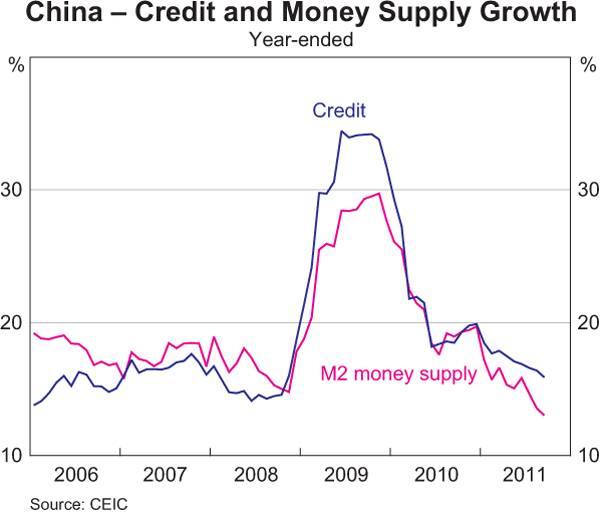
With the China bubble deflating, iron ore and coking coal spot prices are currently trading around 30% below their 2011 peaks:

Source: RBA Chart Pack, Dec 2011 | Click to enlarge

At least the Coalition is aware of the budget risk. Even if they too appear not to have twigged to what is a blindingly obvious extension of logic – that the MRRT is designed to help the Big 3 multinationals increase their profits, and their monopoly:

“There are serious question marks over who will pay what and when under Labor’s mining tax deal,” Shadow Assistant Treasurer Mathias Cormann said.

“FMG says it won’t pay any MRRT for a number of years given the tax design features favouring larger miners,” he said.

“There are credible suggestions that the big three miners who had exclusive access to the Prime Minister and the Treasurer to design the mining tax behind closed doors won’t pay any MRRT for years either.

No wonder the big three say they are happy with the MRRT, while the smaller local miners are not.

“Wayne Swan has consistently refused to release the commodity price and production volume assumptions used to estimate MRRT revenue claiming that they’re based on commercial-in-confidence data provided by the big three miners.

“So not only are the big three miners allowed to design the tax to suit their needs, they’re also the only ones allowed to know the governments mining tax revenue assumptions. That’s just not good enough.

Even on the government’s own figures, the mining tax package is a fiscal train wreck in the making.

The Great Big Mining Tax … that isn’t.

As my kind mentor concluded:

“This bill was drafted BY miners, FOR miners”

“I think the miners and their accountants outsmarted Gillard and Swan, and bamboozled them with mining jargon”

The miners in reality love it.” 

Greens’ supporters … welcome to the Pit of Despair.

“What did this do to you? Tell me. And remember, this is for posterity so, be honest. How do you feel?”
Julia’s $140K Pay Rise Worth Every Scent

15 Dec

This is completely on the nose.

A Pinocchio nose.

It smells like a plotline straight out of Yes Prime Minister:

Julia Gillard is in line for a $140,000 pay rise, while federal backbenchers will see their pay packets swell by more than $50,000 a year, under an overhaul of MPs’ pay rates…

The adjustments will push the Prime Minister’s pay to $481,000 a year, while backbenchers will earn a base salary of $185,000.

Senior public servants will also get big pay rises, which will lift the salaries of the nation’s top bureaucrats to more than $800,000 by 2014.

Fellow Yes Minister fans will recall the episode titled “A Real Partnership”, in which top public servants Sir Humphrey (Cabinet secretary) and Sir Frank (Treasury secretary) conspired to con PM Hacker into granting a huge increase in public servants’ salaries, and getting it approved by linking public servants’ salary increases with increases for MP’s as well.

With senior public servants (like our new Treasury secretary, Martin “Mini-me” Parkinson) to receive the biggest increases, of course.

And all in the face of a looming financial crisis.

Seriously … that was the plotline.

They say that art imitates life.

Given that Yes Minister is allegedly the most popular TV series amongst the Canberra politico-bureaucracy, I’d say this is a case of life imitating art.

But unlike the brilliant Yes Minister, our real-life political comedy is a complete stinker.

UPDATE:

And yes, dear reader, just like in “A Real Partnership”, it is the ‘top’ public servants who are getting the biggest salary increases – even more than the PM – while lower ranked public servants get little-to-nothing (as usual). More from the Daily Telegraph:

The heads of key federal government departments will receive an unprecedented pay rise – in some cases more than $200,000 a year – taking the annual salaries of Canberra’s top mandarins to well over $700,000.

In a decision likely to trigger public fury, the Secretary of Prime Minister and Cabinet Ian Watt and other Commonwealth agency heads have been granted one of the biggest pay increases in years…

The heads of PM&C, Treasury and Defence have been granted remuneration rises from $549,000 to well above $700,000.

Well placed sources said the annual remuneration could be as high as $800,000 for these leading public servants…

The move, just 10 days before Christmas, is bound to be condemned by ordinary public servants who have struggled for far less generous pay rises against a government mantra of budgetary pressure.

Big winners from the pay decision include Mr Watt, Treasury Secretary Dr Martin Parkinson and the Secretary of the Defence Duncan Lewis.

For Sir Humphrey Appleby, substitute Ian Watt.

For Sir Frank Gordon, substitute Martin “Mini-me” Parkinson.

UPDATE 2:

How much do you reckon the World’s Best Finance Minister Trained Monkey is worth?

Treasurer Wayne Swan will get an extra $84,000 a year, pushing his salary to $346,000.

Moreover:

Remuneration Tribunal president John Conde said MPs’ pay rates had to be lifted to reflect their work, and the importance of the position.

“We concluded it was important to have a level of remuneration to attract and retain people from all walks of life,” he said.

Really?

“All walks of life”, you say?

I see few if any tradies, miners, nurses, teachers, engineers, architects, emergency service workers, labourers, truckies, farmers, or other real workers in our Parliament.

What I do see, is a fancy building absolutely chock full of lawyers, union hacks, and has-been minor celebrities.

Parasites.

Living well … very well indeed … off the misfortune, ignorance, and gullibility of others.

Pedal To The Metal – Gillard Shows Rudd How To Drive Up Debt

13 Dec

As an avid motorcyclist and former GT Falcon owner, your humble blogger can certainly vouch for the thrilling adrenalin rush one experiences from serious acceleration.

But it seems I have a thing or two to learn from our flame-haired PM about getting thrust in the back.

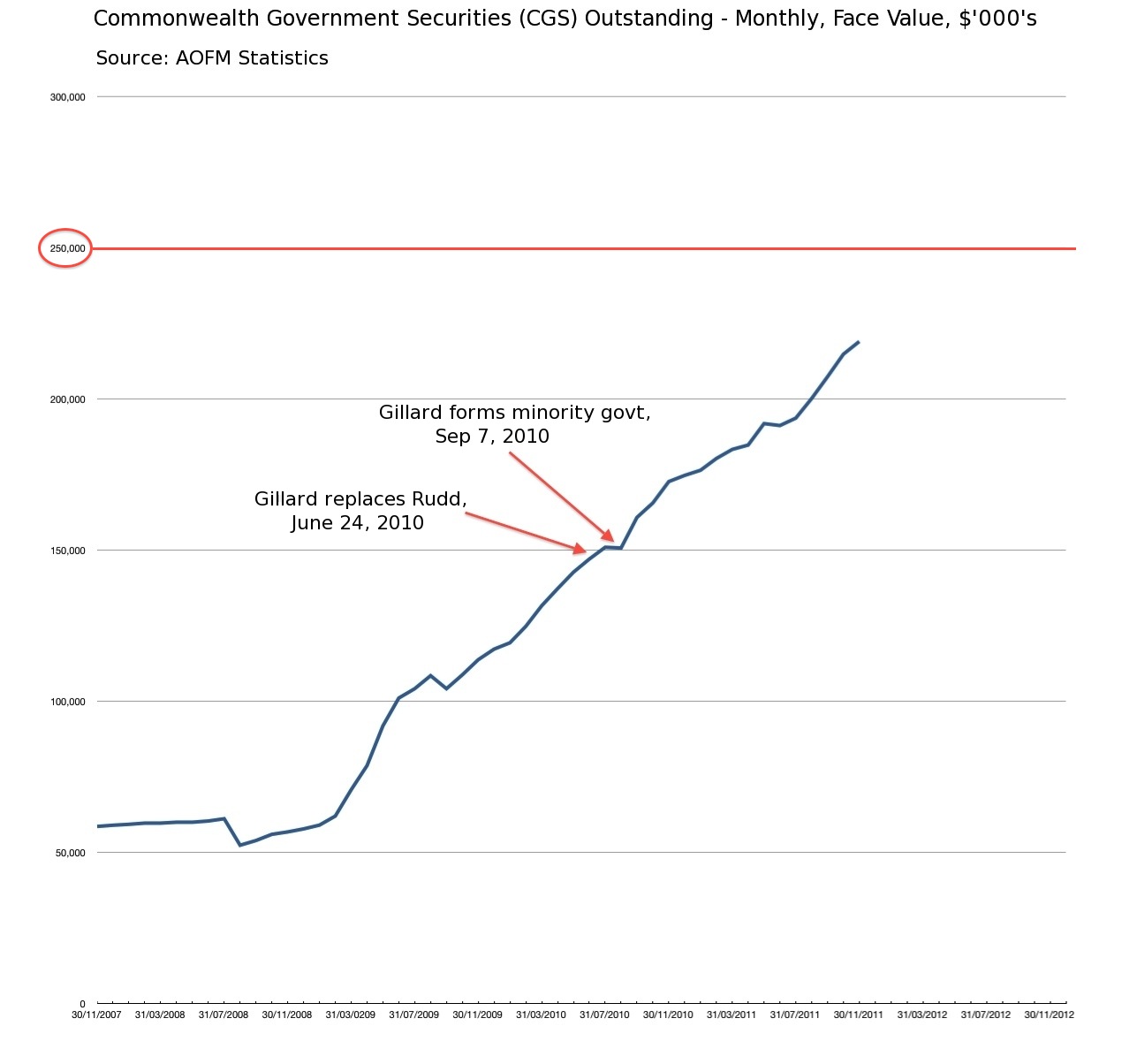
Former PM Kevin Rudd knows all about it, as the chart below demonstrates:

Click to enlarge

Interesting, is it not?

The epic acceleration in government debt under Kevin Rudd abruptly halted for two months, immediately after Gillard knifed him.

She was distracted, you see. Eyes off the road.

Too busy bending over trying to quickly tune in radio 1ETS and 2MRRT before the 2010 election.

Election over, and deal done with the Greens and “Independents” to form government … then instant pedal to the metal.

Given it was then 2 years since the first GFC peak had passed us by, one can only wonder just what Julia was accelerating away from.

It is certainly clear what we are now rapidly accelerating towards.

In case you were wondering, that little flat spot about $20 billion below the $200 billion line?

Yep … it’s the period around the May 2011 budget.

Can’t be racking up the debt at a rate of $1 – $2 billion per week when the big Budget night is coming up. Especially when you are trying to distract everyone’s attention from the upcoming record deficit announcement, by lying about jobs creation.

Budget passed, provisions to steal your super enacted, debt ceiling raised by 25%, financial year ended … and it’s pedal to the metal again.

On the fast track to hit the $250 billion debt wall by mid-2012.

The chart above shows monthly CGS outstanding up to end November 2011.

So far this month, Julia has added another $4.5 billion to the total – now $223.4 billion.

With another $3 billion to be added this Thursday 15th.

$7.5 billion in a fortnight.

Forget CO2 … I reckon she’s flicked on the N2O.

Otherwise known as “laughing gas”:

Global Cooling, Unemployment Rising, Government Lies Unravelling

10 Dec

The World’s Greatest Finance Minister, May 2nd, 2011:

“We created 750,000 jobs since we came to office when other nations shed millions of jobs, and we will create half a million more in the next two years.”

PM Julia Gillard, December 2nd, 2011:

“We are on track to create 300,000 new jobs over the next two years”

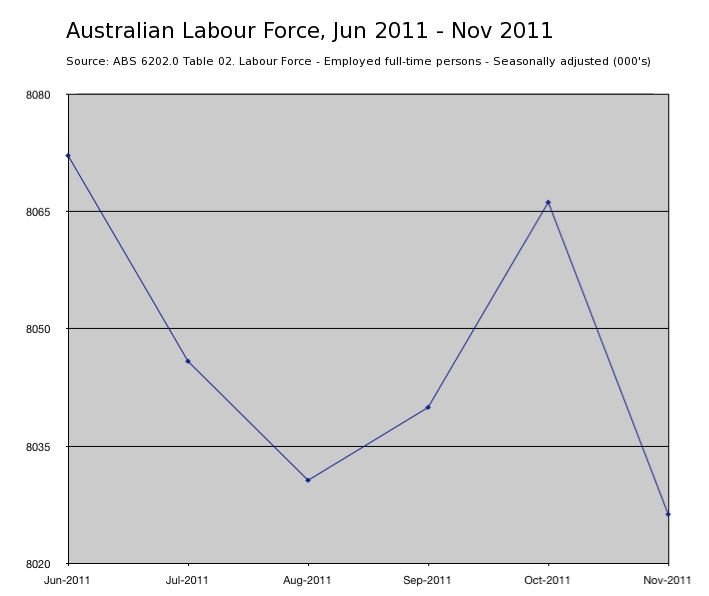
The latest Labour Force data from the Australian Bureau of Statistics:

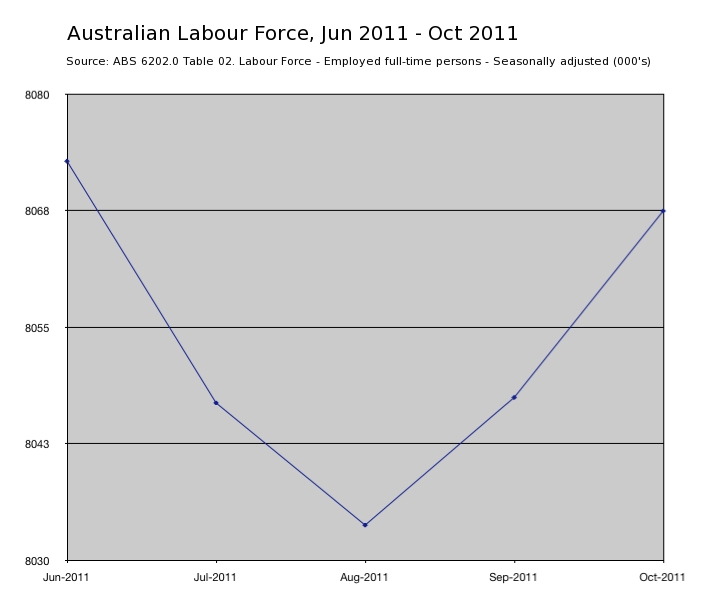
Employed Full-time Persons | Click to enlarge

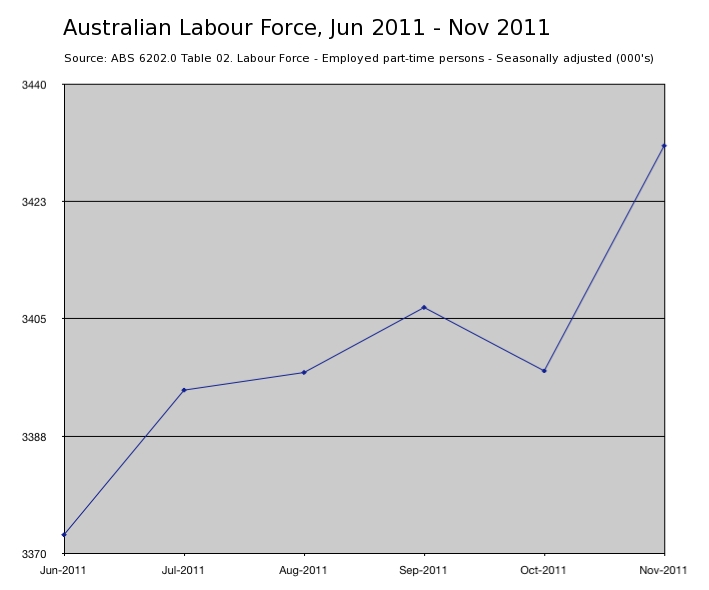
Employed Part-time persons | Click to enlarge

Employed Total persons | Click to enlarge

Number of Full-time employed? Down 45,900.

Number of Part-time employed? Up 58,000.

Number of Employed persons? Up 12,200 (with allowance for rounding).

Since June.

2,440 per month.

At that rate of part-time “jobs created” (to replace Full-time jobs lost), it will take over 10 years for Julia to achieve her “300,000” jobs created. Assuming you believe that the government creates all the new jobs, with zero from the private sector.

It will take 18 years to reach Wayne’s promised “half a million more”.

It’s also worth noting the ABS statistic for just how many are “Unemployed, looking for full-time work”.  That number has risen by 33,900 since June, the month following Wayne’s pre-budget promise.

And the number of persons in total who are “Unemployed” has risen by 38,100 over that time.

So essentially, part-time jobs are replacing full-time jobs. And at a rate way insufficient to meet the rise in total unemployed job-seekers (eg, retrenched full-time employees, school leavers, immigrants, refugees, retirees forced to look for work due having their superannuation “nest egg” decimated, etc).

Now, this is just the “seasonally adjusted fiddled” ABS data.

Some say that Australian government “official statistics” are about as believable as government statistics in other countries.

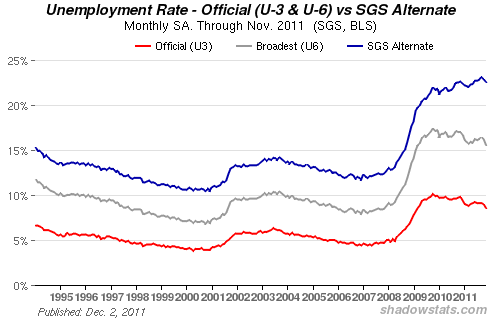
Like the USA, where “official” unemployment has allegedly just fallen to 8.6% … thanks to their simply not counting the millions of people who are unemployed but have given up looking.  Alternate statistics researchers such as the venerable ShadowStats claim US unemployment is more like 22.5%:

Source: ShadowStats.com

In Australia, Roy Morgan research publishes an alternate measure of unemployment. And surprise surprise, it too consistently shows unemployment rates significantly higher than our government’s “official” statistics.

Here’s the latest Roy Morgan stats (emphasis added):

# In November Australia’s total unemployment as measured by Roy Morgan was 1,044,000, or 8.6% (unchanged in percentage terms, but up 18,000) from October 2011 and up 229,000 (up 1.7%) since November 2010 — Australia’s equal highest unemployment rate since March 2004 (8.8%). It is also the highest number of unemployed Australians for nearly a decade — since January 2002 (1,075,000).

# The Roy Morgan November 2011 ‘underemployed’* estimate was 938,000 (7.7%), up 90,000 (0.6%) from October 2011, and up 126,000 (0.9%) since November 2010.

# In total in November 2011 an estimated 1,982,000 (16.3%) of Australians were unemployed or ‘underemployed.’ This is up 108,000 (0.6%) on October 2011 and up 355,000 (2.6%) since November 2010.

# The latest Roy Morgan unemployment estimate is 3.4% above the 5.2% currently quoted by the ABS for October 2011 — this is the equal largest gap since December 2005 (8.5% Roy Morgan cf. 5.1% ABS).

Who to believe?

You decide.

Just remember the indignant words of Sir Humphrey Appleby, in an episode of the classic BBC satire Yes Prime Minister titled “The Smoke Screen”:

“They’re government statis…. they’re facts”

UPDATE:

For any reader questioning the “Global Cooling” reference, I have no interest in pointing you to the many websites where you can find evidence that the world has experienced a slight cooling over the past decade. Instead, in keeping with Thursday’s reference to The Golden Rule (ie, “Follow The Money”), I give you instead the opening paragraph of the official press release for the 2010 Bilderberg Meeting of the world’s ‘elite’ … and suggest you think about it:

Click to enlarge

“Carbon Is All About Vanity”, Says UK Carbon Trader

8 Dec

“There will be no carbon tax under the government I lead”.

Congratulations Julia!

That epic broken promise is looking good now, isn’t it.

Just ask our trans-Tasman neighbours:

Carbon credits pricing crashes and burns

A crash in carbon credit prices means the government has no option but to ban or drastically restrict the use of imported carbon credits of dubious quality, or the emissions trading scheme (ETS) could become a national embarrassment.

The price of New Zealand units (NZUs) has crashed from $22 in May to about $11* last week, stifling interest in developing carbon offsetting initiatives here, according to carbon market participants.

The price crash has been so steep that by one calculation, if the price trend continued for another 100 days, the value of NZU credits would be zero.

The reasons for the crash appear to be the unfettered ability of New Zealand emitters to import credits of dubious quality from overseas, coupled with the recent dumping of international credits by cash-strapped European industrial and utilities companies selling down their stockpiles of carbon to realise cash as the debt crisis worsens, participants in the fledgling carbon trading market say.

Hmmmm. That last bit sounds strangely familiar:

ASX’ announcement came two days after Australia passed a law that will require almost 500 of the country’s largest emitters to pay for their pollution for the first time. The law allows firms to offset as much as half of their Australian discharge by purchasing credits awarded for projects that limit carbon releases abroad.

Lemmings. Cliff. Gravity. Bitch.

In more good news for Julia (and partners in crime Bob, Andrew, Tony and Rob):

Carbon credits may be buried in Durban; India, China to lose

The much-heralded carbon trading system may be headed for a dead end, if discussions underway over the last few days at the United Nations-organised global conference on climate change are any indication. This will have a major impact on India and China, the leaders in such trading.

The carbon markets will crash if Durban fails to send a strong signal that the next round of Kyoto Protocol negotiations are on track,” says Remi Gruet, senior regulatory affairs advisor on climate and environment with the European Wind Energy Association, an industry body.

Doubtless Remi Gruet is “talking his own book”, being a wind energy lobbyist and all.

But his underlying point remains valid.

Because it appears that China and India are not exactly proving helpful in forging a new post-Kyoto agreement:

The world’s three biggest polluters joined in opposing a European Union proposal for talks aimed at drawing up a new climate treaty, dimming the chances of extending the Kyoto Protocol limiting greenhouse gases…

India, along with the U.S. and China are united in opposing the EU’s timeline to a new deal. The 27-nation bloc that’s done the most to limit carbon dioxide fumes since Kyoto was signed in 1997, said it wouldn’t agree to more limits unless a treaty is signed by 2015 and in force by 2020.

The opposing positions may torpedo the chance of a deal on Dec. 9 when two weeks of talks in Durban finish. The EU has called its “road map” proposal a “red line” issue.

Although this report in the Financial Times suggests otherwise:

China and Brazil have warned that one of the world’s biggest carbon markets will be under threat if wealthy countries reject their demands for a new phase of the Kyoto protocol.

It is “inconceivable” that the $20bn UN-backed carbon offset market can continue unless countries agree to a second round of pledges under the Kyoto climate treaty after the first round expires in 12 months, China’s chief negotiator told the FT.

Confused by all the international politicking?

Not to worry.

Barnabyisright.com readers know better than to take much notice of all their noise.

They know that the best way to get an insight into the truth of what is really going on, in almost every life situation, is to simply remember the Golden Rule.

Follow The Money:

Investment banks are cutting traders and analysts in climate-related businesses as a slump in shares and carbon emission permits coincides with a deadlock in international climate talks.

JPMorgan Chase & Co. Managing Director for Environmental Markets Odin Knudsen left his post in New York by mutual accord after his team was shrunk, while UBS Securities LLC fired Vice Chairman Jon Anda and his Climate Policy Group co-workers, Anda and Knudsen said in interviews. Ben Lynch left his London job as an alternative-energy analyst for Commerzbank AG and it was taken over by a utilities analyst, company spokeswoman Claire Tappenden said. The departures took place since September.

The biggest banks, trying to recover from trading losses and a clampdown on investing their own money, are clipping resources from emissions-related businesses as United Nations talks have failed for years to extend Kyoto Protocol greenhouse- gas curbs beyond their expiration in 2012. The International Emissions Trading Association, the main carbon-market trade group, has seen its membership slide about 6 per cent this year.

“People are leaving the industry because they’ve been fired or because they see no prospects,” said Emmanuel Fages, head of energy research for Europe at Societe Generale SA in Paris.

And then there’s this, from eFinancialCareers UK:

At least you don’t work in carbon trading

It’s no longer possible to save the world whilst being paid in the style of a financial services professional. Not unless you’re prepared to live with a degree of job insecurity that offsets the advantage of working in an office rather than camping in Finsbury Square.

Three years ago, carbon trading was a vibrant, growing and politically correct business to work in. Today, it’s moribund and politically expedient.

“Carbon trading was very exciting a few years’ ago,” says Mike Brennan chairman of recruitment group Climate Human Capital. “People were very well paid and very well bid, but not any more.”

Last year, Climate Human Capital estimated there were 169 people working in carbon trading in the City of London, 27% of the European total. Today, Brennan says that number is, “significantly lower.”

Carbon trading refugees are emerging from banks and funds. Bloomberg says an MD for environmental markets has left JPMorgan, “by mutual accord,” that UBS has fired a climate vice chairman and his co-workers, and that Commerzbank has reallocated the responsibilities of its alternative-energy analyst to its utilities analyst. Carbon funds like Climate Change Capital, which were the new, new thing, aren’t: CCC made a loss last year, has lost its chief executive, has no current vacancies and has declared an interest in “strategic partnerships” in an effort to raise more capital.

“People are leaving the industry because they’ve been fired or because they see no prospects,” said Emmanuel Fages, head of energy research for Europe at Societe Generale in Paris, told Bloomberg. “That is the sad story.”

The sources of the sadness are manifold: the price of carbon has plummeted to €7.9 a metric tonne, down from €17 euros in May; the much hoped for US cap and trade carbon scheme has failed to materialize, and the EU carbon trading scheme has been blighted by an oversupply of credits. One trader who’s been acting as an advisor on the carbon market says things are unlikely to improve soon. Carbon is all about vanity. Corporates and governments want to be carbon neutral until they have to start laying people off or facing rioting in the streets. At that point, they don’t give a damn.”

What will happen to the carbon traders who thought they were using capitalism to save the world? “It’s a good job Starbucks are planning to hire so many people in London,” says one carbon headhunter, only semi-humorously.

However, Brennan insists there are some roles still somewhere. “We’re working with some niche brokerages focused on Central and Eastern Europe. They see opportunities there and are selectively adding carbon professionals to their team,” he promises. Unfortunately, applicants may exceed opportunities.

See Julia?

This is what happens when you have your Pinocchio nose jammed so far up Senator Brown’s realm-where-the-sun-don’t-shine.

You can’t see what is really going on out here in the real world.

What’s that old proverb again?

Pride goes before destruction, and a haughty spirit before a fall.

* And just days after that article, this:

New Zealand carbon price collapses below $10 a tonne

The price of a tonne of emitted carbon has fallen below $10 for the first time today, with Westpac quoting a buy price for a New Zealand Unit falling to $9.90 as European carbon prices collapse.

The developments coincide with New Zealand and Australian climate change ministers, meeting on the sidelines of the global climate change summit in Durban, South Africa, announcing terms of reference for efforts to align the two countries’ emissions trading schemes…

“Westpac has regular buy and sell prices, but no one knows whether they contract at those prices, we don’t know,” said one broker who declined to be named. “We’ve hit dire days in carbon pricing.”

Julia’s Big Lie On Jobs

3 Dec

Back in May, barnabyisright.com was the first (and only?) to debunk Treasurer Swan’s hand waving Big Lie about how many jobs the Labor government have “created” since coming to power. Using their own budget documents. It was Wayne’s pre-budget red herring, to distract the media from the upcoming record budget deficit announcement.

We followed up in June, with conclusive proof of his Big Lie from the Australian Bureau of Statistics official Labour Force data.

Now Julia herself has joined in Wayne’s lying-on-the-jobs action.

Here’s what she claimed yesterday at the ALP’s National Conference, in a speech where she used the word “jobs” over 30 times … a classic snow-them-with-BS propaganda technique that explains why the fourth estate won’t notice or check up on what she claimed (h/t Andrew Bolt):

“We are on track to create 300,000 new jobs over the next two years”

Statements like that prompt your humble blogger to rub his typing fingers together with Monty-esque glee:

Especially after our Treasurer’s claims back in May.

Recall, not only did Wayne falsely claim that “we created 750,000 jobs since we came to office when other nations shed millions of jobs…“.

He went further:

“…and we will create half a million more in the next two years

Let us leave aside for the moment the tiny little matter of Wayne’s “half a million more” back in May, versus Julia’s “300,000” yesterday.

Even though we could well say, “Here endeth the lesson”.

Let us instead take another look at the latest ABS Labour Force statistics, to see whether or not Julia is “on track to create 300,000 new jobs over the next two years”.

Here’s a chart of Full-time Employed Persons from June – the end of last financial year, and the month following Wayne’s original “half a million more” claim – through to October:

Click to enlarge

Oops.

That’s 5,300 fewer full-time employed persons. In 4 months (end June to end October).

How about Part-time employed persons?

Click to enlarge

Hmmmm.

That’s 22,700 more part-time employed persons. In 4 months.

And the grand total employed persons?

Click to enlarge

Ok.

17,300 more “employed” persons. In 4 months.

Or just 4,325 more per month.

At that rate, it would take the government until mid-April 2017 to create Julia’s promised “300,000 new jobs”.

And until mid-February 2021 to create Wayne’s promised “half a million more”.

Of course, that’s only if we are happy to (a) ignore the fall in full-time employed persons, and (b) assume that the government alone, not the private sector, “created” a “new job” for every single one of those 17,300 extra “employed persons”.

Ridiculous.

“We are on track” to get there “over the next two years”, Julia?

Labor’s lying on jobs would make the stupidest planker blush.

Economic planking.

A fitting metaphor for the most dishonest, idiotic, incompetent government this nation has ever seen.

Gillard Offers Borrowed Money To Bail Out Europe

3 Nov

Ummmm. About our $250 Billion debt ceiling.

I wrote only yesterday that we are on track to hit it by mid-2012. Unless something went pear-shaped first.

I was right. Something has gone pear-shaped.

The rationality of Australia’s ruling politicians:

Julia Gillard has offered extra cash for the International Monetary Fund to help prop up the ailing European economy and prevent another global financial crisis.

The prime minister made the offer as she arrived in France in the middle of a worsening European financial crisis that is set to dominate the Group of 20 nations meeting this week, The Courier-Mail reported.

“For Australia’s part, we stand ready for an increase in IMF resources,” Ms Gillard said after arriving in Cannes.

“We”? Who’s “we” Julia?

Oh I see. “We” means our unrepresentative overlords in “Canberra” (h/t Wall Street Journal):

Australia’s Prime Minister Julia Gillard arrives in Cannes on a mission — she wants fellow G-20 governments to give more cash to the International Monetary Fund to help it deal with Europe’s crisis.

“I will be raising the need to increase IMF resourcing, both at the G20 meeting itself, and at my bilateral meetings, starting today at my bilateral meeting with the President of Brazil,” Gillard tells reporters on her arrival in Cannes.

Canberra has been a vocal advocate of the need to boost the IMF’s resources. The government has one of the developed world’s strongest sovereign balance sheets so is in a good position to donate more cash.

A “good position” to donate more cash!?!

“Good” compared to who, exactly? Greece? The USA? Zimbabwe?

Of course, silly me.

We only have a record budget deficit.

An economy that only survived the GFC solely on the back of China’s massive money-printing “stimulus”:

… that created a temporary artificial demand for our iron ore and coal – a demand that is now slumping:

Steel China Iron Ore Fines cfr main China port USD/dry metric tonne (MBFOFO01:IND)

Canberra is only borrowing money from foreigners at a record rate to fund Green-Labor’s insane spending … an extra $7 billion per month borrowed through September and October.

And doing favours for foreigners … and foreign banks … assures politicians of a life of ease and comfort upon retiring or being kicked out of office.

So “sure thing” Julia.

You are in a great position to throw bad money (borrowed) after even worse money (insolvent PIIGS).

Let us be perfectly clear, dear reader.

Europe is stuffed. Totally and utterly stuffed.

As is the USA. The UK. Indeed, as is the entire Western world’s financial system.

You simply can not fix a debt problem, by borrowing more money.

History bares witness time and time again, that the so-called “rescue” packages that globalist entities like the IMF offer to over-indebted nations, are no rescue at all.

In exchange for a non-solution – some “free” money, and “better” terms of repayment on existing debts owed – the IMF takes ownership over national infrastructure (ports, railways, toll roads, electricity grids, airports, etc) as collateral … and, effectively takes over dictating the national budget. Hence, “austerity measures”.

It’s called “asset stripping” and “loss of sovereignty”.

The IMF is evil.

And it is beyond appalling to this blogger, that we have reached such a low point in the governance of Australia .. egged on by the general apathy of our citizens … that we now have a minority government that not only blatantly lies to and ignores the will of its people (carbon tax).

It is a government that is so totally beholden to the World Government aspirations of the Green ecoloons, that it would offer to give borrowed money to the IMF, in order to aid and abet their stripping yet another nation of its assets and sovereignty:

Make no mistake, dear reader.

By taking Australia ever deeper into record debt, this government is fast-tracking our nation into the arms of the IMF, World Bank, and other assorted power-crazed “We want to rule the world” lunatics.

Click to enlarge | Source: Australian Office of Financial Management (AOFM)

It could not be clearer where we are headed.

Can’t see it?

Don’t want to believe it?

It’s time to take the Red Pill.

The Matrix: "You take the blue pill – the story ends, you wake up in your bed and believe whatever you want to believe. You take the red pill – you stay in Wonderland and I show you how deep the rabbit-hole goes." - Morpheus

It’s Official: Australia Is Now A Totalitarian ‘Democracy’

12 Oct

Totalitarian democracy is a term made famous by Israeli historian J. L. Talmon to refer to a system of government in which lawfully elected representatives maintain the integrity of a nation state whose citizens, while granted the right to vote, have little or no participation in the decision-making process of the government.

Totalitarianism (or totalitarian rule) is a political system where the state recognizes no limits to its authority and strives to regulate every aspect of public and private life wherever feasible. Totalitarian regimes stay in political power through an all-encompassing propaganda disseminated through the state-controlled mass media, a single party that is often marked by personality cultism, control over the economy, regulation and restriction of speech, mass surveillance, and widespread use of terror.

The first of those two definitions, is where this country is right now.

The second of those two definitions, is where this country is heading.

Unless you, dear reader, grow a pair.

Like, The Incredible Case Of, Like, Julia And The, Like, 400 Shrinking Polluters

10 Aug

h/t reader Bamftiger

First, it was “1,000 of the biggest polluters”.

Then, it was “500 of the biggest polluters”.

Now?

It’s “more in the order of more like 400” of the “biggest polluters”.

Except … even that figure is “somewhat rubbery” (emphasis added):

Prime Minister Julia Gillard originally said the price would be paid by the top 1000 polluters in the country.

But when the $23-a-tonne carbon price was announced in July, that figure was cut in half.

Around 500 of the biggest polluters in Australia will be required to pay for their pollution under the carbon pricing mechanism,” the Government’s policy documents released on July 10 state.

Now the figure has been revised downwards again.

“Under the previous (Kevin Rudd carbon pollution reduction scheme) package the number that we thought was going to be in the system was more in the order of 700,” climate change department secretary Blair Comley said today.

(Now) the number of emitters that we think will be covered is more in the order of more like 400.

Mr Comley was giving evidence in Canberra to a parliamentary inquiry into the proposed carbon tax.

The change of scope was due to the differing treatment of liquid fuels and synthetic gases under Ms Gillard’s carbon price mechanism, he said.

But the 400 figure is somewhat rubbery.

You don’t say?!

barnabyisright.com humbly claims credit as the first (and only) to break the true and complete story of the government’s massive – and perpetual – lying over the real number of so-called “biggest polluters”.

Read the story as broken right here on 25 July. Download and study for yourself the 1.6Mb spreadsheet results of my 3-weeks-work-in-1 research into the government’s “rubbery” (!?!!) National Greenhouse and Energy Reporting department’s official Register of “biggest polluters” –

The 500 “Biggest Polluters” Exposed – Everything The Government Is Not Telling You

“More in the order of more like 400″, they now say?

The government NGER department’s most recent report (April ’11) shows only 299 “polluters” reporting any emissions at all – a story also broken here on 13 July.

And their full Register (775 ABN numbers listed) is chock full of dodgy, unknown/unidentifiable, non-existent, ASIC-unrecognised ABN numbers, liquidated companies, blind trusts, double-triple-quadruple-quintuple-ups, and the “like”.

So Julia … from your own list of “like” 775 company names/numbers, of which only “like” 299 actually reported emissions in your most up-to-date official NGER Report … “like” exactly which “like” 400 “biggest polluters” are you actually going to “tax” in order to legislate the banksters’ carbon derivatives trading platform?

I’ve got the spreadsheet right here – just point out the “like” 400 “biggest polluters” for us.

Stealing Our Super – I DARE You To Ignore This Now

8 Aug

Caricature by Zeg | click to enlarge

My sincere apologies, dear reader.

I understand that you are probably a little concerned about the future for the economy right now.

If you own shares, then you are probably worried about last week’s bloodbath in global sharemarkets.

But I have a very important question to ask you.

It’s a bit of a reality check, I’m afraid.

Do you think your Superannuation “nest egg” is safe from the greedy hand of government?

If you answered “yes”, then …

I dare you.

I dare you to ignore the rest of this blog.

I dare you to ignore the fact that Senator Barnaby Joyce – the only Australian politician who foresaw and forewarned about America’s present debt nightmare – gave this warning on 5th May 2011:

In response to a question I put in Senate estimates, Treasury revealed that $64 billion of the difference between our gross debt and our net debt is made up of the cash and non-equity investments of the Future Fund. The Future Fund is there to cover the otherwise unfunded costs of public servants’ superannuation.

That is a little fact that the people of Canberra might be interested in. When Wayne mentions net debt translate that to, I am going to pay his debt off with my retirement savings.

I dare you to ignore the fact that Barnaby repeated his warning on May 13th, straight after the Budget:

Of course, the public servants will not be happy when we use their retirement savings, put aside in the Future Fund, to pay off some of Labor’s massive debt.

I dare you to ignore the fact that the US Government has been stealing federal workers pensions since May this year:

Treasury to tap pensions to help fund government

The Obama administration will begin to tap federal retiree programs to help fund operations after the government lost its ability Monday to borrow more money from the public, adding urgency to efforts in Washington to fashion a compromise over the debt…

Geithner, who has already suspended a program that helps state and local government manage their finances, will begin to borrow from retirement funds for federal workers.

I dare you to ignore the fact that the US Government has been planning to steal their private citizens’ super too, since at least February 2010:

The plan, as sketched in the 43-page document, calls for the creation of something called  “Guaranteed Retirement Accounts” (GRAs). Biden slyly shifts the onus for the idea through weasel words typical of the federal government: “Some have suggested the creation of Guaranteed Retirement Accounts (GRAs), which would give workers a simple way to invest a portion of their retirement savings in an account that was free of inflation and market risk, and in some versions under discussion, would guarantee a specified real return above the rate of inflation.”

These accounts would be “free of inflation and market risk” because they would be under the direct and absolute control of the federal bureaucracy.

I dare you to ignore the fact that Argentina’s government stole their citizens’ super in October 2008:

Argentina’s center-left President Cristina Fernandez on Tuesday signed a bill for a government takeover of the $30 billion private pension system in a daring and unexpected move that rocked domestic markets.

I dare you to ignore the fact that Hungary’s government nationalised stole their citizens’ super in November last year:

Hungary is giving its citizens an ultimatum: move your private-pension fund assets to the state or lose your state pension.

Economy Minister Gyorgy Matolcsy announced the policy yesterday, escalating a government drive to bring 3 trillion forint ($14.6 billion) of privately managed pension assets under state control to reduce the budget deficit and public debt. Workers who opt against returning to the state system stand to lose 70 percent of their pension claim.

I dare you to ignore the fact that France began stealing their citizens’ super in late 2010 as well:

France seizes €36bn of pension assets

Asset managers will have the chance to get billions of euros in mandates in the next few months for the €36bn Fonds de Réserve pour les Retraites (FRR), the French reserve pension fund, after the French parliament last week passed a law to use its assets to pay off the debts of France’s welfare system.

I dare you to ignore the fact that “Europe’s economic superstar”, the one EU nation that (like Australia) came through GFC1 with positive economic growth, began stealing their citizens’ super in May this year:

It appears moving backwards on pension reforms has become the thing to do on both sides of the Atlantic.

Hungary last year moved much of its private pension assets to the state. Last month, new rules came into effect in Poland diverting 5% of the 7.3% of salary going to private pension funds to the state.

I dare you to ignore the fact that Ireland too, began stealing their citizens’ super in May this year:

Irish Bombshell: Government Raids PRIVATE Pensions To Pay For Spending

“The various tax reduction and additional expenditure measures which I am announcing today will be funded by way of a temporary levy on funded pension schemes and personal pension plans.”

I dare you to ignore the fact that the UK Government announced plans to steal public sector workers’ pension entitlements in June this year:

Thousands of teachers, lecturers and civil servants joined a UK wide strike yesterday in a mass protest over pension reforms.

The government … wants to impose a 3%-of-pay levy on public sector workers’ contributions to help reduce the budget deficit. This amounts to a pay cut to follow on the heels of the current pay freeze.

I dare you to ignore the fact that the Liberal Party of Australia quietly announced a new policy on June 3 this year – sneakily disguised as a helpful “reform” – that should make your hair stand on end:

Further relief for small business

The Coalition will relieve the red tape burden from Australia’s small businesses by giving them the option to remit the compulsory superannuation payments made on behalf of workers, directly to the ATO.

Small business will be given the option to remit superannuation payments to the ATO at the same time as they remit their PAYG payments.

This will require only one payment to one agency – rather than multiple cheques to multiple superannuation funds. The ATO will be responsible for sending the money to superannuation funds directly.

I dare you to ignore the fact that an “option”, can very easily become a “non-option”.

I dare you to ignore the fact that our Green-Labor Government announced plans in the May Budget that should also make your hair stand on end:

The Gillard government’s 2011-12 budget has proposed a raft of initiatives aimed at encouraging superannuation fund and private investment in infrastructure projects.

I dare you to ignore the fact that “encouraging”, can very easily become “enforcing”.

I dare you to ignore the botched “school halls” program, and the white elephant NBN, as you ponder whether or not you really trust this government to wisely and prudently invest your super in Government infrastructure projects, and achieve a reasonable return on your money, when even so-called “experts” have doubts:

The government’s plan to use tax incentives to encourage superannuation funds to invest in new infrastructure could be thwarted by inadequate returns on projects and a reluctance by the states to take on project risk, experts say.

I dare you to ignore the fact that the government’s white elephant NBN is a(nother) Green-Labor thought bubble, drawn up on the back of Kevin Rudd’s in-flight napkin, with no cost/benefit analysis:

Trust us with the NBN; we’re politicians

I dare you to ignore the fact that Bill Shorten, the Minister for Financial Services and Superannuation, already thinks of your super as a “significant national asset” … a kind of “sovereign wealth fund”:

Superannuation is our sovereign wealth fund

This week marks 12 months exactly since the government announced plans to take compulsory superannuation from 9 per cent to 12 per cent.

… our superannuation savings place Australia fourth in the world. Its $1.3 trillion in funds under management through superannuation significantly boosts national savings and provides greater retirement security for millions of Australians. Superannuation is also a significant national asset because it strengthens our financial sector.

I dare you to ignore the fact that our government has guaranteed our banking sector using the promise of your future earnings as collateral, and that Moody’s ratings agency has put our government on notice that our banks are Too Big To Fail – just like in the USA, UK, and Europe:

Heavens to Betsy.  It’s finally out in the open. The big four are too big to fail and Moody’s rates the Australian government’s implicit guarantee of the banks’ wholesale debt (as well as the explicit deposit guarantee) as worth two ratings notches. Moreover, by phrasing it this way, Moody’s has essentially put the Australian government on notice that if it dares back away from that guarantee then it can count on the result. The further implication is that the Budget had better remain shipshape to provide the guarantee.

I dare you to ignore the fact that the government’s carbon pricing scheme scam includes a new “independent” Clean Energy Finance Corporation (carbon bank) that will be permitted to borrow against future government revenue – your future tax dollars – in order to invest in “green” energy projects:

The Clean Energy Council will today release a discussion paper proposing the carbon bank, which it says could be allowed to borrow money to invest in renewable energy projects against the future revenue of Labor’s proposed carbon tax and emissions trading scheme.

The Gillard government is examining the creation of a multi-billion-dollar carbon bank to drive renewable energy technologies as the Greens demand “complementary measures” to cut emissions in return for accepting a lower starting price for the carbon tax.

6.2.1 The Clean Energy Finance Corporation

The $10 billion Clean Energy Finance Corporation will invest in businesses seeking funds to get innovative clean energy proposals and technologies off the ground. These Government-backed investments will deliver the financial capital needed to transform our economy.

A variety of funding tools will be used to support projects, including loans on commercial or concessional terms and equity investments.

The Corporation will be independent from the Government. The Government will appoint an independent Chair who will have appropriate banking or investment management experience.

I dare you to ignore international banking’s core philosophy, now rendered infamous by GFC1: “Privatise the profits … socialise the losses”.

I dare you to ignore the fact that another sharemarket collapse – like in 2008 – would be a perfect pretext for nanny-state, “Big Brother knows best” governments everywhere to step in and “safeguard your retirement”, by taking and “investing” your super in Government-approved “safe investments” … just like the US Government’s planned, doublespeak-titled “Guaranteed Retirement Accounts”.

I dare you to ignore the fact that this blog has documented in detail the wave of super confiscations that is already rolling around the Western world, and the clear evidence that both sides of Australian politics already have their own quiet, sneaky plans to do the same.

I dare you to not bother reading any of my many articles on this topic –

No Super For You!!

US Treasury “Borrowing” Of Federal Pensions Brings Theft Of Private Pensions One Step Closer

Now The UK Government Is Stealing Super Too

Fresh Evidence Our Banks In “Race To The Bottom” Means You Can Kiss Your Super Goodbye

Fitch Ratings: Australian Banks Most Vulnerable To Europe’s Debt Crisis

Our Banks Racing Towards A “Bigger Armageddon”

Money Morning Agrees – Your Retirement Savings Under Threat

The Pricing Carbon Choir – Why Should *Any* Sane Person Trust Economists After The GFC?

Why Would Any Sane Person Believe Treasury’s Carbon Tax Modelling When Its Budget Forecasting Record Is This Bad?

How Wayne ‘Franked’ Another $20 Billion

Wayne: OOPS! I Did It Again

Liberal Party’s Sneaky Plan To Steal Your Super To Pay Labor’s Debt

Dear reader …

I dare you to ignore, mock, and ridicule Barnaby Joyce’s warnings … again.

I dare you to bend over … grab your ankles … bury your head in the sand … and keep telling yourself that “She’ll be right mate”.

I dare you to ignore the fact that …

Barnaby is right.

* A hearty “Thank You” to the inimitable Zeg for his brilliant cartoon drawn especially for this post, and at very short notice.

Please follow him on Twitter – @Zegcartoonist and subscribe to his blog – http://zegsyd.blogspot.com/

Better still … hire him!

Design a site like this with WordPress.com
Get started