Archive | July, 2013

“As A Nation We Are Owning Less But Owing More”

12 Jul

A superb, insightful op-ed from Barnaby Joyce in the Canberra Times:

GrainCorp may be purchased by Archer Daniel Midland. Photo: Natalie Behring

GrainCorp may be purchased by Archer Daniel Midland. Photo: Natalie Behring

To be a strong nation, we must focus on core beliefs

What do you believe in? What would you give your political career up over, rather than compromise?

If politics is the jousting of social clubs, then a politician can be anything on any day, which is a little dangerous. Have we now such a greater fascination with form over substance that it has really become a quasi thespian frolic devoid of Lincoln, Churchill and Julius Caesar.

Are we just minnows usurping the space that would be better returned to the page three babe in a bikini? Is that who we are, a people who as a nation are owning less but owing more?

There has got to be a political spine that the nation stands on, a set of principles that hurt because you stand by them: family as traditionally proposed, even if it’s not your personal reality; small business, the farmers and the shops, despite the lubricious entrapment of economic policy, a policy that has a tendency to favour the large over the small and in many instances the external over the domestic.

The mining boom is waning, prices are falling, our debt is rising and our economy cannot put its hand to an international champion that is domestically owned. BHP is majority foreign-owned, Rio is not even based here anymore. There is no international agricultural champion that is Australian-owned.

If Graincorp is purchased by Archer Daniel Midland, we will have yet another impediment to becoming the agricultural powerhouse of South East Asia. Under the current conditions our debt both public and private is higher than it ever has been and getting worse so our economic bible has taken us to a peculiar religious experience.

Our belief in a global rule book is going to be challenged by a new Asian reality that gives scant regard to wishes but exploits our weaknesses. Our terms and conditions will be just ours, as seen this week when Yancoal stepped away from their Foreign Investment Review Board conditions.

After a mining boom we should be flush with funds, instead we are $258 billion in gross debt and conducting an increasingly desperate search for what will take the place of mining. Maybe live exports because we have excelled there!

China is creating a deeper pool of offshore liquidity as it moves to replacing the US dollar as the global reserve currency. That is a global game-changer and, if we are not fully versed in all the ramifications of that massive power shift we will be in a long term strategic disadvantage.

All this is happening but what is the political debate about? Kevin Rudd managing the process of how Rudd got rid of Gillard, a slew of new ministers from treasury to agriculture with little or no expertise in their new portfolios, a tawdry attempt to politicise indigenous recognition when nothing but bipartisan goodwill has been shown on this issue thus far.

What we can take out of the indigenous recognition issue is, in the history of humankind and economics benevolence takes a backseat to greed. This is the reality of human nature which we ignore at our peril.

Europeans basically dispossessed and exploited the resources that had belonged to indigenous Australians. In a more complicated form that process is still at foot but it is just being conducted by different parties in a more clandestine form. It is naïve to think a policy desire that relies on international relations can be delivered to the detriment of that specific external nation.

Here is my point: when you look at the deeper issues, the more relevant issues that are vital to our nation’s future today, they are not the ephemeral issues that Mr Rudd appears to be engaged with.

Mr Rudd has not changed. He is a man of media, earnestly delivered with sometimes flawed and brash statements.

Whether he has the competency to guide our nation over the longer term is unlikely on previous form.

Barnaby is right.

True Unemployment At 13%, New ABS Measure Reveals

11 Jul

As anyone with two functioning brain cells surely knew already, the “official” unemployment figure — just like the “official” CPI inflation figure — is a farce.

No. Scrap that.

A deliberate deception.

From the Daily Telegraph:

REAL unemployment is double the official figure – with 13 per cent of Australia’s workforce wanting a job or longer hours.

The Australian Bureau of Statistics (ABS) yesterday released a new analysis that combines the official unemployment rate with “discouraged” jobseekers, the “underemployed” and those who want to start work within a month, but cannot begin immediately.

The 13.1 per cent rate of “extended labour force under-utilisation” in August 2012 was more than double the official unemployment rate at the time of 5 per cent.

The ABS counts people as employed even if they only work an hour a week.

But the new measure also counts underemployment – workers in part-time or casual positions who want a permanent job or longer hours.

And it includes those “discouraged” jobseekers who want to work but have given up looking because employers consider them to be too old or too young, if they are ill or disabled, lack the necessary training or experience, cannot find a job locally or in their line of work, or cannot speak English well.

The ABS report shows the labour under-utilisation rate fell steadily between 2001 and 2008 but “increased sharply” when the global financial crisis hit in 2009, from 10.6 per cent to 14.3 per cent.

The ABS report said the under-utilisation rate gave a “more comprehensive picture” of the state of Australia’s workforce than the pure jobless rate.

The “pure” jobless rate?!?! One (1) hour a week is not “jobless”?? You’re kidding, right?!

More at the link.

This revelation is so patently obvious, that my only response is a question.

Any particular reason why you have chosen to admit this now?

But The Sheep Don’t Scatter: Banks Say “Sophisticated” Customers Have “Less Stable” Deposits

10 Jul

BO2BkpACcAALj3y

Here is a shining example of bankers’ true attitude towards depositors.

In the Australian Prudential Regulation Authority (APRA) document titled ‘Implementing Basel III Liquidity Reforms In Australia’ (pdf here), the very important topic of “cash outflows” or “deposit run-off” is discussed at length.

Unsophisticated common people like you and me call it a “bank run”.

In the section titled ‘Other matters raised in submissions’, we learn that bankers consider the deposits of “financially sophisticated” customers to be “less stable” (my emphasis added):

4.2.1 Cash outflows

Retail and qualifying small and medium enterprises (SME) deposit run-off

Within the LCR [Liquidity Coverage Ratio], retail deposit balances are classified as either ‘stable’ or ‘less stable’. Stable deposit balances are those that are considered to have the lowest propensity to be withdrawn during times of stress…

Comments received

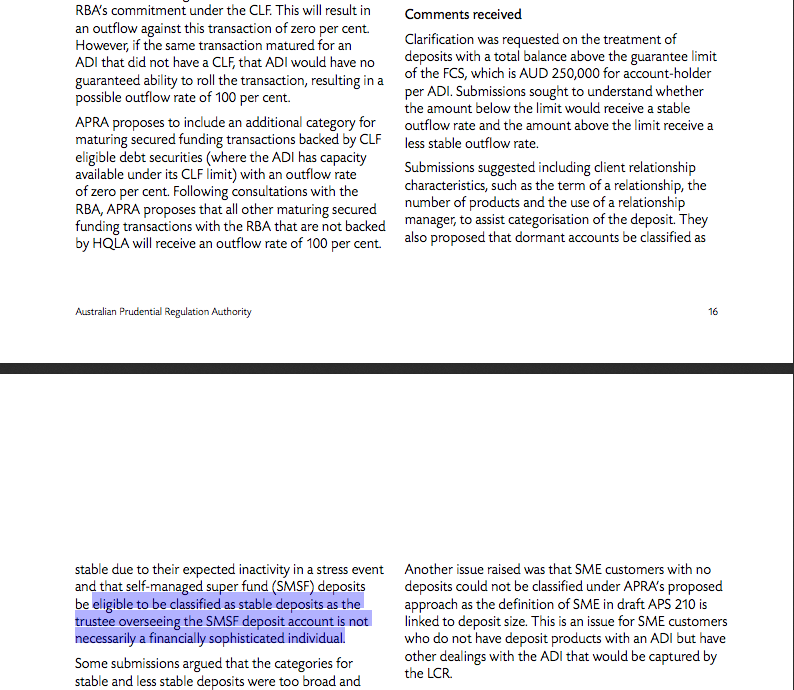
Submissions [from banks] suggested including client relationship characteristics, such as the term of a relationship, the number of products and the use of a relationship manager, to assist categorisation of the deposit. They also proposed that dormant accounts be classified as stable due to their expected inactivity in a stress event and that self-managed super fund (SMSF) deposits be eligible to be classified as stable deposits as the trustee overseeing the SMSF deposit account is not necessarily a financially sophisticated individual.

APRA - Implementing Basel III Liquidity Reforms in Australia, page 17

APRA – Implementing Basel III Liquidity Reforms in Australia, page 17

In other words, “financially sophisticated” people won’t be stupid enough to keep their money in the bank if a crisis looms on the horizon. Their deposits are “less stable”.

People who are “not necessarily financially sophisticated” will leave their money in the bank. Their deposits are “stable”.

Somewhat amusingly (to this blogger), the bankers want to classify the deposits of Self-Managed Super Fund trustees in the same “stable” category as “dormant” accounts. They consider SMSF trustees to be idiots — “not necessarily financially sophisticated individuals” — who won’t try to withdraw their money.

Under the new FSB-directed global regime agreed to by the G20 in 2010 — now being implemented by Australia, Canada, Europe, the UK and USA — just as in Cyprus, all “unsophisticated” bank depositors will get screwed overnight.

Or more likely, over weekend.

It is also worth noting the bankers’ views on internet access to bank accounts in a “crisis” (ie, possible bank run scenario):

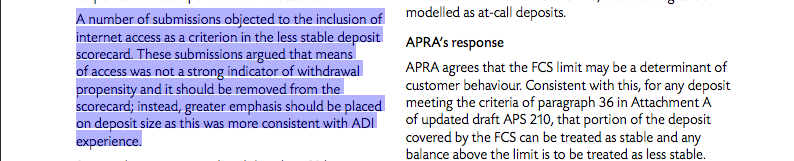
A number of submissions objected to the inclusion of internet access as a criterion in the less stable deposit scorecard. These submissions argued that means of access was not a strong indicator of withdrawal propensity and it should be removed from the scorecard; instead, greater emphasis should be placed on deposit size as this was more consistent with ADI experience.

APRA: Implementing Basel III Liquidity Reforms in Australia

APRA: Implementing Basel III Liquidity Reforms in Australia, page 17

In other words, the banks are confident that your having internet access does not necessarily mean that you are more likely to get your money out in a crisis. Given the number of times our banks have mysteriously suffered from internet banking “outages” in recent years, I’m not surprised. It’s called “economic shock testing” (see Electro-Physics: The Theory Of Economic Warfare).

Do not be deceived by the smokescreen of the “government guarantee” for depositors.

As we have seen in The Bank Deposits Guarantee Is No Guarantee At All, Australia’s so-called “guarantee” for deposits up to $250,000 only provides for up to $20 billion in Federal (borrowed) money per bank — less than 1/10th of the amount that each of the Big Four has in (electronic) obligations to bank account depositors (ie, “creditors”).

Or should I say, it “only promises to provide for up to $20 billion…”.

There is no money actually set aside to “guarantee” any depositors.

As confirmed in the APRA document, page 15:

Fully guaranteed retail deposits

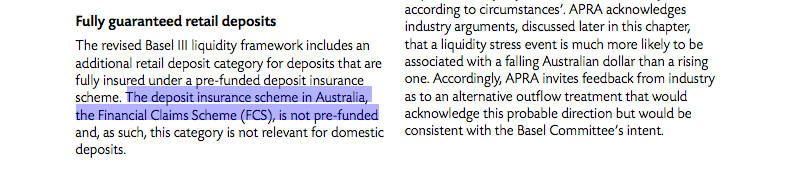
The revised Basel III liquidity framework includes an additional retail deposit category for deposits that are fully insured under a pre-funded deposit insurance scheme. The deposit insurance scheme in Australia, the Financial Claims Scheme (FCS), is not pre-funded and, as such, this category is not relevant for domestic deposits.

APRA, 'Implementing Basel III Liquidity Reforms In Australia'

APRA, ‘Implementing Basel III Liquidity Reforms In Australia’

You have been warned.

Australian banks not only have ten times more in deposit obligations than the government has guaranteed promised to provide as insurance for each bank’s eligible deposits.

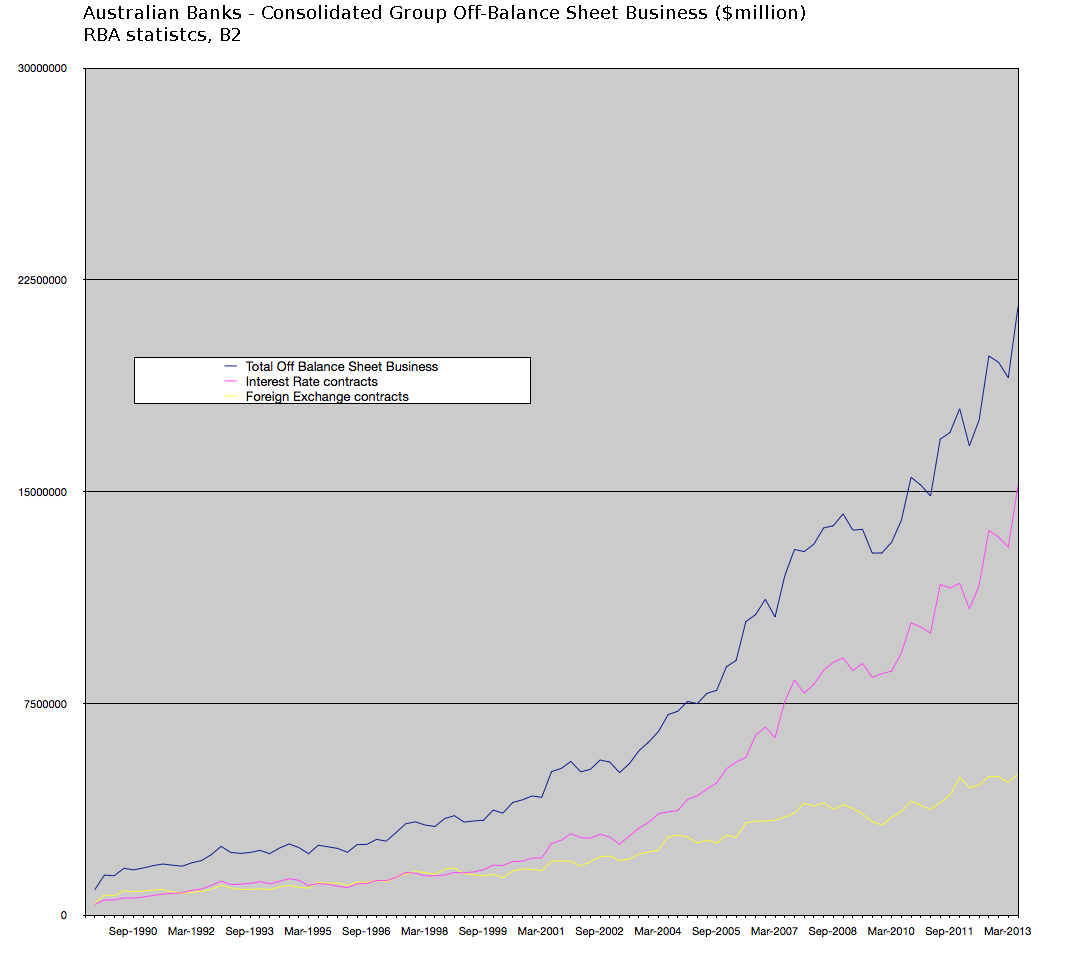
As of March 2013, the banks also have a new record $21.5 Trillion in Off-Balance Sheet “business” that is mostly derivatives; an increase of $2.5 Trillion in the March quarter alone, including a $2.2 Trillion increase in Interest Rate derivative contracts:

Screen shot 2013-07-10 at 6.24.32 PM

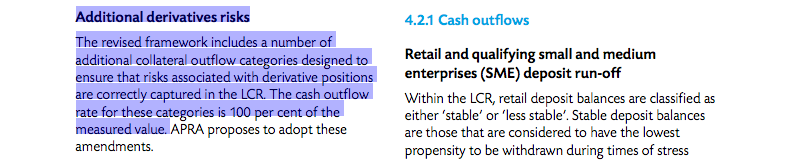
In the APRA document on implementing the Basel III bank liquidity reforms, we learn that the “cash outflow rate” for derivatives positions will be rated at 100 per cent of their measured value:

Additional derivatives risks

The revised framework includes a number of additional collateral outflow categories designed to ensure that risks associated with derivative positions are correctly captured in the LCR. The cash outflow rate for these categories is 100 per cent of the measured value.

APRA: Implementing Basel III Bank Liquidity Reforms, page 16

APRA: Implementing Basel III Liquidity Reforms In Australia, page 16

… while derivatives that are (supposedly) “secured” by so-called “High Quality Liquid Assets” — limited to cash; central bank reserves that “can be drawn down in times of stress”; and “marketable securities representing claims on or claims guaranteed by sovereigns, quasi-sovereigns, central banks and multilateral development banks, that have undoubted liquidity, even during stressed market conditions, and that are assigned a zero risk-weight under the Basel II standardised approach to credit risk” — these will have a cash outflow rate deemed to be zero per cent:

Derivatives secured by HQLA

The revised framework has clarified that where a derivative cash flow is secured with HQLA1, a cash outflow rate of zero per cent is to be applied.

APRA: Implementing Basel III Bank Liquidity Reforms, page 16

APRA: Implementing Basel III Liquidity Reforms In Australia, page 16

Remember that the cash outflow rate is determined by the perceived risk of it actually “flowing out”.

In the case of the form of “liquidity” known as “deposits”, APRA says (page 16) that “Stable deposit balances are those that are considered to have the lowest propensity to be withdrawn during times of stress and, hence, receive a low three or five per cent cash outflow rate. Less stable deposits are considered to have a higher propensity to be withdrawn and as a result, depending on deposit characteristics, receive a 10 per cent or higher cash outflow rate.”

So, in an actual crisis situation, just how much of the banks’ $21.5 Trillion in Off-Balance Sheet “business” will have a “cash outflow rate” of 100 per cent, and how much will have a cash outflow rate of zero per cent?

Who knows.

But one thing I do know.

I’d not want to have any of my money in a bank on the day — make that, the weekend — when we all find out.

Australia Plans Cyprus-Style “Bail-In” Of Banks In 2013-14 Budget

10 Jul
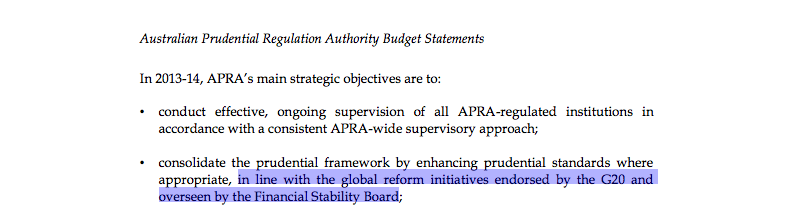
page 134, Portfolio Budget Statements, Australian Prudential Regulation Authority, Australian Government Budget 2013-14. CLICK TO ENLARGE

page 134, Portfolio Budget Statements, Australian Prudential Regulation Authority, Australian Government Budget 2013-14.

I found it.

As predicted. Apologies it took so long.

Unsurprisingly, the evidence was fairly well buried. Naturally, the government does not want you to know what they are doing.

Just like the Canadian government did in March, and just as Europe, the USA and the UK have now done, the Australian government too is now beginning to make good on its 2010 G20 commitment to implement the Goldman Sachs-chaired, internationalist Financial Stability Board’s new regime for bailing out the banks using depositors’ money.

On page 134 of the Australian Government Budget 2013-14 Portfolio Budget Statements, under the section for the Australian Prudential Regulation Authority, we find the first of APRA’s main strategic objectives for 2013-14.  It can be effectively summarised as “business as usual”.

Their second strategic objective for 2013-14, is to:

  • consolidate the prudential framework by enhancing prudential standards where appropriate, in line with the global reform initiatives endorsed by the G20 and overseen by the Financial Stability Board; [see image at top of this post]

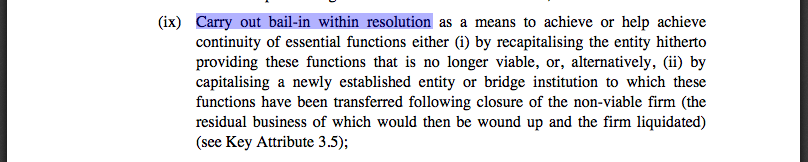
Those “global reform initiatives endorsed by the G20” include the FSB plan to “bail-in” insolvent banks:

Click to enlarge

FSB: ‘Key Attributes of Effective Resolution Regimes for Financial Institutions’, Annex III (click to enlarge)

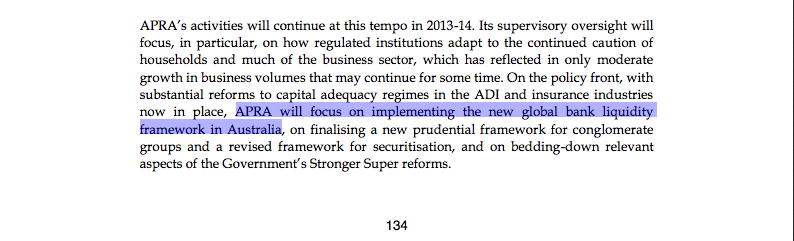
In the waffle that follows, we find further that:

APRA will focus on implementing the new global bank liquidity framework in Australia…

page 134, Portfolio Budget Statements, APRA, Australian Government Budget 2013-14

page 134, Portfolio Budget Statements, Australian Prudential Regulation Authority, Australian Government Budget 2013-14.

This is likely referring in particular to the Basel III International Framework For Liquidity Risk Measurement, Standards, and Monitoring.

When published in combination with the previously mentioned strategic objective to “consolidate the prudential framework… in line with the global reform initiatives endorsed by the G20 and overseen by the Financial Stability Board”, the implication is crystal clear.

“Global bank liquidity framework” is really just technocrat-ese for “global bankster plan to prop up insolvent banks using other people’s money, and so instantly impoverish everyone who still has any savings left”.

For further proof that what this all means is the Australian government planning to steal your money to “bail-in” so-called “systemically-important financial institutions” (SIFI’s) — under the orders of an unelected international body (of bankers and bureaucrats) you’ve never heard of; a body funded by the Bank for International Settlements (BIS), and chaired consecutively by Goldman Sachs alumni — then please study the detailed primary source evidence in this blog’s original breaking story published on April 1st –

G20 Governments All Agreed to Cyprus-Style Theft Of Bank Deposits … In 2010

That’s something else to thank our recently-deposed PM Julia Gillard for doing, without our knowledge or permission.


The Small Business Debt Canary Is Dead

10 Jul
Illustration: Simon Letch

Illustration: Simon Letch

From today’s Sydney Morning Herald:

When creditors are happy to accept an average of less than three cents in the dollar on debts owed, it is a portent of dark days.

When half the statutory demands served on small to medium-sized businesses result in no payment, it isn’t too far a stretch to think those dark days are closing in.

If the rising levels of company insolvencies and bankruptcies are thrown in the mix, along with the latest NAB business survey showing business conditions sliding to a four-year low, it should be a clarion call that the economic picture is even uglier than the official statistics would have us believe.

It explains a briefing paper to Victorian Treasurer Michael O’Brien last week that is understood to show that the downturn is widespread, with the billable hours of the state’s top law firms and accountancy firms down 25 per cent year on year.

Debt collection agency Prushka has been monitoring the trends for the past 12 months and likens the rapid deterioration in debt collection to the ”canary in the coalmine”.

According to Prushka’s Roger Mendelson, the figures from the group’s debt collection agency and legal arm show that of all the statutory demands served on behalf of Prushka over the past 12 months, 47 per cent across the country resulted in no payment. It says the amount recovered equated to 2.9 per cent of the total amount claimed. The reason? ”Creditors were prepared to accept very substantial reductions rather than face the cost and risk of proceeding to a petition to wind-up the respective company,” according to the agency.

To put it into perspective, a year ago only 20 per cent of statutory demands resulted in no payment and an average of 20 per cent of the total debt was recovered. This indicates a significant deterioration in debt collection and confidence.

Put simply an insolvency time bomb is ticking away in the small to medium-sized sector, which is a huge concern for the broader economy as SMEs employ 70 per cent of private sector employees.

The implication is that tens of thousands of companies – or even more – are technically insolvent, but are still trading because creditors are becoming increasingly cautious and prefer to recover a small amount of debt rather than spend the money chasing the full amount.

… these official figures are the tip of the iceberg. The fact that clients are reluctant to spend money winding up companies shows that things are far worse than any figures from ASIC and ITSA.

The brutal reality is official statistics don’t really show what is going on in large slabs of the economy. In addition, there is a time lag involved with the figures that do.

For Mendelson, it means more business failures in 2013, a rise in unemployment and a fall in tax receipts, which will combine to have a negative impact on the budget deficit. ”There is a risk, based on micro factors only, that a spiral will develop within the SME sector which could potentially lead to a recession. The spiral is caused by SMEs cutting costs, reducing business activity and therefore margins of their suppliers. This forces others to respond the same way, leading to a significant increase in unemployment which spooks the household sector and could lead to consumers cutting spending further.”

I’m sure the steep rise in small business loans at usury rates of 17 per cent or more has had no impact at all here.

/sarc.

Former Opposition Finance spokesman Barnaby is right.

“If you do not manage debt, debt manages you.”

– Feb 2010

Chinese ‘Shadow’ Banker In Defence Of Raping Peasants

10 Jul

In a timely follow-up to yesterday’s post, we see that the steep rise in small business loans by Australian bankers at usury rates of 17 per cent or more, really has nothing on the Chinese ‘shadow’ banking industry.

From Bloomberg (via the Sydney Morning Herald):

“Although we charge about 24 per cent annually for our money, demand remains virtually unlimited.”

In the autumn of 2010, as deputy head of China investment banking at UBS, I spoke to a group of wealthy investors in Beijing about the outlook for Chinese stocks.

A rumpled, 50-something man from Hangzhou named Wang Zhigang pulled me aside afterward and asked for my advice about investing. Until then, he had made his money through kerbside lending, not stocks. But, he lamented, his returns had dropped from more than 30 per cent a year to a mere 23 per cent. He worried about his personal fortune, which he had built up from nothing to almost 3 billion yuan (about $US490 million then).

He hardly needed my advice, I told him. ”With your performance, even Ba-Fei-Te should farm out some money for you to manage!” I said, referring to Warren Buffett’s name in Chinese.

Intrigued, I flew to Hangzhou a few days later to find out how Wang had done so well. He drove me to the Haining Leather Market to meet some of his customers. They were merchants of leather shoes, handbags and accessories. Their network was wide and close-knit, and they sold products globally through traditional channels, as well as online.

Twenty years ago, these guys would have looked like small fish to a traditional bank. Even after their businesses had grown exponentially, they couldn’t supply the kind of collateral banks demanded. Yet these merchants needed money and fast. So they turned for help to ”shadow” bankers such as Wang.

There has been a lot of talk lately about shadow banking in China. Between kerbside lenders, microcredit institutions, pawnshops, trust loans, ”wealth management products” from banks and other components, this murky and unregulated financial universe is now worth an estimated $US5 trillion ($5.5 trillion), challenging the dominance of the traditional banking sector. Such unrestrained growth naturally worries China’s central bank, which fears a flood of bad shadow loans could prompt a financial meltdown similar to the US subprime crisis in 2008.

A liquidity squeeze in June, when the central bank allowed interbank lending rates to rise as high as 20 per cent before intervening, was widely interpreted as a warning to banks to clean up shadow portfolios.

China’s shadow bankers are easy to demonise. Like Wang, many are seemingly unsophisticated. Their methods are unorthodox, possibly even unsavoury. Their loans don’t show up on balance sheets. They look like a disaster waiting to happen. I believe these fears are misplaced, and I should know: Eight months after my visit to Hangzhou, I became a shadow banker.

Since 2011, I have run a microcredit firm in Guangzhou, which provides loans to thousands of small-scale entrepreneurs: florists, restaurateurs, fish farmers, vegetable growers, hawkers.

Although we charge about 24 per cent annually for our money, demand remains virtually unlimited. Our customers are too small and unstable to get traditional bank loans. At the same time, because we keep our loan amounts small – $US20,000 apiece on average – and because we have close contact with our clients, the business has proved reasonably secure. Our bad debts have not strayed above 5 per cent since the firm was founded five years ago.

This month, I visited Wang again. A few borrowers had defaulted in recent months, he told me, but unlike some competitors, he had been ”extremely lucky”. He was scrupulous about lending only to clients and businesses he knew well, and experience had given him a good eye. ”This is my hard-earned money; I have to be careful,” he said. ”My family was dirt-poor when I was a child. I am just so afraid of becoming poor again.” Wang’s fortune had almost doubled since I last saw him.

One cannot defend a $US5 trillion industry with a couple of examples. Two of Wang’s colleagues had been wiped out in the past year after large borrowers defaulted. Several other informal lenders in Hangzhou had ended up behind bars after disgruntled investors accused them of fraud. In recent weeks, news reports have described mass bankruptcies among small businesses that had borrowed heavily from shadow banks at exorbitant rates.

But neither should one condemn all of shadow banking because of stories like these. Shadow banking is well diversified and serves a legitimate customer base. By and large, it has much lower leverage than banks or corporate China. Losses at shadow banks are often absorbed by entrepreneurs themselves, without affecting the taxpayer.

Even the ”wealth management products” offered by regular banks are not to be feared, because they are just deposits, pure and simple, whatever the theoretical distinctions. I buy them myself.

Certainly, the sector could stand greater supervision. But many of the regulations in place are vague and unreasonable. Authorities have never clearly defined something as fundamental as what constitutes ”illegal fund-raising”.

Microcredit operations, such as ours, are allowed to borrow from no more than two banks for any more than 50 per cent of their equity capital. Why only two banks? Why only 50 per cent? These restrictions are arbitrary and limit our ability to lend to underprivileged customers.

The government and the media are making a scapegoat of the wrong culprit. Shadow banking has flourished in China for one reason: financial repression. By keeping interest rates artificially low, authorities have forced savers to search for more lucrative financial products. By favouring banks – which, in turn, favour state-owned or well-connected private-sector companies with loans – they have forced small enterprises to seek out people like me and Wang.

Meanwhile, projects that might look sketchy at 9 per cent interest rates suddenly look feasible at 6 per cent. Under such conditions, traditional banks have steadily lowered their lending standards – from prime loans to subprime and then to simply silly loans.

Sound familiar? That’s how the 2008 financial crisis began, too. Leaders are right to worry about the possibility of a banking crisis in China. But instead of focusing their ire on shadow bankers, they should raise benchmark interest rates in order to reduce the amount of credit flowing to dodgy loans through the formal banking sector. The threat to China’s financial system is right there – out in the open – not lurking in the shadows.

This is a very cunning apologia for his profit-making machine, by shadow bankster Joe Zhang.

His self-serving moral relativism is breathtaking. And nauseating.

In former UBS (Swiss) banker Zhang’s self-justifying mind, the fact of his (and other carpetbagging main-chancers of his ilk) making fast, vast personal fortunes by charging peasants “about” 24% interest for small loans of “credit” — using “methods” that are “unorthodox, possibly even unsavoury” — is actually a good thing.

So many poor peasants “helped”, you see.

Never mind that all the “money” originates as little more than digital bookkeeping entries.

In China’s 1.35 billion people, the predatory masters parasites of the international banking universe have always seen a vast pool of potential slave labour.

A rich human resource to be exploited (and ultimately, controlled), just like everyone elsewhere.

Through usury.

Offering “credit”. At “interest”.

Little do they care if thousands of small remora like Zhang come along for the ride.

5680140164_53f49cea09_z

At fellow anti-usury activist anonemiss’s superb Applied Philosophy, see also:

Micro Credit is Usury

Micro-Usury Shows Its Ugly Face

“Generate Your Own Capital Through Savings” – Shoaib Sultan Khan

5 Charts Show How Banks Are Raping Small Business

9 Jul

“If you owe the bank $100 that’s your problem. If you owe the bank $100 million, that’s the bank’s problem.”

– J. Paul Getty

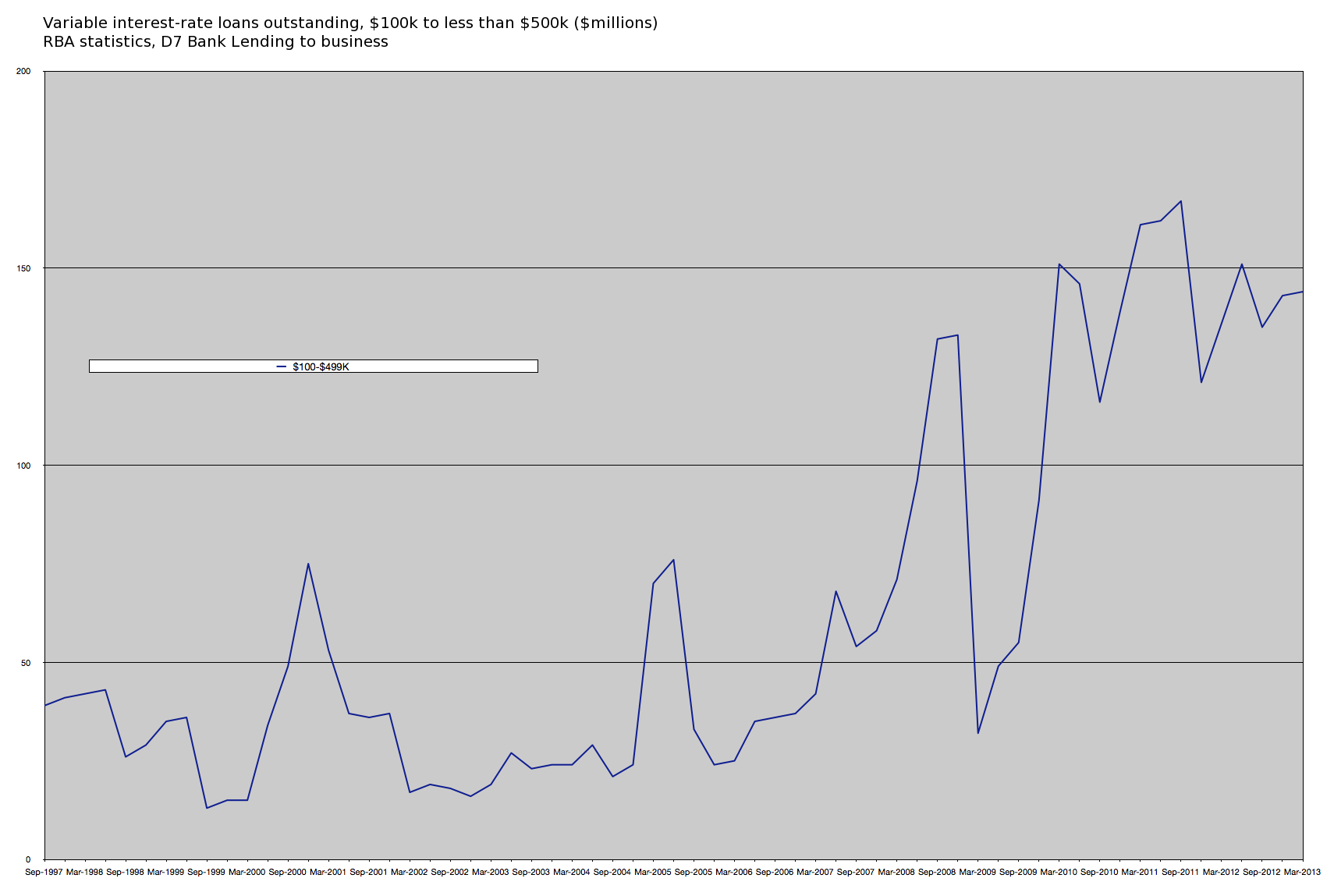
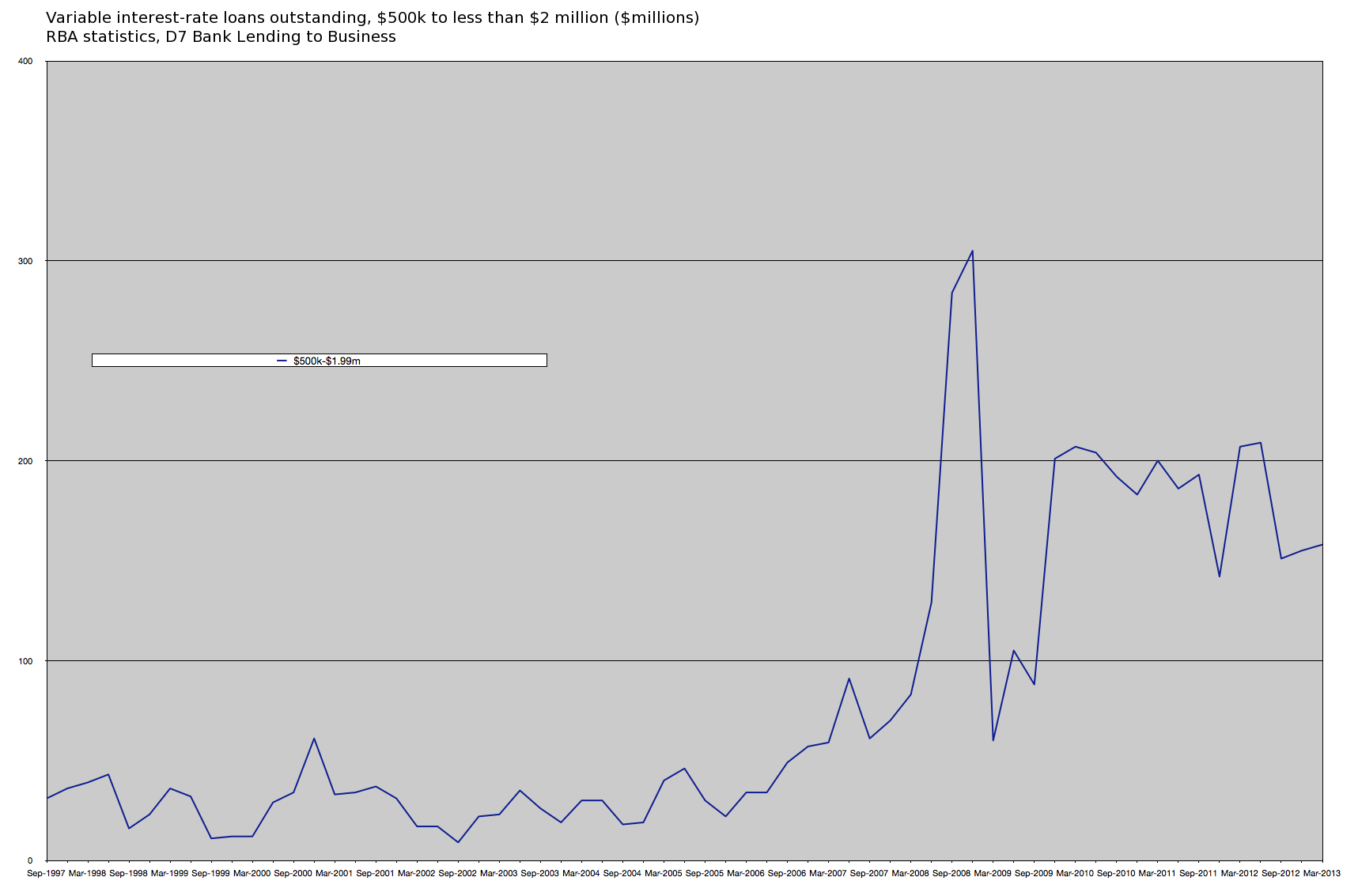
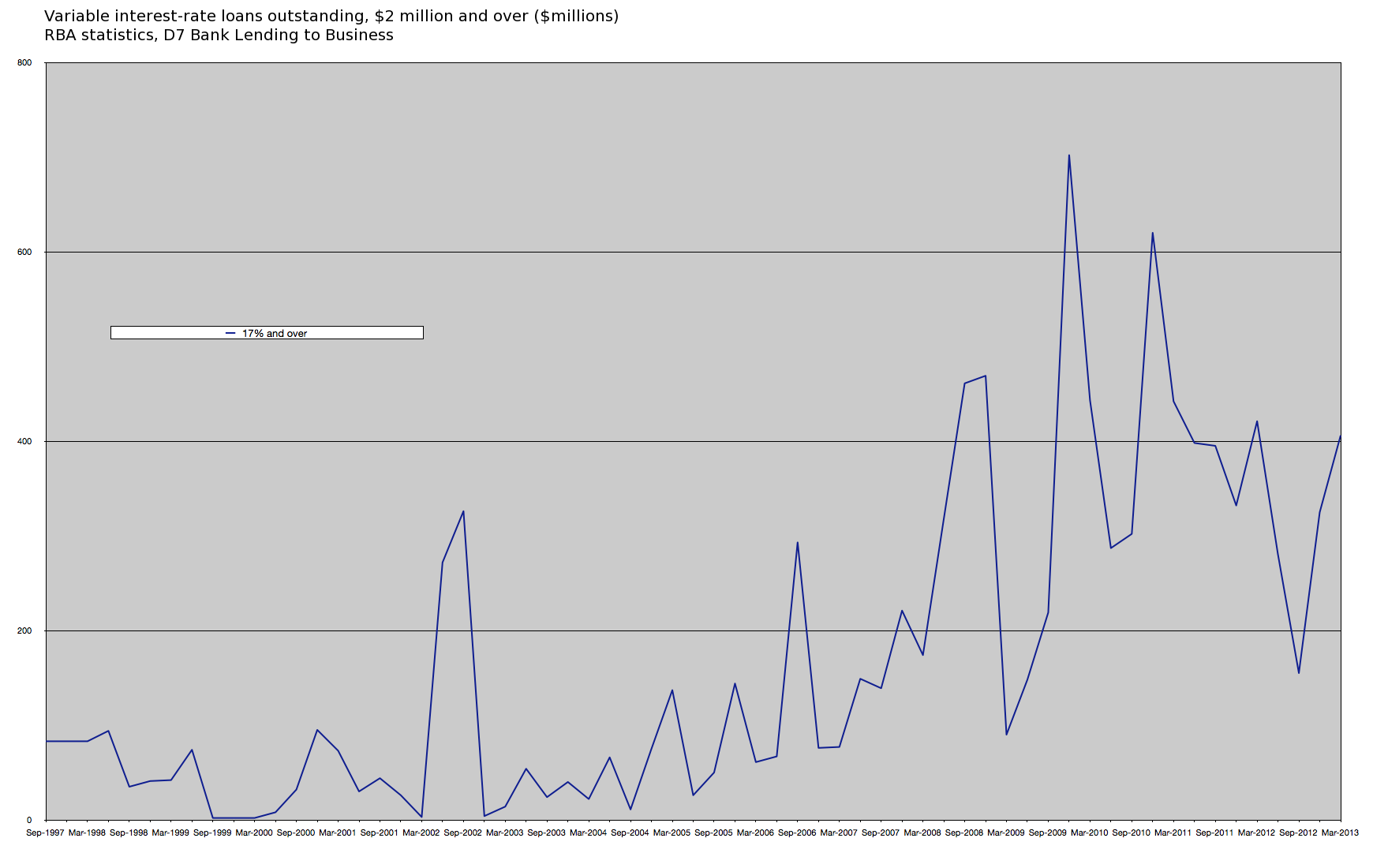
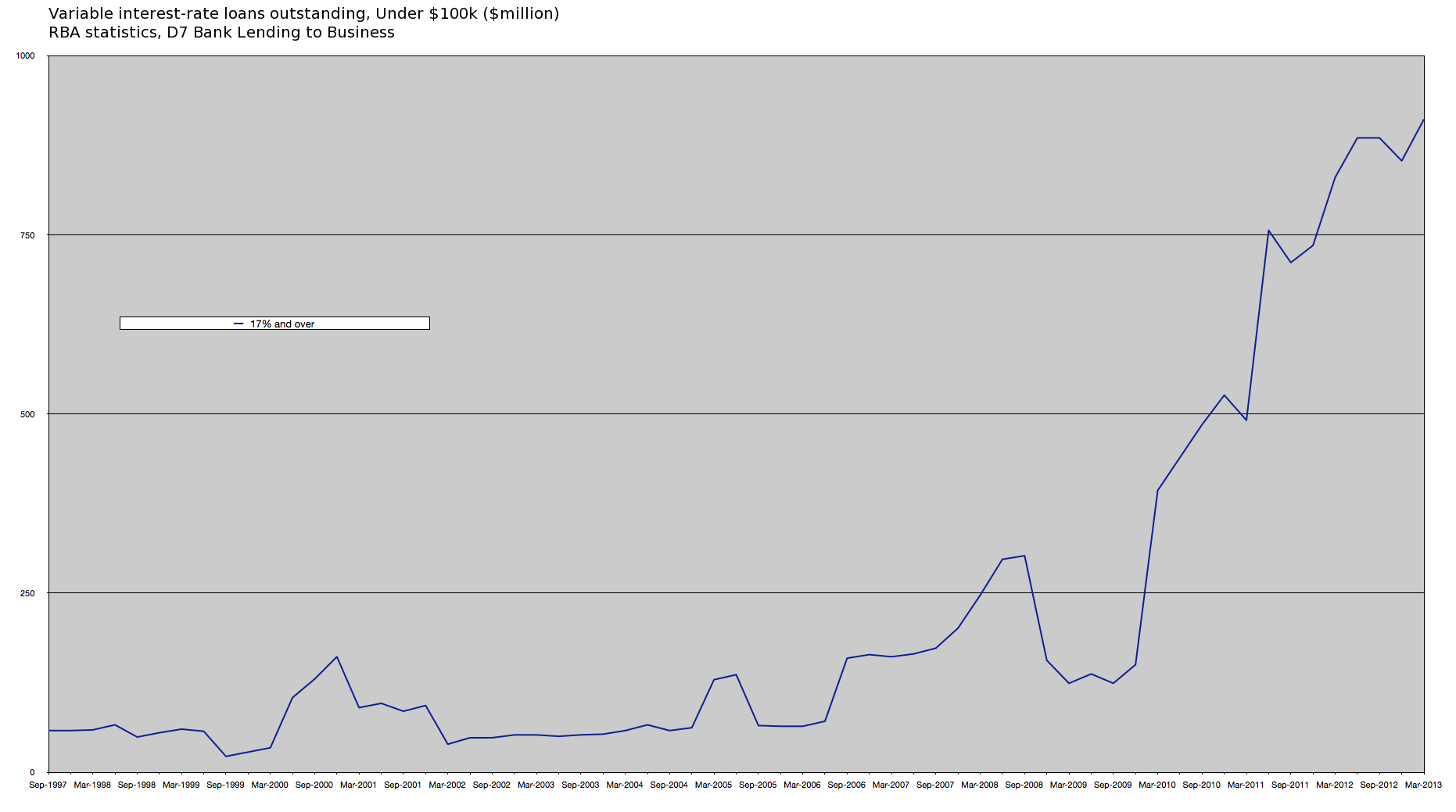
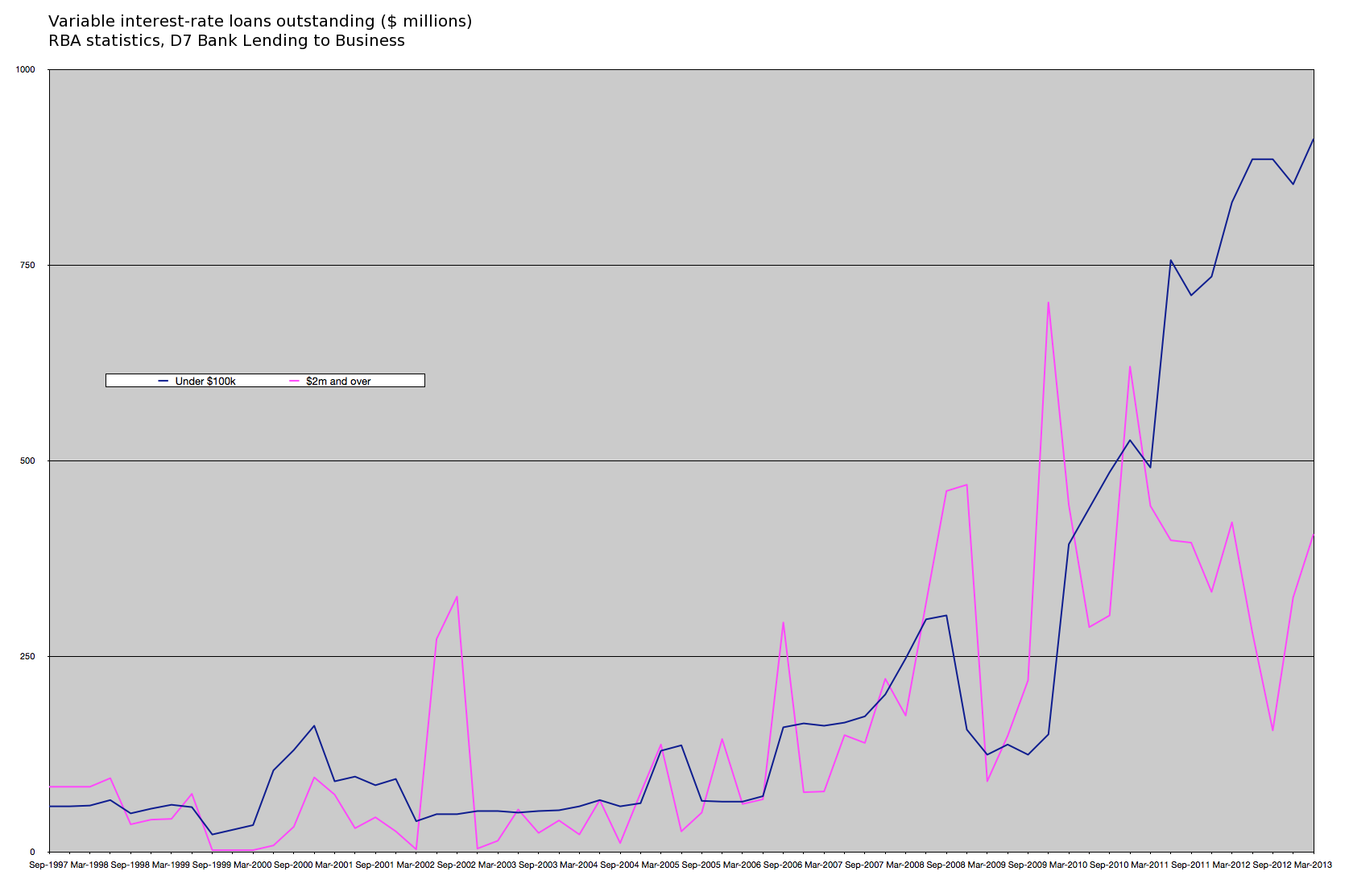
With Dun & Bradstreet’s most recent ‘Business Failure and Start-up Analysis’ reporting that “the number of small businesses going bankrupt jumped by 48 per cent over the last 12 months” — growing by 57 per cent over the year among firms with less than five employees, and 40 per cent over the year among firms with six to 19 employees — and that the start-up rate for small businesses fell by 95 per cent, it is worth taking a closer look at the usury rates charged by the banks for small business loans, as compared to large ones.

The following charts show the total value of variable usury-rate business loans, that have a usury rate of 17 per cent or greater.

First, loans of $100k to less than $500k:

Click to enlarge

Click to enlarge

Loans of $500k to less than $2 million:

Click to enlarge

Click to enlarge

Loans of $2 million and over:

Click to enlarge

Click to enlarge

And finally, loans of less than $100k:

Click to enlarge

Click to enlarge

Clearly there’s been no mercy shown by the usurers to their smallest business borrowers, post-GFC.

Here’s the direct comparison of business loans less than $100k, versus loans greater than $2 million, that are copping a 17 per cent or greater rate of usury:

Click to enlarge

Click to enlarge

All-time record low “official” interest rates?

Perhaps someone forgot to tell the usurers.

Who needs small businesses anyway, right?

Monopoly “capitalism” is much better.

For the 0.1% at the very top.

“Competition is a sin.”

– John D. Rockefeller

Raising The Ruddy Standards

8 Jul

What. A. Total. Wanker.

7 Jul

tumblr_lpax8yxyFy1qip14mo1_500The Ego has landed:

Mr Rudd said today he was happy to be returning to Indonesia, where he’d been on at least 10 previous occasions both as “a somebody” and “a nobody”.

I’m back to being a somebody,” he said.

Oh, right.

I get it.

Unless you’re the PM, you’re “a nobody”.

Thanks for letting us all know, Kev.

*cough* WANKER! *cough*

I wonder why your PMO staff neglected to include that bit in the official transcript of your speech:

FRI 05 JULY 2013
Prime Minister
Jakarta, Indonesia

In 2007 – less than a month after I became Prime Minister – Indonesia was the destination of my first overseas visit.

Today, in 2013, I am pleased to return here once again in my capacity as Prime Minister and to meet again with my counterpart, and good friend, President Yudhoyono.

In these five-and-a-half years, I have been to Indonesia ten times.

This is a beautiful country.

Thérèse and I love this country and its people.

And it is good to be back again.

UPDATE:

Yes, he really did say it (ABC Lateline video here):

TRANSCRIPT

TOM IGGULDEN, REPORTER: There was a touch of triumphalism about Kevin Rudd’s trip to Indonesia.

KEVIN RUDD, PRIME MINISTER: I’ve been back here 10 or 11 times, in one capacity or another. As a somebody and as a nobody, and back to being a somebody.

Mortgage Insurance Through The Roof, And Other Nasty Signs

7 Jul

From the Sunday Telegraph:

PREMIUMS have gone through the roof for the supposed “insurance” that a quarter of all homebuyers have to pay when taking out a loan.

Lenders Mortgage Insurance for a borrower with a typical 10 per cent deposit on a $500,000 property has risen from less than $6000 last year to nearly $9000, a surge of close to 50 per cent according to brokers Home Loan Experts.

… LMI has been used in more than two million loans but is poorly understood and is rarely discussed in detail. It is charged whenever a borrower has a deposit of less than 20 per cent. Many of those who pay it don’t even realise it protects the bank, not them.

In August 2011, then Treasurer Wayne Swan announced the introduction of a one-page fact sheet on LMI. Nearly two years on it still isn’t in place. It is “close” to being in place, according to the office of Assistant Treasurer David Bradbury.

Incredibly, when it is, it won’t even nominate the cost. And it is unlikely to point out that LMI is neither portable nor refundable.

That means any household looking to refinance with another lender faces paying thousands of dollars in LMI for a second time, unless they have at least 20 per cent equity in their home.

Mortgage brokers and consumer groups say this is undermining the Government’s efforts to increase competition in the home-loan market because having to pay LMI again makes switching lenders financially unviable.

… Home Loan Experts’ LMI premium increase calculations were based on comparing 2012 and 2013 rates for Genworth, one of the two major providers of lenders mortgage insurance in Australia.

When contacted for comment, Genworth said all executives authorised to speak to the media were on holidays.

Premiums levied by the other big provider, QBE, have also increased considerably. A mortgage broker who asked not to be named for fear of retribution said there had been a 17 per cent increase since 2010…

QBE would not provide any information on its premium rates. However, a spokeswoman did say premium increases were due to elevated claim levels and higher reinsurance costs, as well as lower investment income.

Lenders Mortgage Insurance is a perfect example of how our society is totally ruled by bankers.

Consider for a moment just how completely unjust … how utterly f***ed up … “our” financial system is:

  1. Banks are (exclusively) allowed to create new “credit” — backed by nothing — simply by typing new numbers into their computer.
  2. Banks are allowed to make profits by charging usury (interest) on that new “credit”, when they sign you up to a loan contract — which you must repay, or risk losing everything you own (bank-rupt).
  3. You have to pay for insurance to protect the bank in the event that you can not continue repayments of their “credit” + usury.
  4. You have to pay for that insurance again, if you want to transfer your 30-year debt+usury repayment obligations to a different bank.

The “finance” game is completely rigged.

They can’t lose.

In related news, the real estate industry lobby parasites are now calling on the government to let first home buyers tap into their superannuation savings, in order to come up with enough money for a deposit:

Call to supersize home deposits

Concerned about declining home ownership levels and a sharp fall in the proportion of buyers purchasing their first property, the Real Estate Institute of Australia (REIA) wants first homebuyers to be able to tap into their superannuation savings to help them scrape together a deposit.

… The institute says recent interest rate cuts have had little impact on the desire of potential first homebuyers to enter the market.

Er … hello?! Maybe that’s because Australian house prices — the highest on the planet — are simply too expensive?

Maybe it’s because the younger, internet-savvy generations are discovering the truth about our world-leading housing Ponzi?

Or maybe it’s because they do not want to be in debt to the bankers usurers for the rest of their working lives?

The institute cites two schemes operating overseas – in Singapore and Canada – that allow first homebuyers to use their superannuation savings when they buy a property.

… The REIA has also called on state and territory government to reverse the trend to only offer first homebuyers grants for new dwellings. “It’s excluding 80-odd per cent of people who have historically bought established homes,” [REIA President Peter] Bushby says.

When it comes to keeping the flow of property buyers coming in at the bottom of the Great Australian Housing Ponzi scheme, supporting and driving up prices (and thus, their commissions from property sales), there really is nothing — no bald-faced lie, no cunning deceit, no twisting of the truth — that these filthy rotten morally vacuous scumbags won’t say.

Perhaps it would be best for the common good if these people — along with the bankers, whose scraps they feed off — were all rounded up, taken down the back paddock, and their 100% self-serving thought processes “rebalanced” the good old-fashioned way.

With a small high velocity lead weight implanted in the side of their heads.

If you are not keenly interested in understanding and sharing the truth about the evil, deceitful, parasitic way in which the bankers’ debt-at-usury “money” system works, then you — your apathy, your ignorance, your disinterest — are a vital part of the reason why this predatory, cancerous system continues.

Design a site like this with WordPress.com
Get started