IMF Says Rudd’s Depositor Guarantee Scheme “Increases Moral Hazard Greatly”

25 Jul

It’s yet another Rudd Labor disaster, just waiting to happen.

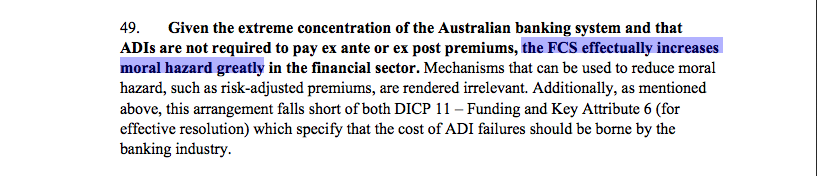
According to the IMF’s November 2012 technical note, Australia: Financial Safety Net and Crisis Management Framework, page 26, not only is there an “extreme concentration” in our banking system; the Financial Claims Scheme (FCS) introduced by the Rudd Government in 2008 “increases moral hazard greatly” –

Australia: Financial Safety Net and Crisis Management Framework. Source: IMF (click to enlarge)

Australia: Financial Safety Net and Crisis Management Framework. Source: IMF (click to enlarge)

Why so?

The IMF says that, unlike “most” similar schemes elsewhere, the Rudd scheme does not require the banks to make any contributions towards pre-funding of the guarantee. The responsibility for funding it, falls on the government. Meaning, the taxpayer.

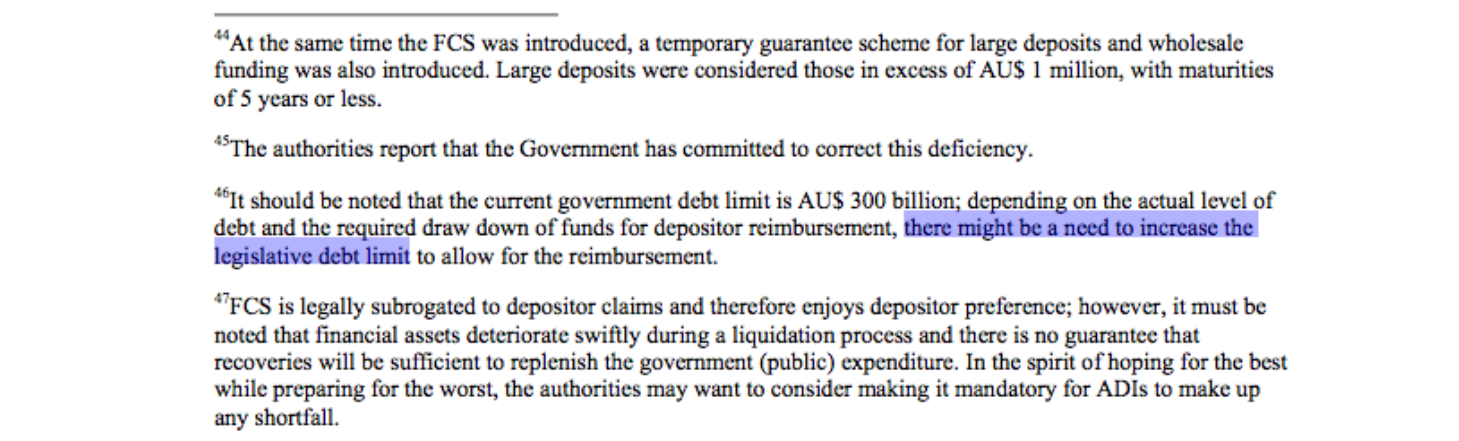
Indeed, the IMF points out that the government may need to increase the public debt limit above the present $300 billion ceiling, if payouts under the scheme became necessary –

Click to enlarge

Click to enlarge

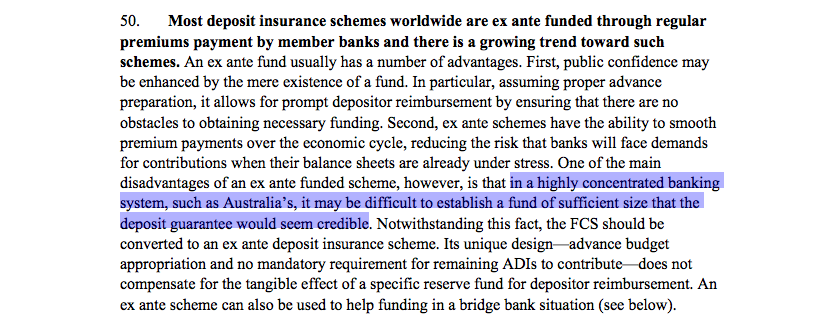
The IMF’s suggested solution to this “moral hazard” problem, is to make the banks pay “premiums” towards a “reserve fund” that could be used to support payouts under a depositor guarantee. However, the IMF also notes that even if a requirement for premium contributions was established, Australia’s banking system is so highly concentrated that “it may be difficult to establish a fund of sufficient size that the deposit guarantee would seem credible”

Click to enlarge

Click to enlarge

When you pause to carefully think this through, merely forcing the banks to pay a premium contribution towards a depositor claims reserve fund is really a rather ridiculous non-solution to the highlighted problem of moral hazard. It is analogous to charging an insurance premium for a policy that promises to pay for the ticket if the banker gets caught speeding –

121807_2025_MoralHazard2

We have recently seen the evidence in the Portfolio Budget Statements (page 134) for Budget 2013-14 that the government is now well-advanced in preparations for a Cyprus-style “bail-in” of our banks.

We have also seen the recent warning by Moodys ratings agency that our banking system has the world’s highest exposure to mortgages, and so is vulnerable to collapse if house prices fall.

Combine this with the IMF’s warning about Rudd Labor’s rushed and bungled depositor guarantee scheme that “increases moral hazard greatly”, and it is increasingly clear that I will soon have to redraft the debt trajectory chart on the masthead of this blog.

It only goes up to $300 billion.

See also:

The Bank Deposits Guarantee Is No Guarantee At All

Full Reserve Banking Advocates Are Myopic: Here’s Why

23 Jul

myopic-lasik

From central bank governors, to the IMF, to brilliant contrarian economists, to well-intentioned activist groups, there is a growing chorus of voices calling for an end to fractional reserve banking … or, more correctly, fractional reserve lending.

These voices are of those suffering from myopia.

Their complaint is this; that the root cause of the world’s ongoing economic ills is that, due to fractional reserve lending, private banks have been permitted to create too much “money” (debt) out of nothing, and lend it for profit.

Alas, they are only seeing what is immediately in front of their eyes.

The creation of “money” out of nothing, is only a lever.

Usury (ie, net interest income), is what is being lever-aged.

Consider the words of the National Australia Bank:

How Banks Work

…Their profit is the difference between what they pay in interest on your deposits and what you pay them in interest for the loan they made you.

Creating money — debt — out of nothing, does not make profits for bankers.

Charging interest on money (debt) created out of nothing, is what makes profits for bankers.

For those with full vision, the Big Picture is clear.

Every “solution” to the economic crisis that does not focus on the real problem — usury — is a short-sighted, and inevitably short-lived, non-solution.

4,500 years of recorded economic history prove it so.

See An Historical Warning For Proponents Of A Modern Debt Jubilee

New York Times: Keen Right, Bernanke Wrong

22 Jul
Steve Keen, an Australian economist, used the ideas of another economist, Hyman Minsky, to  set forth the possibility of a global debt crisis that now seems prescient. In a 2000 book,  Mr. Bernanke briefly mentioned, and dismissed, Mr. Minsky. (Source: Demetrius Freeman/New York Times)

Steve Keen, an Australian economist, used the ideas of another economist, Hyman Minsky, to set forth the possibility of a global debt crisis that now seems prescient. In a 2000 book, Mr. Bernanke briefly mentioned, and dismissed, Mr. Minsky. (Source: Demetrius Freeman/New York Times)

Oh dear.

What does it tell you — particularly about the gross misallocation (and mis-remuneration) of human intellectual resources — when the New York Times declares the most powerful central banker on the planet, US Federal Reserve chairman Ben Bernanke, to be fundamentally wrong, and a humble Aussie economist, (now unemployed) Associate Professor Steve Keen, to be fundamentally right:

For a time, the period before the collapse was known as the “Great Moderation,” a term that Mr. Bernanke helped to publicize in a 2004 speech. Low levels of inflation, long periods of economic growth and low levels of employment volatility were viewed as unquestioned proof of success.

And what brought on that success? In 2004, Mr. Bernanke, then a Fed governor, conceded good luck might have helped, but his view was that “improvements in monetary policy, though certainly not the only factor, have probably been an important source of the Great Moderation.”

In 2005, three Fed economists, Karen E. Dynan, Douglas W. Elmendorf and Daniel E. Sichel, proposed an additional explanation for the Great Moderation: the success of financial innovation.

“Improved assessment and pricing of risk, expanded lending to households without strong collateral, more widespread securitization of loans, and the development of markets for riskier corporate debt have enhanced the ability of households and businesses to borrow funds,” they wrote. “Greater use of credit could foster a reduction in economic volatility by lessening the sensitivity of household and business spending to downturns in income and cash flow.”

At least Mr. Bernanke’s hubris was not as great as that of Robert E. Lucas Jr., the Nobel Prize-winning University of Chicago economist. In 2003, he began his presidential address to the American Economic Association by proclaiming that macroeconomics “has succeeded: Its central problem of depression prevention has been solved.”

In his speech last week, Mr. Bernanke cited several assessments of the Great Moderation, including the one by the Fed economists. None questioned that it was wonderful.

The Fed chairman conceded that “one cannot look back at the Great Moderation today without asking whether the sustained economic stability of the period somehow promoted the excessive risk-taking that followed. The idea that this long period of calm lulled investors, financial firms and financial regulators into paying insufficient attention to building risks must have some truth in it.”

One economist who would have expected that development was Hyman Minsky. In 1995, the year before Minsky died, Steve Keen, an Australian economist, used his ideas to set forth a possibility that now seems prescient. It was published in The Journal of Post Keynesian Economics.

He suggested that lending standards would be gradually reduced, and asset prices would rise, as confidence grew that “the future is assured, and therefore that most investments will succeed.” Eventually, the income-earning ability of an asset would seem less important than the expected capital gains. Buyers would pay high prices and finance their purchases with ever-rising amounts of debt.

When something went wrong, an immediate need for liquidity would cause financiers to try to sell assets immediately. “The asset market becomes flooded,” Mr. Keen wrote, “and the euphoria becomes a panic, the boom becomes a slump.” Minsky argued that could end without disaster, if inflation bailed everyone out. But if it happened in a period of low inflation, it could feed upon itself and lead to depression.

“The chaotic dynamics explored in this paper,” Mr. Keen concluded, “should warn us against accepting a period of relative tranquillity in a capitalist economy as anything other than a lull before the storm.”

When I talked to Mr. Keen this week, he called my attention to the fact that Mr. Bernanke, in his 2000 book “Essays on the Great Depression,” briefly mentioned, and dismissed, both Minsky and Charles Kindleberger, author of the classic “Manias, Panics and Crashes.”

They had, Mr. Bernanke wrote, “argued for the inherent instability of the financial system but in doing so have had to depart from the assumption of rational economic behavior.” In a footnote, he added, “I do not deny the possible importance of irrationality in economic life; however it seems that the best research strategy is to push the rationality postulate as far as it will go.”

It seems to me that he had both Minsky and Kindleberger wrong. Their insight was that behavior that seems perfectly rational at the time can turn out to be destructive.

Warning Of Global Systemic Crisis 2.0 In Second Half 2013

20 Jul

warning-sign

There are many who take careful notice of the GlobalEurope Anticipation Bulletin (GEAB). I too, have often found it interesting, and insightful.

The latest GEAB is certainly worth reading, and heeding. But not for the obvious, headline reason.

It may be flagging in advance a “reform” agenda, to be triggered as a response to a new, bigger crisis. A reform that some, including myself, have long expected (excerpt-only below):

A situation which is now out of control

The illusions which have still blinded the last remaining optimists are in the process of dissipating. In previous GEAB issues we have already laid out the world economy’s grim picture. Since then the situation has got worse. The Chinese economy confirms its slowdown (1) as well as Australia (2), emerging countries’ currencies are disconnecting (3), bond interest rates are rising, UK salaries are continuing to fall (4), riots are affecting Turkey and even peaceful Sweden (5), the Eurozone is still in recession (6), the news filtering out of the United States is no longer cheerful (7)…

Nervousness is now clearly palpable on all financial markets where the question is no longer knowing when the next record will be but succeeding in getting out soon enough before the stampede. The Nikkei has fallen more than 20% in three weeks during which there have been three sessions with losses exceeding 5%. So, the contagion has now reached the “standard” indices such as the stock exchanges, interest rates, and currency exchange rates… the last bastions still controlled by the central banks and, therefore, totally distorted as our team has repeatedly explained.

In Japan this situation is the result of the over-the-top sized quantitative easing programme undertaken by the central bank. The Yen’s fall has brought about strong inflation in the price of imported goods (particularly oil). The huge swings in the Japanese stock exchange and currency is destabilising the whole of global finance. But the implementation of the Bank of Japan’s programme is so new that its effects are still much less pronounced than those of the Fed’s quantitative easing. It’s primarily the Fed which is responsible for all the current bubbles: real estate in the United States (8), stock exchange record highs, bubbles in and destabilisation of emerging countries (9), etc.

It’s also thanks to it, or rather because of it, that the virtual economy has got going again with even greater intensity and that the necessary balancing hasn’t taken place. The same methods are producing the same effects (10), an increased virtualisation of the economy is leading us to a second crisis in five years, for which the United States is once again responsible. The central banks can’t hold the global economy together indefinitely; at the moment they are losing control.

A second US crisis

If the months of April-May, with a great deal of media hype, seem to agree with the US-UK-Japanese method of monetary easing (to put it mildly) against the Euroland method of reasoned austerity, for several weeks now the champions of all-finance have had a little more difficulty in claiming victory. The IMF, terrified by the global impact of the economic slowdown in Europe, doesn’t know what else to come up with to force Europeans to continue spending and make deficits explode again: even empty boutique World must continue to give the impression that it’s still in business, and Europe isn’t playing the game.

But the toxic effects of central bank operations in Japan, the United States and the United Kingdom now demolish the argument (or rather propaganda) touting the success of the “other method”, supposed to allow recovery in Japan, the US and the United Kingdom (incidentally, the latter has never even been mentioned).

The currently developing second crisis could have been avoided if the world had taken note that the United States, structurally incapable of reforming itself, was unable to implement other methods than those which had led to the 2008 crisis. Like the irresponsible “too big to fail” banks, the “systemically” irresponsible countries should have been placed under supervision from 2009 as suggested from the GEAB n° 28 (October 2008). Unfortunately the institutions of global governance have proved to be completely ineffective and powerless in managing the crisis. Only regional good sense has been able to put it in place; the international arena producing nothing, everyone began to settle their problems in their part of the world.

The other crucial reform advocated (11) since 2009 by the LEAP/E2020 team focused on taking a completely new look at the international monetary system. In 40 years of US trade imbalances and the volatility of its currency, the dollar as the pillar of the international monetary system has been the carrier of all the United States’ colds to the rest of the world, and this destabilising pillar is now at the heart of the global problem because the United States is no longer suffering from a cold but bubonic plague.

Absent having reformed the international monetary system in 2009, a second crisis is coming. With it comes a new window of opportunity to reform the international monetary system at the G20 in September (12) and one almost hopes that the shock happens by then to force an agreement on this subject, otherwise the summit risks taking place too soon to gain everyone’s support.

——–
Notes:

(1) Source: The New York Times, 08/06/2013.

(2) Source: The Sydney Morning Herald, 05/06/2013. Read also Mish’s Global Economic, 10/06/2013.

(3) Source: CNBC, 12/06/2013.

(4) Source: The Guardian, 12/06/2013.

(5) Read Sweden’s riots, a blazing surprise, The Economist, 01/06/2013.

(6) Source: BBC News, 06/06/2013.

(7) Read Economic dominos falling one by one, MarketWatch, 12/06/2013.

(8) A bubble in current market conditions; normally this would be considered a thrill. Market Oracle, 10/06/2013.

(9) On the consequences of worldwide QE in India: Reuters, 13/06/2013.

(10) The return of financial products at the origin of the 2008 crisis is not insignificant. Source : Le Monde, 11/06/2013.

(11) Cf. GEAB n°29, November 2008.

(12) Source: Ria Novosti, 14/06/2013.

Hmmmmm.

September 2013.

That would be convenient timing.

Since we have now seen the irrefutable evidence that, as agreed at Seoul in 2010, the G20 nations — in particular, the EU, UK, USA, Canada, Australia, and New Zealand — are all now well advanced in their preparations to implement a Cyprus-style “bail-in” of banks.

See Timeline For “Bail-In” Of G20 Banking System.

I’ve said it before, and will again.

Any “new” monetary system that is suggested by the usual suspects — the internationalist IMF, World Bank, FSB, etc, which are all little more than elitist bankster covens — is NOT the new monetary system we should want.

Because it would only ever be, as now, their system. Of their design. For their benefit.

What the world needs is something very different to anything that the bankers would ever promote –

Imagine A World With No Banks

“Money has no motherland; financiers are without patriotism and without decency; their sole object is gain.”

– Napoleon, 1815

Labor’s Economic Plan: Copy Cyprus And Iceland

19 Jul

Airplane-wreckage-Iceland1

Your humble blogger was interested to watch new treasurer Chris Bowen’s speech at the National Press Club yesterday.

Readers may have noticed that resuscitated PM Rudd has immediately distanced his own economic narrative from that of former PM Gillard, and her imbecilic deputy PM and “World’s Greatest Treasurer” Swan. Rather than their mantra-like “Strongest advanced economy / mining boom forever / everything is fine / stop being so negative” tripe, Kevin Rudd has instead begun to offer the teensiest bit of honesty about the problems the economy faces, both now, and in the weeks and months ahead.

So in that vein, I wondered whether our new treasurer might just put a little bit more meat on the bone of Rudd’s rhetoric, by outlining (or even hinting at) just what this “new Labor” under Rudd might have in mind in terms of economic policies. One could be forgiven for expecting so, considering that the title of Bowen’s speech was Labor: Managing The Economic Transition.

Now I grant you, unlike any appearance of Wayne Swan on TV, I was able to quite easily watch all of Bowen’s speech without feeling an immediate boiling of the blood and red mist descending. So that’s something to be said for our erstwhile new treasurer.

Shame then, that nothing good can be said for the content of his speech.

Indeed, it would appear Labor’s grand economic plan is to copy Cyprus and Iceland, by turning Australia into a “financial services centre” (my bold added):

The estimated net contribution of the resource sector to real GDP growth is expected to fall – from contributing to roughly half of Australia’s economic growth over the past two years to around a third by the end of the forecast horizon.

The production phase of the resource boom will also be significantly less labour-intensive than the investment phase.

This brings me to the second transition we face.

That transition is to growth being driven by the non‑resource sectors.

It’s not surprising to see Treasury forecasting that the non-mining economy will make a larger contribution to Australia’s economic growth.

These transitions will occur inevitably.

The question is: will they be smooth or bumpy? Will the Australian economy benefit from them or suffer?

Our challenge is in improving our productivity and competitiveness to assist in this transition.

This is the key economic challenge for the next three years – and lies at the core of Labor’s positive plan to promote competitiveness to spur jobs and investment.

This will mean working with the manufacturing and services sectors to promote investment.

I’m not talking about picking winners or subsidies – I’m talking about breaking down barriers to competitiveness.

What we’re doing in financial services is a good example of what can be done.

Financial services

The financial services sector has seen incredible growth in the last 20 years and it is this growth that we need to harness.

Despite the strength of the local industry, our exports and imports of financial services are low by international standards.

There is a great opportunity for the financial services industry to become more outwardly focused.

Encouraging competition and efficiency would improve the range and choice of financial products available to consumers and promote increased exports of financial services.

Improved economies of scale would reduce the costs of financial products for Australian consumers and businesses.

As our track record shows, only Labor is interested in taking advantage of these opportunities.

In 2009 and 2010, it was pretty unfashionable for Governments around the world to announce that they wanted to promote financial services.

But in January 2010, as Minister for Financial Services and Superannuation, I released the Australian Financial Centre Forum’s report on Australia as a Financial Centre – the Johnson Report as it became known – and four months later, the Government started implementing the key reforms.

Stages 1 and 2 of the signature reform – the Investment Manager Regime – have passed the Parliament.

We have taken steps to create a deep and liquid corporate bond market in Australia. Legislation to simplify corporate bonds issuance has passed the House of Representatives.

The Government has passed legislation to enable the retail trading of Australian Government Bonds.

And the Government recently announced that Australia will be the third major currency in the world to be able to trade directly against with the Chinese Renminbi, after the US dollar and the Japanese Yen, in China’s foreign exchange market.

Why have we done this?

Because Labor knows that increased trade in financial services will increase Australia’s growth prospects and standard of living.

We know positioning Australia as a financial services centre in the region means that we would be able to offer increased job opportunities for a range of skilled workers in the financial sector.

And there is potential to do so much more.

Yes, I can just see all those tradies coming back from the mining construction boom, shedding their Consciences, donning white collared shirts, and learning how to become peddlers of usury products.

Aspiring to be a “financial services centre” is nothing more, and nothing less, than aspiring to copy the economic model of Iceland and Cyprus, both of whom enjoyed an initial “boom” from doing this.

Followed by another one.

If this is what Labor have to offer in terms of “managing the economic transition”, then we really are in deep, deep doo doo.

A final comment.

It is interesting to this blogger to note the complete absence of criticism of Bowen’s speech in the mainstream press, either yesterday or today.

Bowen’s speech contained no indication of Labor having any other new economic policy initiatives. None whatsoever.

A “financial services centre for the region”. That is the great Labor plan, or so it would seem.

After what we have seen happen to other small nations that embarked on this same path, what we should have seen is the media tearing strips off Labor.

Instead, if anything, what we have seen is muted applause.

Methinks the economic commentariat’s left-leaning slip is showing under their skirts.

Crisis Management: APRA To Be Given Power To “Direct” Your Super

17 Jul
Australian Treasury,  Strengthening APRA's Crisis Management Powers, September 2012, page 34 (click to enlarge)

Australian Treasury, Strengthening APRA’s Crisis Management Powers, September 2012, page 34 (click to enlarge)

It’s been a big week for your humble blogger, vis-a-vis finding incriminating evidence on government websites.

Here’s another example of something I have warned of (repeatedly) since the inception of this blog, now coming to fruition.

That like so many other countries in the Western world since 2008, our government too would, someday, use the pretext of “crisis management” to steal your super to prop up an insolvent financial system.

Today, we learn that the Orwellian euphemism that has been chosen to describe this process in Australia, is “direction powers”.

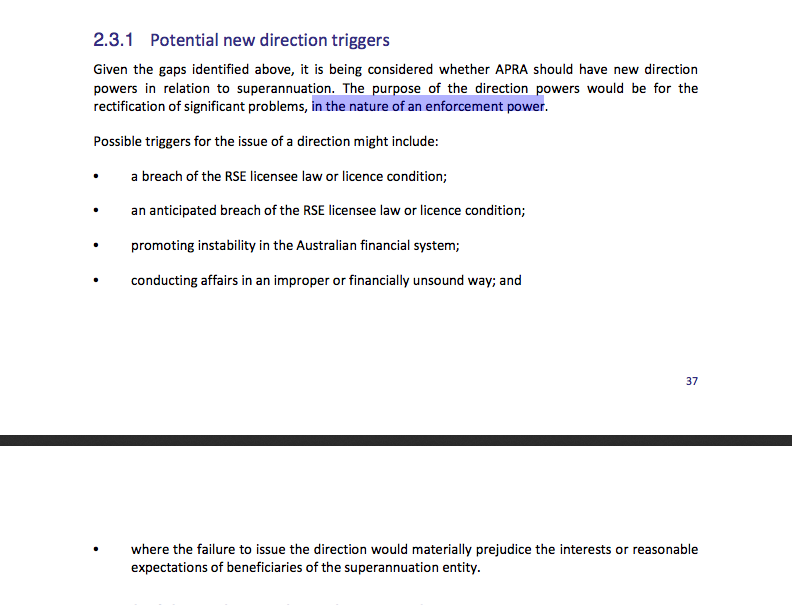
From the Australian Treasury’s Consultation Paper, Strengthening APRA’s Crisis Management Powers, September 2012 (my bold emphasis added):

2.3.1 Potential new direction triggers

…it is being considered whether APRA should have new direction powers in relation to superannuation.

The purpose of the direction powers would be for the rectification of significant problems, in the nature of an enforcement power.

Possible triggers for the issue of a direction might include:

  • a breach of the RSE licensee law or licence condition;
  • an anticipated breach of the RSE licensee law or licence condition;
  • promoting instability in the Australian financial system;
  • conducting affairs in an improper or financially unsound way; and
  • where the failure to issue the direction would materially prejudice the interests or reasonable expectations of beneficiaries of the superannuation entity.

Note carefully what is being described here.

Earlier in the same document, the Treasury department bemoaned that:

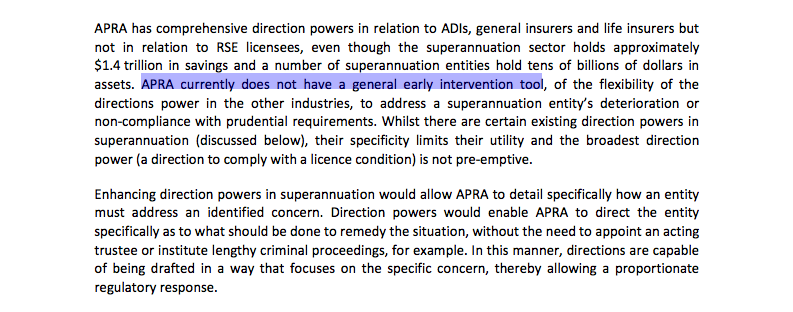
APRA has comprehensive direction powers in relation to ADIs, general insurers and life insurers but not in relation to RSE licensees, even though the superannuation sector holds approximately $1.4 trillion in savings and a number of superannuation entities hold tens of billions of dollars in assets.

Oh dear! All that money, just sitting there making private sector fund managers rich on fees, and they (the government) don’t have the power to direct what happens to it. Sacre bleu!

Treasury went on to say that APRA needs an “early intervention tool” that is “preemptive”, and so allows it to “address a superannuation entity’s deterioration or non-compliance with prudential requirements”:

Australian Treasury, Strengthening APRA's Crisis Management Powers, September 2012, page 34 (click to enlarge)

Australian Treasury, Strengthening APRA’s Crisis Management Powers, September 2012, page 34 (click to enlarge)

Now here is where the cunning comes in.

How do you ensure that you give yourself the ability to “trigger” your new “enforcement power”, in order to give “direction” to a superannuation fund to … oh let’s say … direct a percentage of its (ie, yours, dear reader) money into government bonds to support the national government’s solvency? Or to the shares of a collapsing bank? Or to the shares in a new “bridging institution”, as directed by the FSB under its new, G20-wide bank resolution “bail-in” regime?

Easy.

You establish a set of “triggers” for your new “direction power”. Just like those they have listed above. Including, most notably, the trigger that — in their judgment — “the failure to issue the direction would materially prejudice the interests or reasonable expectations of beneficiaries of the superannuation entity.”

In other words, if APRA (or the IMF, or FSB, who now tell APRA what to do) were to decide that it “would materially prejudice” your interests if they did NOT “direct” your super fund to do whatever the government wants, then that is all the “trigger” they need to enforce a “direction” on your super savings.

Don’t believe me?

Think I’m twisting what they said?

Read it again.

Very carefully.

With special note of this:

Enhancing direction powers in superannuation would allow APRA to detail specifically how an entity must address an identified concern. Direction powers would enable APRA to direct the entity as to what should be done to remedy the situation…

What if the “identified concern” is that failure to issue the direction would materially prejudice the interests or reasonable expectations of beneficiaries of the superannuation entity”?

Or what if the “identified concern” is simply that the super funds are not parking your money in the “investments” that the government wants them to, and that this is or could be “promoting instability in the Australian financial system” — another one of the “triggers” listed?

By this action, the government is effectively abrogating to itself what is essentially an unlimited power to “direct” your super fund to do “specifically” whatever the government says with your money, under the dangerously broad, and subjective, Big-Brother-Knows-Best pretext that “failure to issue the direction would materially prejudice” your interests.

See also:

Your Super Screwed By The Laboral Party

Stealing Our Super – I DARE You To Ignore This Now

IMF Tells Australian Lawmakers To “Prevent Premature Disclosure Of Sensitive Information” On Bank Bail-Ins

17 Jul

IMF_technote_Nov2012

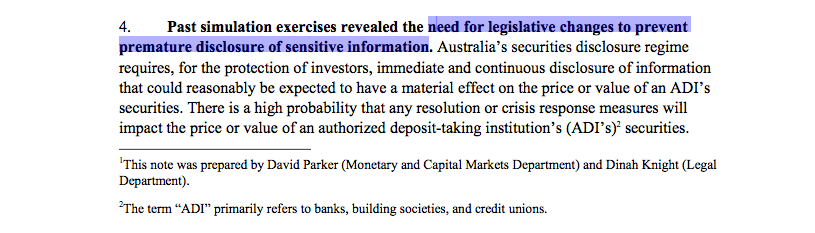
IMF: Financial Safety Net and Crisis Management Framework, November 2012, page 4 (click to enlarge)

IMF: Financial Safety Net and Crisis Management Framework, November 2012, page 4 (click to enlarge)

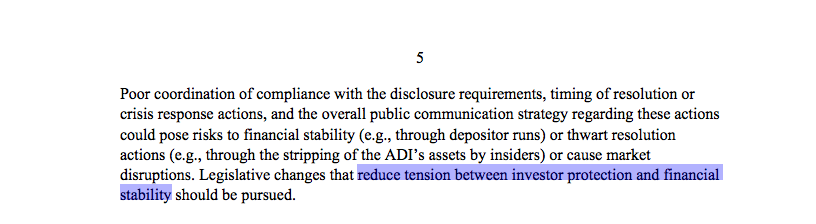
IMF: Financial Safety Net and Crisis Management Framework, November 2012, page 5 (click to enlarge)

IMF: Financial Safety Net and Crisis Management Framework, November 2012, page 5 (click to enlarge)


Orwell would be impressed with this.

In a November 2012 Technical Note on the Financial Sector Program Update for Australia, as part of their Financial Safety Net and Crisis Management Framework, the IMF has advised that there is a problem (my bold emphasis added):

Past simulation exercises revealed the need for legislative changes to prevent premature disclosure of sensitive information. Australia’s securities disclosure regime requires, for the protection of investors, immediate and continuous disclosure of information that could reasonably be expected to have a material effect on the price or value of an ADI’s securities. There is a high probability that any resolution or crisis response measures will impact the price or value of an authorized deposit-taking institution’s (ADI’s) securities.

Poor coordination of compliance with the disclosure requirements, timing of resolution or crisis response actions, and the overall public communication strategy regarding these actions could pose risks to financial stability (e.g., through depositor runs) or thwart resolution actions (e.g., through the stripping of the ADI’s assets by insiders) or cause market disruptions. Legislative changes that reduce tension between investor protection and financial stability should be pursued.

“Reduce tension” between investor protection and financial stability?!

By making laws to “prevent premature disclosure of sensitive information”?!?!

In order to prevent bank runs, which would happen if investors were to find out that a Cyprus-style “resolution or crisis response measure” is in the offing for the bank that they have their money in?!?!!!!

Truly, moral relativism is one of The greatest evils of our time.

These people have no Conscience.

None.

UPDATE:

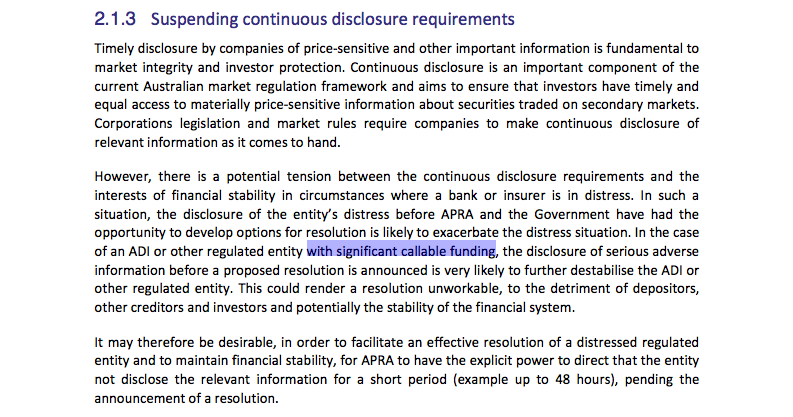
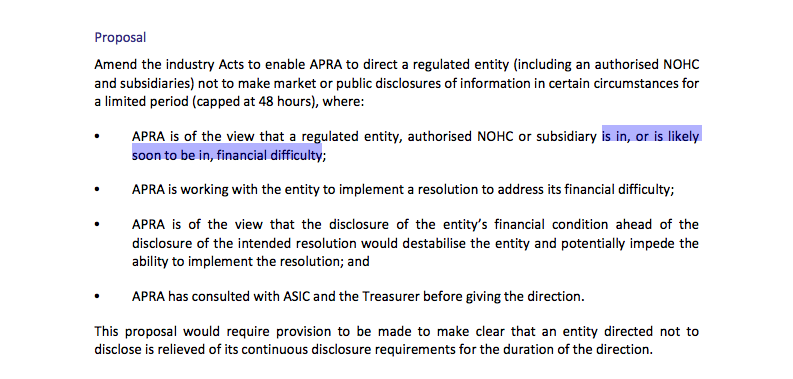
The Treasury department put this problem to the banks in their September 2012 Consultation Paper, with a proposal to suspend the continuous disclosure requirements:

Australian Treasury, Strengthening APRA’s Crisis Management Powers, September 2012, page 26 (click to enlarge)

Australian Treasury, Strengthening APRA’s Crisis Management Powers, September 2012, page 26 (click to enlarge)

Australian Treasury, Strengthening APRA's Crisis Management Powers, September 2012, page 29 (click to enlarge)

Australian Treasury, Strengthening APRA’s Crisis Management Powers, September 2012, page 29 (click to enlarge)

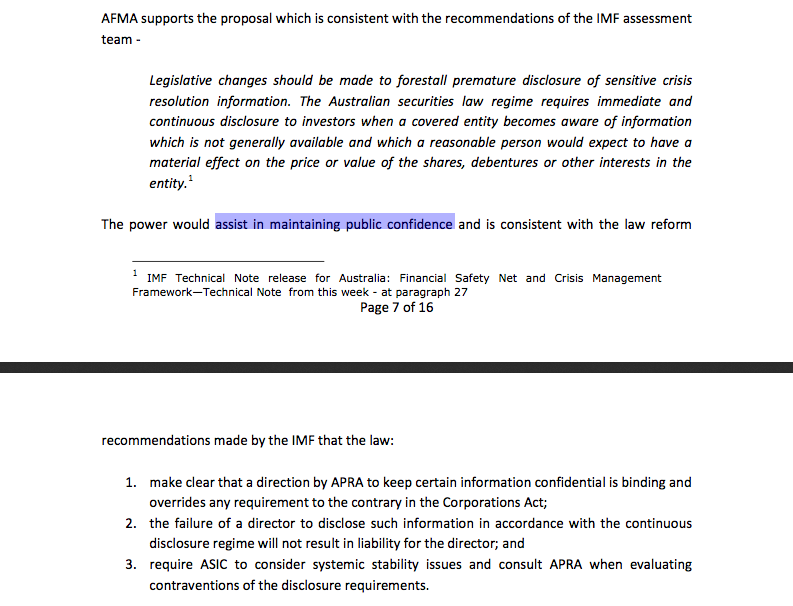
… and unsurprisingly, the banks have agreed to it:

AFMA, letter to Australian Treasury, January 2013, pp 7-8 (click to enlarge)

AFMA, letter to Australian Treasury, January 2013, pp 7-8 (click to enlarge)

Australian Banks “Welcome” Cyprus-Style Bail-In Plan

17 Jul
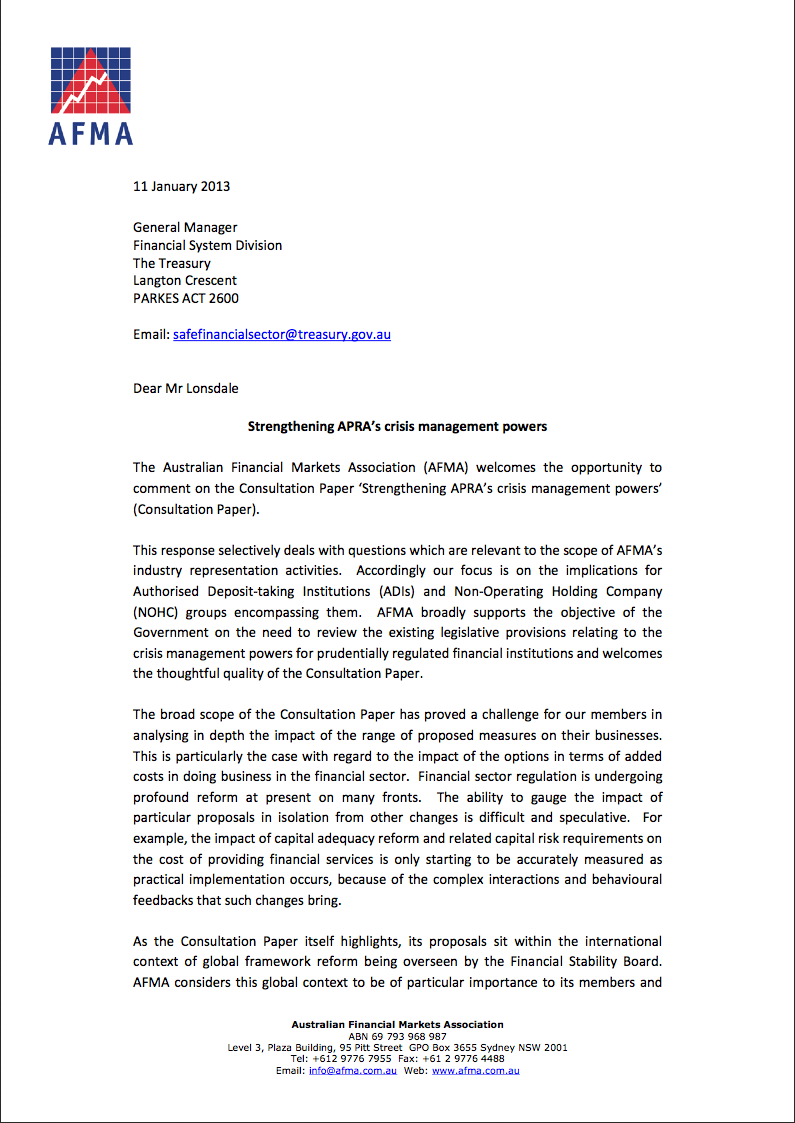
AFMA letter to Australian Treasury, 11 January 2013, page 5 (click to enlarge)

AFMA letter to Australian Treasury, 11 January 2013, page 5 (click to enlarge)

On 11 January 2013, the Australian Financial Markets Association (AFMA) responded to the Australian Treasury regarding the government’s Consultation Paper (September 2012) Strengthening APRA’s Crisis Management Powers.

Click to enlarge

Click to enlarge

There is much of interest in AFMA’s letter.

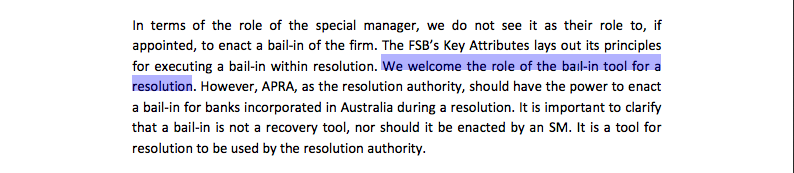
But this (page 5) is arguably the “money quote” that should be of most interest to Aussies with savings in a bank:

“The FSB’s Key Attributes lays out its principles for executing a bail-in within resolution. We welcome the role of the bail-in tool for a resolution.”

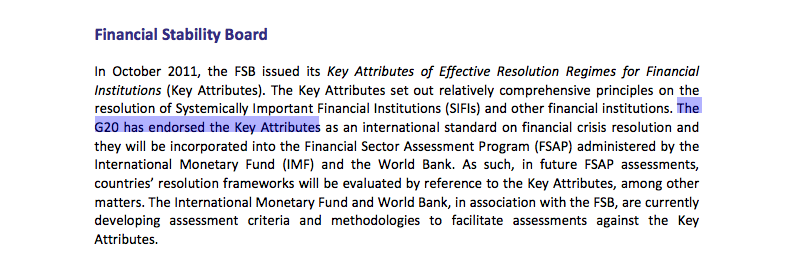
The Australian Treasury’s consultation paper further evidences that the internationalist, Goldman-Sachs chaired, FSB-directed new regime for Cyprus-style bail-in of banks using depositors savings was endorsed by the G20:

Australian Treasury, Strengthening APRA's Crisis Management Powers, September 2012, page 4 (click to enlarge)

Australian Treasury, Strengthening APRA’s Crisis Management Powers, September 2012, page 4 (click to enlarge)

Treasury_StrengtheningAPRA_cover

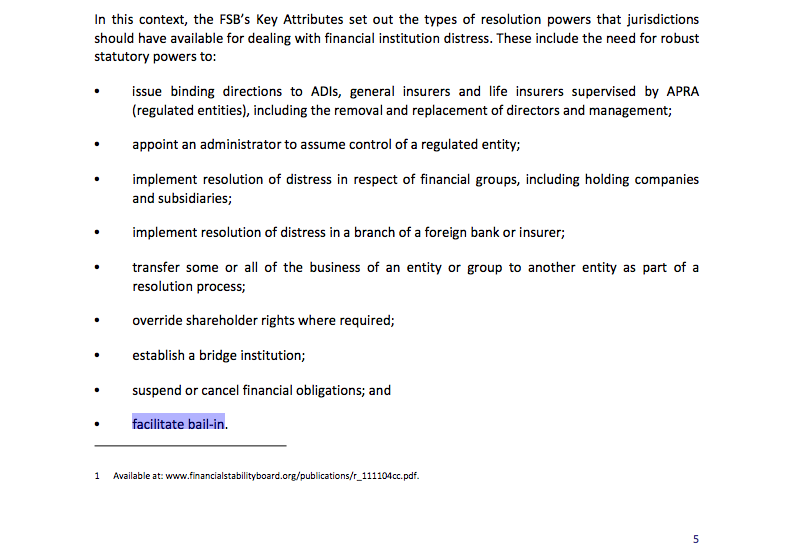
… and that bail-in of Australian banks is an FSB requirement, one that will be enforced by APRA as Australia’s “resolution authority”, under new “robust statutory powers”:

Australian Treasury, Strengthening APRA's Crisis Management Powers, September 2012, page 5 (click to enlarge)

Australian Treasury, Strengthening APRA’s Crisis Management Powers, September 2012, page 5 (click to enlarge)

More to come.

See also:

Australia Plans Cyprus-Style “Bail-In” Of Banks In 2013-14 Budget

Timeline For “Bail-In” Of G20 Banking System

G20 Governments All Agreed To Cyprus-Style Theft Of Bank Deposits … In 2010

Get ‘Em Naked – Rudd’s Deal To Buy Youth Access

17 Jul

Next, a revival of his 2009 proposal to lower the voting age to 16?

From the Sydney Morning Herald:

The Labor Party’s advertising agency has been offering “exclusive” interviews with Prime Minister Kevin Rudd in exchange for free pro-Labor advertising and editorial on youth websites.

The deal, which also encouraged journalists to produce “entertaining content on the theme of the inadequacy of the Liberal NBN plan”, had been rejected on ethical grounds by Fairfax Media’s popular culture website, TheVine. Two other youth-focused websites – Vice and Pedestrian.tv – have received the same brief.

The deal was being spruiked by Naked Communications, the online and youth-focused advertising agency for Labor’s campaign.

Labor’s national secretary, George Wright, who is in charge of the election campaign, said he had never seen the advertising-for-access deal, despite the document carrying Labor Party branding…

Earlier a spokeswoman for Mr Rudd had said: “The actions of Naked Communications were conducted without the authority or knowledge of the Prime Minister, or his office.”

However, emails obtained by Fairfax Media suggest the Prime Minister’s office was informed of the negotiations.

After being told his deal for access to Mr Rudd was unethical, Naked Communications executive Nick Kavanagh discussed a compromise arrangement with TheVine’s editor, Alyx Gorman.

“No news from the [Prime Minister’s Office] as yet but we’ll keep you updated,” Mr Kavanagh wrote.

Politicians.

P . R . E . D . A . T . O . R . S.

Bailout Fund Not So Stable: Fitch Downgrades Credit Rating Of European Stability Facility

16 Jul

Emptied your bank account yet?

The global ratings agency Fitch has downgraded the eurozone’s temporary bailout fund from AAA to AA+, following its downgrading of France’s credit rating.

On Monday, Fitch announced that the European Financial Stability Facility’s (EFSF’s) had lost its credit rating, saying that France’s downgrading had had a “high weight” on the EFSF fund’s credit status.

“EFSF’s ratings rely on the irrevocable and unconditional guarantees and overguarantees provided by euro area member states,” the ratings agency said in a statement.

On Friday, Fitch announced that France had lost its top credit rating, citing concerns about the lack of growth and the buildup of government debt in the second largest economy of the European Union.

Design a site like this with WordPress.com
Get started